
Storms can take a toll on commercial roofs across Central Florida, leaving property owners with complicated choices that go beyond quick fixes. Each decision about roofing materials affects energy costs, insurance premiums, and compliance with local regulations built for hurricane-prone environments. This guide explores the critical differences in commercial roofing material selection, highlighting options that combine durability, energy savings, and code-compliant installation for businesses facing unpredictable Florida weather.
Table of Contents
- Defining Commercial Roofing Materials and Uses
- Popular Roofing Types for Florida Businesses
- Key Features: Durability, Energy, Storm Protection
- Florida Building Codes and Compliance Essentials
- Costs, Maintenance, and Longevity Compared
- Mistakes to Avoid When Choosing Roof Materials
Key Takeaways
| Point | Details |
|---|---|
| Material Selection Impacts Costs | Choosing the right roofing material affects not just initial costs but also long-term energy savings and maintenance expenses. |
| Compliance is Crucial | Ensure roofing materials meet Florida Building Code requirements to avoid penalties and insurance issues. |
| Durability Affects Longevity | Select durable materials like metal roofing for long-term cost efficiency and reduced maintenance needs. |
| Professional Installation Matters | Quality installation following specifications is essential for preventing premature roof failure and ensuring compliance. |
Defining Commercial Roofing Materials and Uses
Commercial roofing materials are fundamentally different from residential options. They need to cover larger surface areas, handle more foot traffic from maintenance crews, and withstand the demands of mechanical equipment, HVAC units, and rooftop installations. The materials you choose aren’t just about aesthetics or basic weather protection. They directly impact your building’s energy efficiency, maintenance costs, insurance rates, and long-term structural integrity.
Roofing materials serve as the outermost layer protecting your building, which is why understanding the differences between types matters significantly for Central Florida commercial properties. Your roof operates in a uniquely challenging climate. We experience intense UV radiation, salt spray corrosion from coastal proximity, heavy tropical rainfall, and the occasional hurricane force winds. A roofing material that performs admirably in Arizona or Colorado may deteriorate rapidly under these conditions. That’s the reality you face as a business owner here.
Commercial roofing materials fall into several primary categories based on their application and performance characteristics:
- Membrane systems (TPO, EPDM, PVC) dominate the low slope commercial market and offer flexibility, durability, and straightforward installation on flat or nearly flat roofs common to warehouses, office buildings, and retail spaces
- Metal roofing provides superior longevity, excellent wind resistance, and strong energy reflection properties, making it ideal for facilities where cost-per-year and storm resilience matter
- Built-up roofing (BUR) uses alternating layers of bitumen and reinforcing fabrics, creating a traditional system with proven 20+ year lifespans that many older commercial structures in Brevard and Orange County still employ
- Concrete or clay tiles work well for sloped commercial roofs on structures where architectural style aligns with Mediterranean or Spanish revival designs
- Composite materials blend multiple components to optimize specific performance goals, from enhanced fire ratings to improved solar reflectance
Each material type demands different installation expertise, maintenance protocols, and budget considerations. ASTM roofing standards help specify performance requirements that manufacturers, architects, and contractors must follow during fabrication and installation. For Central Florida properties specifically, compliance with local building codes means your roofing material must meet specific wind load ratings established by your county. Orange County requires different specifications than Volusia or Brevard, particularly regarding hurricane resistance and drainage capacity.
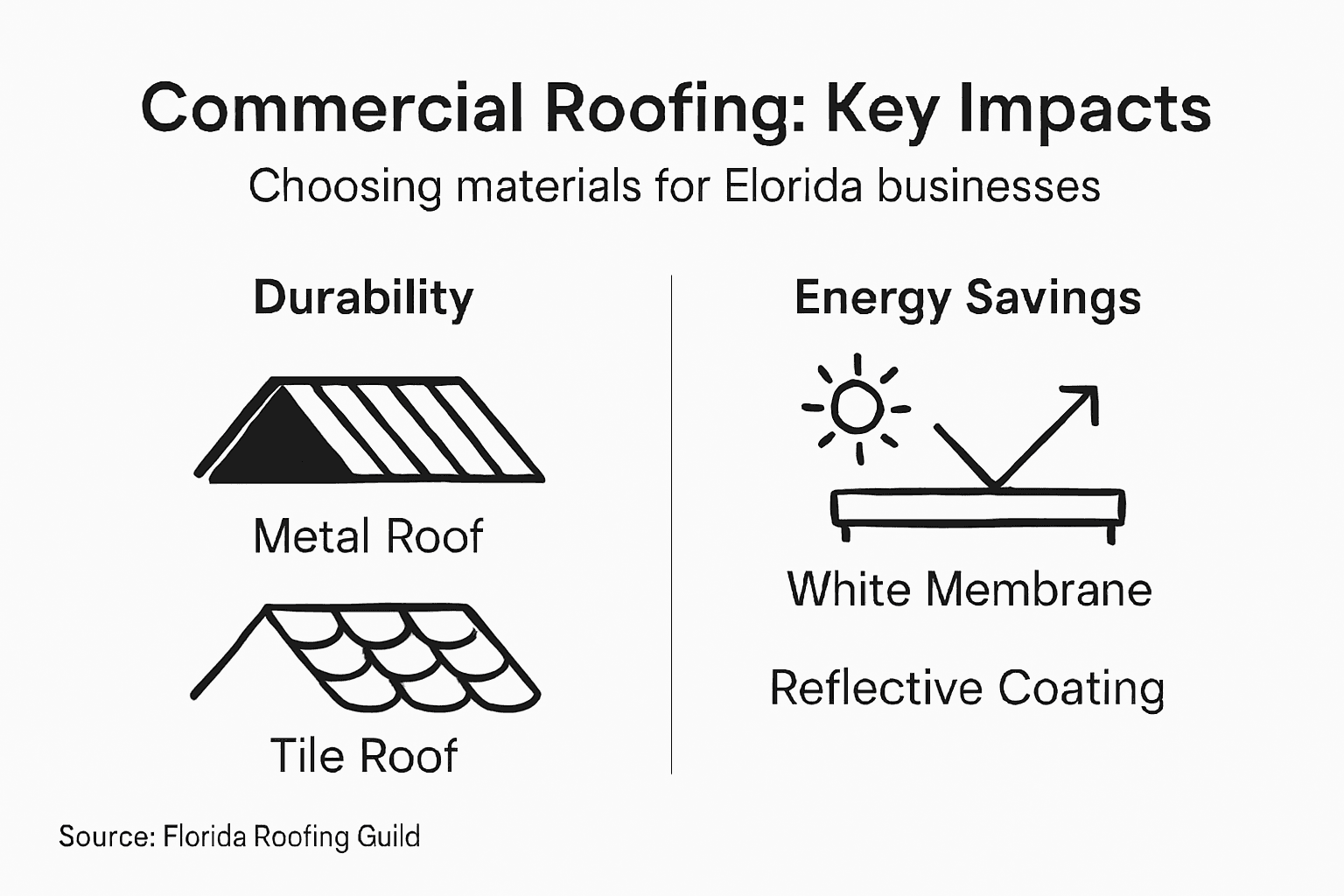
Your choice also impacts insurance premiums. Carriers recognize that certain materials and installation methods reduce storm damage risk. A commercial property with a recently installed metal roof or a properly installed TPO membrane system with secure fastening gets quoted differently than one with an aging tar and gravel system. Over 10 years, material selection can influence thousands of dollars in insurance costs.
Beyond the obvious protective function, materials influence daily operational costs. Lighter colored membranes reflect more solar heat, reducing air conditioning loads during Florida’s long summers. Darker materials absorb more heat but may suit properties where thermal mass benefits the building design. Material thickness affects insulation value. Some systems integrate insulation layers that simultaneously provide weatherproofing and thermal resistance.
Below is a summary table outlining how commercial roofing material selection impacts key areas of business operations.
| Impact Area | How Roofing Material Choice Affects It | Example Consideration |
|---|---|---|
| Energy Costs | Influences annual HVAC usage and bills | Reflective metal reduces cooling loads |
| Insurance Premiums | Adjusts risk profile and claim demands | New compliance lowers rates |
| Maintenance Expenses | Determines regular inspection and repair needs | Membrane needs more seam repairs |
| Structural Longevity | Affects building lifespan and asset value | BUR adds heavy load, needs strong support |
Pro tip: _Request material samples and review how each option performs under extreme conditions specific to Central Florida, then cross-reference the manufacturer’s warranty terms with your local building department’s requirements before committing to any system.
Popular Roofing Types for Florida Businesses
Florida’s climate demands roofing materials that can handle relentless sun, saltwater exposure, torrential rain, and hurricane-force winds. This isn’t just about picking what looks good or costs the least upfront. Your choice determines whether your roof survives the next major storm intact or whether you’re filing insurance claims and dealing with business interruptions. The Florida Building Code outlines roofing assemblies specifically designed for commercial buildings in high-velocity hurricane zones, which means any material you install should meet these standards.
Metal roofing stands out as the top performer for Central Florida commercial properties. It resists rust when properly installed with marine-grade fasteners, handles wind speeds that would tear apart other systems, and reflects solar heat to reduce cooling costs by up to 25 percent during summer months. Many warehouse facilities, manufacturing plants, and agricultural buildings in Brevard County have switched to metal after experiencing storm damage with traditional materials. The longevity is remarkable too, with quality metal systems lasting 40 to 50 years compared to 15 to 20 years for membrane systems. The upfront cost runs higher, but when you calculate the cost-per-year over decades, metal often wins the financial argument.
Membrane systems dominate flat-roof commercial applications across Central Florida. Single-ply membranes like TPO (thermoplastic polyolefin), EPDM (ethylene propylene diene monomer), and PVC come in large sheets that installers seam together, creating a unified weatherproof barrier. These systems are quick to install, relatively forgiving if repairs are needed, and provide excellent flexibility in temperature extremes. TPO has gained significant market share recently because it offers good cost performance and decent UV resistance without the added cost of PVC. EPDM remains popular on older buildings where retrofitting with existing systems makes sense. For office parks, shopping centers, and multi-story commercial structures with low slopes, membranes deliver the right balance of performance and expense.
Built-up roofing, sometimes called tar and gravel or BUR, represents the traditional approach still used on many commercial properties throughout Orange and Volusia counties. Multiple layers of bitumen alternate with reinforcing felts, creating a thick protective assembly. While newer systems get more attention, BUR systems prove their worth through durability when installed correctly. They handle foot traffic better than membranes and provide exceptional fire ratings. The downside includes longer installation time, stronger odors during application, and the need for gravel ballast that adds weight. If your building structure can handle the weight and you value proven longevity, BUR remains a solid choice.
Concrete and clay tile roofing works well for sloped commercial structures where architectural character matters. Spanish colonial revival buildings, Mediterranean-style resorts, and high-end retail locations benefit from tile’s aesthetic appeal. The material itself handles Florida weather beautifully, with clay tiles lasting 50 to 100 years. However, the cost runs substantially higher than other options, installation requires specialized expertise, and the weight demands robust underlying structure. Tiles also require more frequent maintenance to ensure proper drainage and prevent moss or mold growth in humid climates. This option appeals most to property owners where appearance directly influences customer perception and property value.
Modified bitumen and asphalt-based systems occupy a middle ground, combining elements of traditional tar roofing with modern improvements. These materials come in rolls and are torch-applied or self-adhesive, offering better flexibility than conventional BUR while maintaining familiar characteristics. They work particularly well for edge transitions, parapet walls, and areas requiring regular foot traffic. Many contractors use modified bitumen for the field of a roof and membrane for expanded sections, creating a hybrid system tailored to specific building needs.
Pro tip: Compare materials not just on initial installation cost, but calculate the total cost of ownership over 20 years including energy savings, maintenance expenses, and replacement timing to identify which system truly delivers the best value for your specific Central Florida property.
Key Features: Durability, Energy, Storm Protection
When evaluating roofing materials for your Central Florida business, three factors dominate the decision: how long the material lasts, how much it costs to operate annually, and whether it survives the weather events that threaten your region. These aren’t separate concerns you can optimize independently. They interconnect in ways that directly affect your bottom line and your ability to keep your business operational when storms hit.
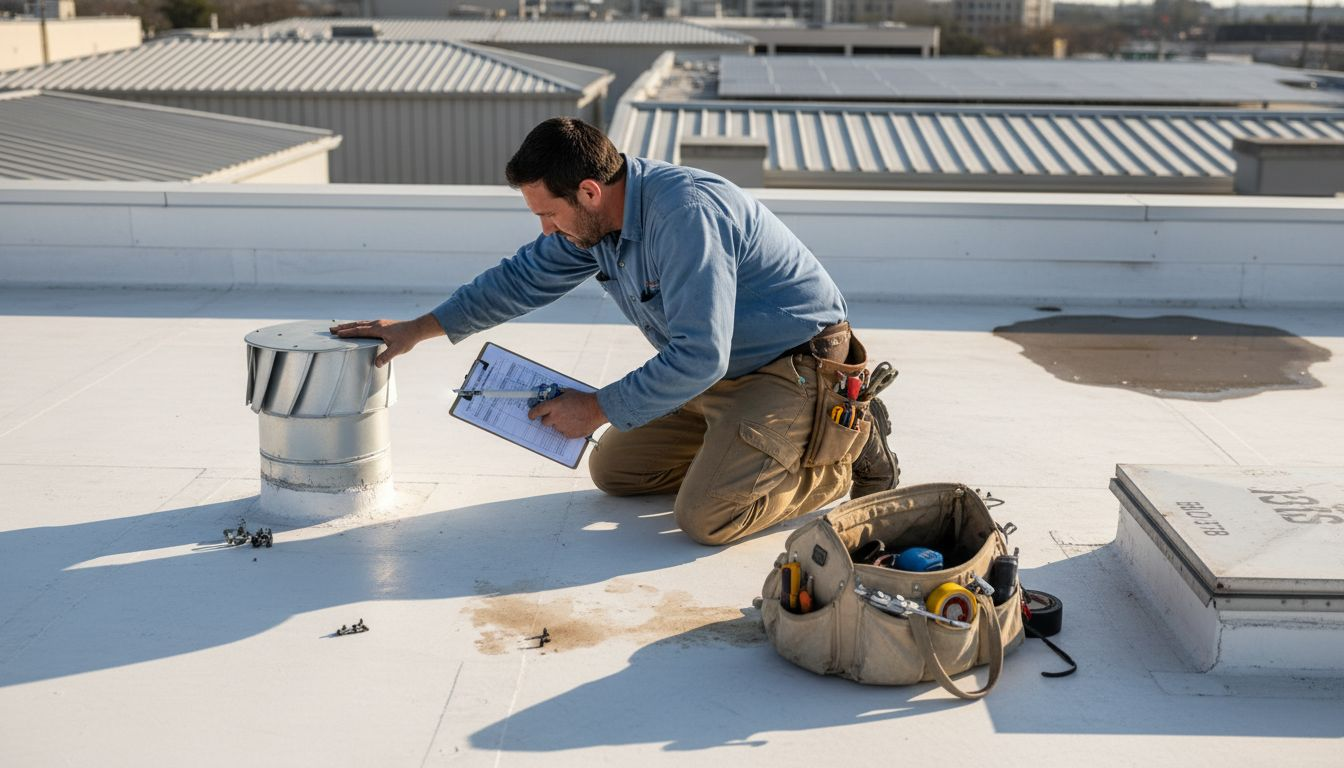
Durability matters most because a roof that fails prematurely forces emergency repairs, business interruption, and unexpected capital expenses. Metal roofing systems rated for 40 to 50 year lifespans make sense for businesses planning long-term operations in the same location. Membrane systems typically deliver 15 to 20 years of reliable service when properly installed and maintained. Clay and concrete tile roofing demonstrates exceptional durability across Florida’s climate, resisting the heavy rain, hurricane-force winds, hail, and temperature swings that Central Florida experiences. The material proves its worth in older buildings where original tile roofing installed 50 or 60 years ago still protects the structure. Built-up roofing systems, when installed correctly with proper ventilation and maintenance, can last 25 to 30 years. The critical factor isn’t just the material itself but the quality of installation. Poor workmanship cuts any system’s lifespan dramatically, regardless of the material’s theoretical durability.
Energy efficiency translates directly into monthly operating costs. This matters year-round but peaks during Florida’s intense summer months when air conditioning consumes 40 to 50 percent of commercial building energy usage. Light-colored membrane roofings reflect 65 to 80 percent of solar radiation back into the atmosphere instead of absorbing it into your building. Metal roofing with reflective coatings achieves similar results. This reflectivity reduces the cooling load on your HVAC system by 15 to 25 percent, cutting electricity consumption and lowering your bill. A 50,000 square foot commercial building with a cool roof coating might save $15,000 to $25,000 annually on energy costs compared to a dark roof absorbing solar heat. Over 20 years, that’s $300,000 to $500,000 in savings. Darker materials like asphalt shingles or uncoated BUR absorb more heat, increasing cooling demands. If your building has poor insulation or an aging HVAC system already struggling with heat load, the energy penalty of a dark material becomes even more significant.
Storm protection represents the third critical dimension, especially given Central Florida’s exposure to hurricanes, tropical storms, and intense thunderstorms. Roofing materials selected for FORTIFIED Commercial construction demonstrate proven ability to withstand hurricanes and tornadoes, with emphasis on wind resistance, secure adherence, and structural integrity. Metal roofing systems with proper fastening can handle sustained winds exceeding 140 miles per hour. The fasteners matter as much as the panels themselves. Installers must use corrosion-resistant fasteners spaced according to wind load calculations specific to your location and building height. Membrane systems require proper sealing at all penetrations and perimeter edges. Water infiltration doesn’t happen just through punctures. It creeps around loose seams, under improperly sealed vents, and along edges where the membrane pulls away during high winds. Built-up roofing systems resist water infiltration through their layered construction, but wind damage can tear the membrane and expose underlying felts. Tile roofing systems resist wind well when tiles are mechanically fastened to the underlying structure, though individual tiles can break under severe impacts.
Material Comparison by Key Feature
| Material Type | Durability | Energy Efficiency | Storm Resistance | Maintenance |
|---|---|---|---|---|
| Metal Roofing | 40-50 years | Excellent with coating | Excellent | Minimal |
| TPO Membrane | 15-20 years | Good (light colors) | Good | Moderate |
| EPDM Membrane | 15-20 years | Fair | Fair | Moderate |
| Built-up (BUR) | 25-30 years | Poor | Good | Significant |
| Concrete Tile | 50+ years | Fair | Excellent | Significant |
| Clay Tile | 50-100 years | Fair | Excellent | Significant |
The intersection of these three features determines value. A metal roof costs more upfront but delivers superior energy performance for decades, reducing annual operating costs substantially. A membrane system costs less initially but requires replacement sooner and offers moderate energy benefits. Your specific business situation, building structure, and financial position all influence which trade-offs make sense.
Pro tip: Request energy audits and wind load calculations from your roofing contractor before making a final material choice, then model the 20-year total cost of ownership including energy savings, maintenance, and replacement timing rather than focusing solely on installation price.
Florida Building Codes and Compliance Essentials
Florida’s building codes exist for one reason: to keep buildings standing when nature tries to tear them apart. As a commercial property owner or manager in Central Florida, you cannot ignore these regulations. They are not suggestions or guidelines. They are legal requirements enforced by county building departments, and non-compliance creates liability exposure, failed inspections, insurance disputes, and potential fines. When you hire a roofing contractor, that contractor must install materials and assemblies that meet these codes, regardless of cost or timeline.
The Florida Building Code Chapter 15 defines specific requirements for roof assemblies and rooftop structures, with particular emphasis on buildings located in high-velocity hurricane zones. Central Florida properties in Orange, Brevard, and Volusia counties fall under these stricter requirements because of demonstrated hurricane risk. The code mandates that roofing materials and systems must meet specific wind resistance and impact standards. This means the contractor cannot simply install whatever material is cheapest or easiest to work with. Your Orange County building department will not approve a permit for installation until the materials and installation method conform to Chapter 15 requirements. Your building inspector will examine the roof during construction to verify compliance.
The 2020 Florida Building Code strengthens roofing requirements by mandating sealed roof decks and enhanced underlayment types. These provisions address a critical vulnerability exposed by past hurricanes. Wind-driven rain doesn’t just leak through torn membrane or missing shingles. It penetrates around fasteners, under flashing, and along edges where water can wick into the building structure for weeks after the storm ends. The sealed deck requirement means the decking itself must be sealed to prevent water vapor and moisture infiltration from below. Enhanced underlayments must meet specific water absorption standards and tear resistance ratings. Reinforced fastening protocols specify exactly how far apart fasteners must be spaced, what gauge fasteners must be used, and in some cases, which fastener types are acceptable.
Key Compliance Requirements for Your Commercial Roof
Wind Load Ratings and Calculations
Your county building department determines the design wind speed for your specific location and building height. A warehouse in Palm Bay near the coast experiences different design wind speeds than an office building in Orlando. Your roofing contractor must perform wind load calculations based on your building’s dimensions, shape, and exposure category. The roofing material and fastening system selected must meet or exceed these calculated loads. Metal roofing with proper fastening might rate for 160 mph sustained winds, while an improperly fastened membrane system might only withstand 100 mph. The difference becomes critical when the next hurricane arrives.
Material Approval and Certification
Not every roofing product on the market meets Florida’s requirements. Manufacturers must test products according to ASTM standards and obtain Miami-Dade County approval for products used in high-velocity hurricane zones. Miami-Dade approval is the gold standard in Florida because that county has experienced the most frequent and severe hurricanes. A roofing material approved in other states might not be approved in Florida. Your contractor should provide documentation showing that every material component meets Florida Building Code requirements before installation begins.
Installation Method Certification
The way the roof is installed matters as much as the material itself. A qualified installer must follow the manufacturer’s specifications exactly. This includes fastener spacing, underlayment overlap, flashing details, and sealing requirements. Building inspectors verify these details during and after installation. Shortcuts that save time or money during installation create non-compliance that the building department can order corrected at your expense. Some contractors maintain Florida certification for specific roofing products, demonstrating that they have been trained and tested on proper installation methods.
Documentation and Permits
You cannot legally begin a roofing project without a building permit from your county. The permit application requires detailed specifications of materials, installation methods, wind load calculations, and contractor certification. Your county reviews these documents before approving the permit. After installation, the county building inspector performs a final inspection and issues a certificate of completion. This documentation becomes critical if you ever need to file an insurance claim or sell the property. Buyers and insurance companies want proof that the roof meets current code requirements.
Pro tip: Before requesting roofing proposals, contact your county building department and request the specific wind load requirements and code requirements for your building address, then share this information with all contractors to ensure they provide accurate quotes and comply with requirements specific to your location.
Costs, Maintenance, and Longevity Compared
The sticker shock of a new commercial roof can make you want to defer the project. A 50,000 square foot metal roof installation might run $500,000 to $750,000 in materials and labor. A membrane system for the same area could cost $250,000 to $400,000. Built-up roofing might fall somewhere between. These are real expenses that hit your capital budget hard. But comparing materials based solely on installation cost misses the complete financial picture. You need to think in terms of total cost of ownership over the roof’s lifespan, including maintenance expenses, energy costs, and replacement timing.
Metal roofing carries the highest upfront cost but delivers the lowest cost-per-year when you spread expenses across 40 to 50 years of service life. A metal roof costing $15 per square foot over a 45-year lifespan equals roughly 33 cents per square foot annually. Maintenance on metal roofing runs minimal, typically just clearing debris and inspecting fasteners every few years at a cost of $500 to $2,000 annually for a large commercial building. You will not need patching, re-sealing, or partial replacements unless severe physical damage occurs. Energy savings from reflective coatings add another $300 to $500 monthly savings during summer cooling season, totaling $3,600 to $6,000 annually. Over 20 years, that represents $72,000 to $120,000 in cooling cost reductions. Membrane systems cost less initially but require more hands-on maintenance. Annual inspections, sealing around penetrations, and clearing debris runs $2,000 to $5,000 yearly. Small repairs of tears or seam separations add another $1,000 to $3,000 annually once the system reaches year 10 or beyond. By year 15, you face membrane replacement decisions as UV degradation and thermal cycling take their toll. Replacement costs run $5 to $8 per square foot, or $250,000 to $400,000 for your typical commercial building.
Built-up roofing systems present an interesting middle path. Initial installation costs $4 to $7 per square foot, significantly less than metal but comparable to quality membranes. Maintenance demands more attention than metal, with annual inspections, gravel raking, and drainage clearing running $3,000 to $6,000 yearly. The layered construction resists water intrusion effectively, often extending service life to 25 to 30 years with proper care. However, the system weighs more than membranes, sometimes requiring reinforcement of underlying structure during installation, adding cost and complexity. When replacement finally arrives, removal of old materials adds $2 to $3 per square foot to demolition costs before new installation begins.
Roof restoration and membrane replacement through re-covers extend roof life affordably compared to full replacement, reducing waste while maintaining underlying components. This approach works well when your existing roof deck remains structurally sound but the membrane or surface layer has deteriorated. Instead of tearing off the old system, contractors install a new membrane over the existing structure, essentially creating a second weather barrier. Re-cover projects cost 40 to 60 percent less than complete replacement because removal and debris disposal represent 20 to 30 percent of total replacement expense. For a membrane system at year 15 or 18 of expected 20-year life, a re-cover might extend the roof’s effective service life another 15 to 20 years at a fraction of replacement cost. The catch is that you cannot re-cover indefinitely. After one or two applications, the roof assembly becomes too thick and heavy, and building codes may prohibit additional covers. Plan your re-cover strategy when you install the initial system.
Cost Comparison Over 40 Years
| Material Type | Initial Cost | Annual Maintenance | Year 20 Action | Year 40 Total Cost |
|---|---|---|---|---|
| Metal Roofing | $750,000 | $1,500 | Inspect fasteners | $810,000 |
| TPO Membrane | $350,000 | $3,500 | Replace membrane | $825,000 |
| EPDM Membrane | $320,000 | $3,000 | Replace membrane | $800,000 |
| Built-up (BUR) | $400,000 | $4,500 | Replace system | $870,000 |
| Clay Tile | $1,200,000 | $5,000 | Re-grouting | $1,400,000 |
Tenant Considerations
If your commercial building houses tenants, roofing decisions affect lease negotiations and tenant satisfaction. A roof leak disrupts business operations, damages merchandise or equipment, and creates liability exposure. Well-maintained roofs reduce vacancy rates and support higher lease rates. Prospective tenants often request roof age and condition before committing to multi-year leases. A building with a roof past its expected service life may see lease rates reduced by 10 to 15 percent compared to similar buildings with newer roofs. This incentivizes proactive replacement rather than waiting for failure.
Pro tip: Calculate your building’s total cost of ownership for each roofing option over 25 to 30 years including installation, annual maintenance, energy savings, and replacement timing, then compare the annual cost to determine which material delivers the best financial value for your specific situation.
Mistakes to Avoid When Choosing Roof Materials
Choosing the wrong roofing material for your Central Florida commercial building can cost you six figures in premature failures, emergency repairs, and business interruptions. Some mistakes become obvious only after the roof leaks during a storm or fails years ahead of its expected lifespan. By then, you have already spent the money. The good news is that most costly mistakes are preventable if you understand what goes wrong and why.
Selecting Non-Compliant Materials
The first and most critical mistake is choosing a roofing material that does not meet Florida Building Code requirements. Some contractors or property owners select materials based on cost or availability without verifying compliance. A roofing product that performs excellently in Arizona or California may not meet Florida’s hurricane-specific standards. Roofing materials that do not comply with Florida’s building codes or lack adequate testing for high wind and water resistance create immediate problems. Your county building department will reject the permit application. If contractors somehow install non-compliant materials anyway, the county inspector will order removal and reinstallation at your expense. Insurance companies may deny claims on roofs installed with non-compliant materials. This is not a gray area. Verify that every material component carries Miami-Dade County approval or equivalent certification before signing any contract.
Ignoring Underlayment and Flashing Details
Many property owners focus entirely on the visible roofing layer, overlooking the critical components underneath. The underlayment sits between the decking and the roofing material, providing a secondary water barrier that catches water penetrating the top layer. Improper underlayment selection, installation gaps, or missing underlayment altogether creates a vulnerability that appears only when water infiltrates during heavy rain or wind-driven precipitation. Flashing, the metal trim that directs water around penetrations like vents, chimneys, and equipment, requires meticulous installation. Shortcuts in flashing installation represent one of the most common sources of commercial roof leaks. Water does not flow in straight lines. It travels sideways, backward, and downward, finding any opening where the flashing does not properly seal. A contractor might save $5,000 by cutting corners on flashing details, but you will spend $50,000 fixing water damage inside your building.
Poor Installation Quality
Even excellent materials fail when installers do not follow specifications. Errors arise from installing roofing materials without adherence to prescribed fire classification and weather protection standards, and improper installation of flashing can lead to premature roof failures and code non-compliance. Fastener spacing matters. Wind load calculations determine exactly how many fasteners per square are required and where they must be placed. Installers who space fasteners six inches apart instead of the required four inches create weak points where wind can lift and tear the membrane or panels. Sealing requirements exist because unsealed seams allow water to infiltrate. A contractor cutting a membrane system into the decking without sealing the cut edges creates a pathway for water to spread underneath the surface where you cannot see it until the damage becomes severe.
Here is a reference table showing typical reasons for premature commercial roof failure in Central Florida and how to prevent them.
| Failure Cause | Common Scenario | Prevention Strategy |
|---|---|---|
| Improper Fastener Spacing | Panels lift during high winds | Verify code-specific spacing before install |
| Poor Flashing Installation | Leaks around roof penetrations | Use trained crews, inspect flashing points |
| Non-compliant Material Choice | Permit rejected or insurance denied | Request Miami-Dade or ASTM certification |
| Inadequate Underlayment | Water damage after storms | Select advanced underlayment, seal deck |
Choosing Based on Price Alone
The lowest bid rarely delivers the best value. A contractor bidding 20 percent below competitors likely cut corners somewhere, whether through material substitution, inadequate underlayment, reduced fastener counts, or skipped warranty provisions. When three contractors bid similar work and one comes in significantly lower, ask why. The answer often reveals red flags. Experienced contractors price work to include proper materials, adequate labor for quality installation, and business overhead. Bargain contractors often lack insurance, skip permitting, or cut specification corners to deliver a low price. Your lowest-cost roof might be the most expensive in the long run.
Failing to Account for Building Specifics
Every building presents unique challenges. A warehouse near the coast faces higher corrosion risk than an inland office park. A building with numerous roof penetrations requires different flashing strategies than a simple rectangular structure. A building on a tall hill experiences stronger wind loads than the same building in a protected valley. Contractors must perform site-specific calculations and design the roof system accordingly. A contractor who uses a one-size-fits-all approach without considering your building’s particular exposure category, height, shape, and location creates unnecessary risk. Request detailed wind load calculations and site-specific design specifications before committing to any contract.
Bypassing Professional Inspection
Some property owners choose materials without having a structural engineer or roofing specialist assess the building’s existing conditions. Old buildings may have structural limitations that rule out heavier tile or concrete systems. Inadequate ventilation under the existing roof deck may cause moisture problems if you do not address it during replacement. Hidden damage from previous leaks might require repairs before installing new material. A professional roof condition assessment identifies these issues before they become expensive surprises.
Pro tip: Request written specifications that detail materials, installation methods, underlayment requirements, flashing details, fastener specifications, and wind load calculations, then have an independent inspector verify that the completed work matches these specifications before final payment.
Protect Your Central Florida Business with Expert Commercial Roofing Solutions
Navigating the complex challenges of Florida’s climate requires roofing materials and installations that meet strict local codes and deliver lasting performance. Whether you are concerned about hurricane resistance, energy efficiency, or long-term durability, Thomas Roofing and Repair specializes in tailored commercial roofing services for properties in Brevard, Volusia, and Orange counties. We understand that choosing the right roofing materials for businesses involves balancing upfront costs with maintenance, storm protection, and energy savings as outlined in the article.
Our professional team ensures every project complies with Florida Building Code requirements, including proper fastening, sealed roof decks, and certified materials to protect you from premature failures and costly repairs. From expert membrane installations to durable metal roofing, we focus on craftsmanship, dependability, and transparent service that safeguards your investment and your peace of mind.
Take control of your commercial roof today before the next storm hits.

Contact Thomas Roofing and Repair now for a free estimate and personalized consultation. Visit Thomas Roofing and Repair to schedule your inspection and discover how our expert solutions can provide you with a strong, energy-efficient roof built to outperform Central Florida’s toughest weather conditions.
Frequently Asked Questions
What are the primary types of commercial roofing materials?
Commercial roofing materials primarily include membrane systems (TPO, EPDM, PVC), metal roofing, built-up roofing (BUR), concrete or clay tiles, and composite materials. Each type serves different performance characteristics and applications for various business needs.
How do I choose the right roofing material for my business?
Selecting the right roofing material involves considering factors like durability, energy efficiency, storm resistance, and compliance with local building codes. It’s essential to assess your building’s specific needs, local climate conditions, and the material’s long-term cost of ownership.
What impact do roofing materials have on energy costs?
The choice of roofing materials can significantly influence energy costs. For example, lighter-colored membranes or reflective metal roofs reduce cooling loads during summer, resulting in lower HVAC energy bills. Conversely, darker materials may increase energy use due to heat absorption.
What building code compliance issues should I be aware of when selecting roofing materials?
When choosing roofing materials, ensure they meet local building codes, particularly regarding wind load ratings and water resistance. Materials must also pass necessary certifications to withstand high-velocity hurricane conditions if applicable. Non-compliance can lead to permit rejections and insurance issues.