
 407-408-0577
TL;DR:
- Regular roof tune-ups help Central Florida homeowners prevent costly repairs and extend their roof’s lifespan. Conducted biannually, these inspections identify minor issues early, especially before hurricane season, ensuring optimal protection and maintaining property value. Prompt attention to signs like missing shingles or water stains safeguards homes from severe damage and costly emergencies.
Most Central Florida homeowners think of their roof the same way they think of their foundation: out of sight, out of mind, until something catastrophic happens. That mindset is exactly why so many end up facing a $12,000 emergency replacement instead of a $300 maintenance visit. Understanding why schedule roof tune-ups matters is not about fear. It is about making a smarter financial decision before the storms make it for you. Central Florida’s year-round heat, afternoon downpours, and hurricane season create a roof environment unlike anywhere else in the country. This guide gives you a clear, honest picture of what tune-ups involve, when to schedule them, and what happens when you do not.
Table of Contents
- Key takeaways
- Why schedule roof tune-ups: the real reason it matters
- What a roof tune-up actually includes
- How often should roofs be serviced in Central Florida
- Common signs your roof needs a tune-up now
- How to choose and prepare for a professional tune-up
- My honest take on skipping routine maintenance
- How Thomasroofingandrepair keeps your roof storm-ready
- FAQ
Key takeaways
| Point | Details |
|---|---|
| Tune-ups prevent expensive repairs | Preventive maintenance cuts repair costs by 30 to 50 percent and adds years to your roof. |
| Twice a year is the standard | Schedule inspections in spring and fall, plus after any major storm event. |
| Central Florida timing matters | Pre-hurricane season inspections should happen by March or April at the latest. |
| Signs demand immediate action | Missing shingles, granule loss, and interior water stains mean you cannot wait for the next scheduled visit. |
| Choose certified professionals | Certified roofers protect your warranty and give you documentation that matters for insurance claims. |
Why schedule roof tune-ups: the real reason it matters
The answer is not just “to avoid leaks.” The real reason is leverage. A roof tune-up gives you control over a system that, left alone, quietly deteriorates until the problem is impossible to ignore and expensive to fix.
Preventive maintenance reduces repair costs by 30 to 50 percent and can add 10 to 15 years to your roof’s working life. That is not a minor benefit. A standard asphalt shingle roof in Florida might cost $12,000 to replace. If a consistent tune-up schedule pushes replacement back by a decade, you are talking about thousands of dollars that stay in your pocket.
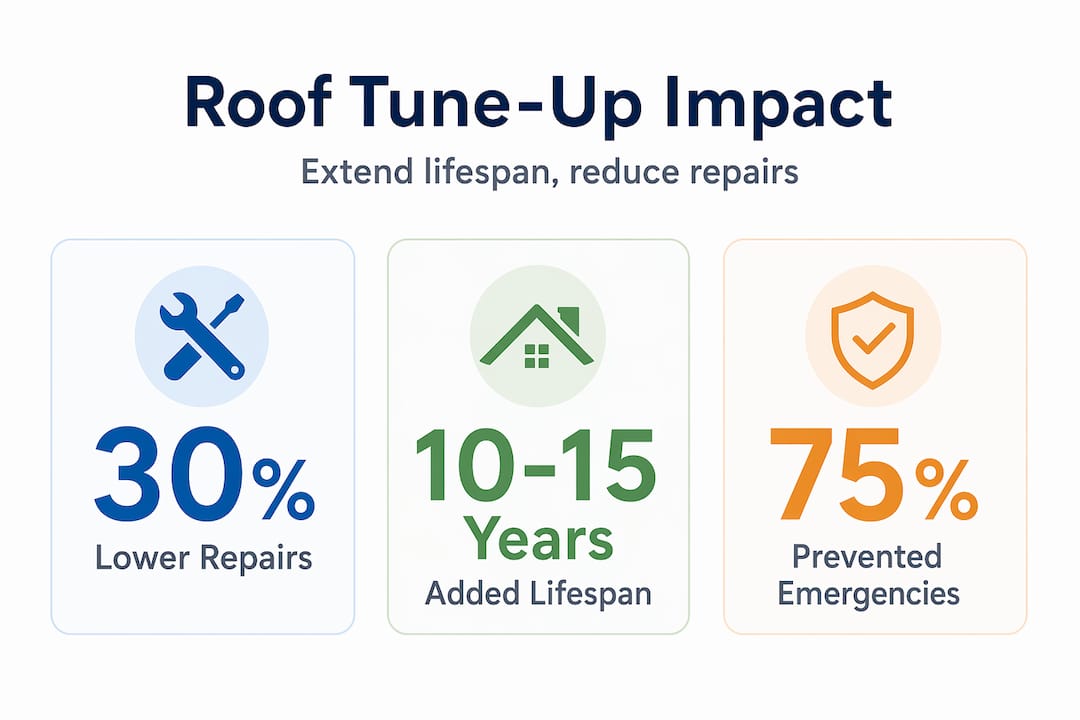
Beyond the raw numbers, there is something equally valuable: peace of mind going into hurricane season. 75 percent of emergency repair calls involve damage that a professional inspection would have caught six to twelve months earlier. Homeowners who skip routine tune-ups are not just rolling the dice on repairs. They are rolling the dice during the worst possible time, often mid-storm, when contractor availability is low and prices are high.
Regular maintenance also preserves home value and keeps your property looking well cared for. Curb appeal is real money when it comes time to sell, and a documented maintenance history is a selling point buyers notice.
What a roof tune-up actually includes
A roof tune-up is not a full inspection with a clipboard and a vague verbal summary. It is a hands-on, preventive service that addresses minor problems before they become structural ones.
A standard tune-up typically covers a 25-point inspection, gutter cleaning, and minor repairs to stop small issues from escalating. Here is what that looks like in practice:
- Shingle assessment: Checking for cracked, curling, lifted, or missing shingles that expose the underlayment to moisture
- Flashing inspection: Examining the metal strips around chimneys, vents, and skylights where most leaks originate
- Gutter cleaning and inspection: Removing debris, checking for proper drainage, and confirming gutters are firmly attached
- Sealant and caulking check: Reapplying sealant around penetrations that have dried or cracked from heat exposure
- Attic ventilation review: Confirming airflow is adequate to prevent heat buildup, which accelerates shingle deterioration
- Minor repairs on the spot: Nailing down lifted shingles, replacing a few damaged ones, or resealing flashing during the same visit
The key distinction between a tune-up and a repair is scope. A tune-up is proactive. It addresses what is starting to wear. A repair responds to what has already failed. You want to be in the tune-up category.
Pro Tip: Always ask whether your contractor is NRCIA certified or carries manufacturer certifications. Certified professionals provide thorough assessments that satisfy warranty requirements and give you documentation insurance companies actually accept.
How often should roofs be serviced in Central Florida
The short answer is at least twice a year. The longer answer is that Central Florida’s climate adds layers to that recommendation that flat-state homeowners never have to think about.
The NRCA recommends professional inspections twice per year: once in spring after winter weather and once in fall before colder months arrive. In Central Florida, those windows shift slightly. Spring inspection in February or March sets you up before the heat and afternoon storms intensify. A fall inspection in October or November catches any hurricane season damage before it worsens through winter.
Hurricane season runs from June 1 through November 30, and the best practice is to complete your pre-season inspection by March or April. That gives you time to schedule any needed repairs before contractor schedules fill up in May.
Here is a practical guide for scheduling based on your roof’s age and condition:
| Roof age and condition | Recommended tune-up frequency | Additional notes |
|---|---|---|
| Under 10 years, good condition | Once a year (spring) | Add inspection after any named storm |
| 10 to 15 years, good condition | Twice a year (spring and fall) | Monitor granule loss in gutters |
| 15 to 20 years, any condition | Twice a year plus post-storm | Budget for potential component replacements |
| Over 20 years or showing wear | Three times a year | Prioritize attic checks and flashing integrity |
| Post-storm, any age | Immediately after major weather | Do not wait for your scheduled window |
Older roofs need more attention not because they are necessarily failing, but because their components have less tolerance for minor damage. A small flashing gap on a five-year-old roof is a slow leak. On a 20-year-old roof with brittle underlayment, it becomes a water intrusion problem fast.
Pro Tip: Wind mitigation inspections in Florida can yield $500 to $2,500 in annual insurance premium discounts. Ask your roofer whether your tune-up can include documentation for a wind mitigation report. That single conversation can pay for several years of tune-ups.
Common signs your roof needs a tune-up now
Routine scheduling is the foundation of good roof health. But some situations cannot wait for the calendar. Knowing what to look for protects you from letting a manageable problem become an emergency.
Typical signs that demand immediate attention include visible shingle damage, water intrusion, gutter problems, granule loss, and structural changes:
- Missing or cracked shingles: Even one missing shingle creates a direct path for water to reach the decking. Florida’s heat and UV exposure accelerate shingle cracking faster than in cooler climates.
- Curling or lifting shingle edges: This indicates the shingle has lost its adhesive bond. Wind gets underneath, and the problem compounds quickly during storms.
- Water stains on interior ceilings: Brown or yellow rings on your ceiling mean water has already breached the roof system. The source is usually further up the slope than the stain suggests.
- Granule accumulation in gutters: Asphalt shingles shed granules as they age. A heavy buildup after rain means the shingles are thinning and losing UV protection.
- Sagging areas on the roof deck: This signals moisture has penetrated the structural decking. It is the most serious visible sign and requires immediate professional assessment.
- Persistent gutter overflow: When gutters overflow despite seeming clean, the issue is often improper drainage caused by debris caught further down the system or sagging gutter sections.
Professional inspection costs between $150 and $400, compared to average replacement costs of $8,000 to $15,000. If you spot any of the above, that math makes the decision easy. Scheduling an inspection the moment you notice something irregular is always cheaper than waiting to confirm your suspicions.
How to choose and prepare for a professional tune-up
Getting value from a roof tune-up starts before the contractor shows up. Homeowners who prepare get better service and better documentation.
-
Verify licensing and certifications. In Florida, roofing contractors must hold a state license. Check the Florida Department of Business and Professional Regulation database before signing anything. Certified inspections provide thorough assessments and maintain your warranty compliance.
-
Take photos before the appointment. Walk around your property and photograph visible areas of concern. This creates a baseline that proves useful if you ever need to make an insurance claim tied to gradual damage.
-
Ask what the report includes. A quality tune-up produces a written report with photos, a list of completed minor repairs, and recommendations ranked by urgency. If a contractor offers only a verbal summary, look elsewhere.
-
Understand the difference between urgent and monitoring items. Good contractors separate “fix this now” from “watch this over the next six months.” That distinction tells you a contractor is being honest rather than upselling.
-
Ask about warranty and insurance compatibility. Some manufacturer warranties require documented professional inspections at set intervals. Missing one can void coverage you are counting on.
Pro Tip: Schedule your tune-up during a weekday morning in February or March. Contractor availability is highest, weather is cooperative, and you get results back before the spring storm season kicks in. Waiting until May means competing with dozens of homeowners who all had the same idea.
My honest take on skipping routine maintenance
I have seen the pattern repeat more times than I can count. A homeowner calls in a panic after a summer storm, convinced they have a leak from the storm itself. We get up on the roof and find shingles that were already compromised months before the storm hit. The storm did not cause the damage. It just revealed it.
What I have found is that homeowners tend to think of roof tune-ups the way they think of gym memberships: nice in theory, easy to delay when nothing feels wrong. The problem is that your roof does not show symptoms until the damage is already expensive. Unlike a squeaky hinge or a flickering light, a failing flashing seal or a cracked vent boot does its worst work silently and invisibly.
My experience working in Central Florida’s climate has taught me one specific lesson: the homes that come through hurricane season with minimal damage are almost always the ones with documented maintenance histories. It is not just about the physical condition of the roof. It is about knowing exactly what you are starting with before the season hits. That knowledge changes how you respond, how you communicate with your insurance company, and how quickly you can get back to normal after a storm.
Annual roof inspections are not a contractor’s sales tactic. They are the single most cost-effective thing a homeowner can do to protect what is almost certainly their largest investment.
— Thomasroofingandrepair
How Thomasroofingandrepair keeps your roof storm-ready
At Thomasroofingandrepair, we work exclusively in Central Florida, covering Brevard, Volusia, and Orange counties. That focus matters because our crews understand how the region’s heat, humidity, and storm patterns affect roofing materials in ways that a general contractor from out of state simply does not.

Our tune-up and maintenance services are built around the same philosophy that drives everything we do: catch problems early, fix them right, and give homeowners documentation they can actually use. Whether you need a pre-season inspection before hurricane season, a post-storm assessment, or a storm-ready roof evaluation, we bring the same level of craftsmanship to every job. If a tune-up reveals damage beyond routine maintenance, our emergency repair workflow gets your roof secured fast. Reach out for a free estimate and find out exactly where your roof stands before the next storm season begins.
FAQ
What does a roof tune-up include?
A standard roof tune-up covers a 25-point inspection, gutter cleaning, and minor repairs such as resealing flashing, replacing a few shingles, and checking attic ventilation. The goal is to address wear before it becomes damage.
How often should roofs be serviced in Central Florida?
The NRCA recommends twice-yearly inspections, and Central Florida homeowners should add a pre-hurricane season inspection by March or April. Older roofs and post-storm situations warrant additional visits.
Why schedule roof tune-ups instead of waiting for a problem?
Because 75 percent of emergency repair calls involve damage detectable six to twelve months earlier. Scheduling proactively costs a fraction of what reactive repairs run, especially after a major storm.
Can roof tune-ups help with insurance in Florida?
Yes. Wind mitigation documentation from a professional inspection can generate $500 to $2,500 in annual premium discounts in Florida, making tune-ups one of the few home maintenance expenses that pays back directly.
What are the signs your roof needs attention right away?
Watch for missing or cracked shingles, interior water stains, granule buildup in gutters, sagging deck areas, and visible shingle damage. Any one of these means scheduling an inspection should happen within days, not weeks.