
 407-408-0577
TL;DR:
- Wind ratings are lab benchmarks for specific roofing assemblies and do not guarantee storm performance. Proper installation, including fasteners, structural connections, and deck attachment, is essential for wind resilience. Florida codes require minimum standards, but retrofits like re-nailing and hurricane straps can significantly improve roof strength before storms.
Most Central Florida homeowners assume that if a shingle or panel carries a high wind rating, the roof will hold up in a hurricane. That assumption gets roofs torn off every storm season. Wind ratings explained in roofing terms are lab-based benchmarks, not field guarantees. They measure how a specific material assembly performs under controlled conditions. What actually determines whether your roof survives a storm is the entire system: fasteners, deck attachment, structural connectors, and installation quality. This guide breaks down what wind ratings really mean, how Florida codes apply them, and what you need to do to make them count.
Table of Contents
- Key takeaways
- Wind ratings in roofing explained
- Why installation quality determines wind survival
- Comparing roofing materials for Central Florida wind zones
- Florida building code wind requirements
- Strengthening your existing roof before storm season
- My take on wind ratings after years in Florida roofing
- Get your roof rated for what Florida actually throws at it
- FAQ
Key takeaways
| Point | Details |
|---|---|
| Ratings are lab benchmarks | Wind ratings reflect tested assemblies under controlled conditions, not real-world guarantees. |
| Installation decides performance | Fastener type, spacing, and deck attachment often matter more than the material’s rated speed. |
| Florida has strict code minimums | Central Florida homes must meet a 130 mph wind design standard with approved materials. |
| Retrofits can close the gap | Re-nailing decks and adding hurricane clips can improve wind resistance 20 to 30 percent. |
| Material choice affects insurance | Wind-rated and impact-resistant materials can reduce homeowner insurance premiums significantly. |
Wind ratings in roofing explained
Understanding wind ratings starts with knowing that no single number tells the whole story. There are multiple testing standards in use, and each measures something different.
UL 580 tests the entire roof assembly for uplift resistance. It assigns classes based on how many pounds per square foot the assembly can withstand before failure. Class 90 rating corresponds to 90 psf uplift resistance and is the standard required for severe hurricane-force conditions. Class 30 and Class 60 exist for lower-risk zones but are not appropriate for most of Central Florida.
ASTM D3161 and ASTM D7158 test individual shingles for wind resistance. Class F shingles are rated to 110 mph, while Class H shingles reach 150 mph and are required in Florida’s High Velocity Hurricane Zone. These are shingle-only ratings. They tell you nothing about how the deck below is fastened or whether the structural connectors are adequate.
FM Global ratings are commonly used for commercial low-slope roofing and assign wind uplift classifications to entire assemblies, including insulation and membrane systems.
Here is a quick reference for what common ratings mean in practical terms:
| Rating Standard | What It Tests | Wind Speed or Pressure |
|---|---|---|
| UL 580 Class 90 | Full roof assembly uplift | 90 psf, hurricane-force zones |
| ASTM D3161 Class H | Shingle wind resistance | Up to 150 mph |
| ASTM D3161 Class F | Shingle wind resistance | Up to 110 mph |
| FM Global 1-90 | Commercial assembly uplift | 90 psf |
| Miami-Dade NOA | Full system field approval | Required for HVHZ Florida |
The most critical thing to understand is what these ratings do not cover. Wind ratings are benchmarks for specific assemblies under lab conditions. A panel that performs perfectly in testing can fail early if installed outside the tested parameters. The rating on the product label assumes everything else in the system is installed correctly.
Why installation quality determines wind survival
This is where most homeowners get blindsided. The roofing material gets all the attention, but the weakest link in wind resistance is almost always the roof deck attachment to the framing, not the material on top of it.
Wind creates uplift pressure by moving fast across the roof surface, lowering the air pressure above while interior pressure pushes up from below. That force has to travel from the shingles or panels, through the deck, through the framing, and into the walls. Any weak connection in that chain is where the roof peels away.
Several installation factors directly control how well your roof resists that uplift:
- Fastener type: Ring-shank nails spaced 6 inches on center on edges dramatically outperform smooth-shank nails at wider spacing. Smooth-shank nails pull out under sustained wind loads.
- Nailing schedule: Codes specify nail count, spacing, and placement zones. Deviating from those specs, even slightly, compromises the tested assembly.
- Edge and corner detailing: ASCE 7 wind pressure standards assign significantly higher pressures to perimeter and corner zones, requiring additional fasteners beyond the general field. These zones are where blow-off almost always starts.
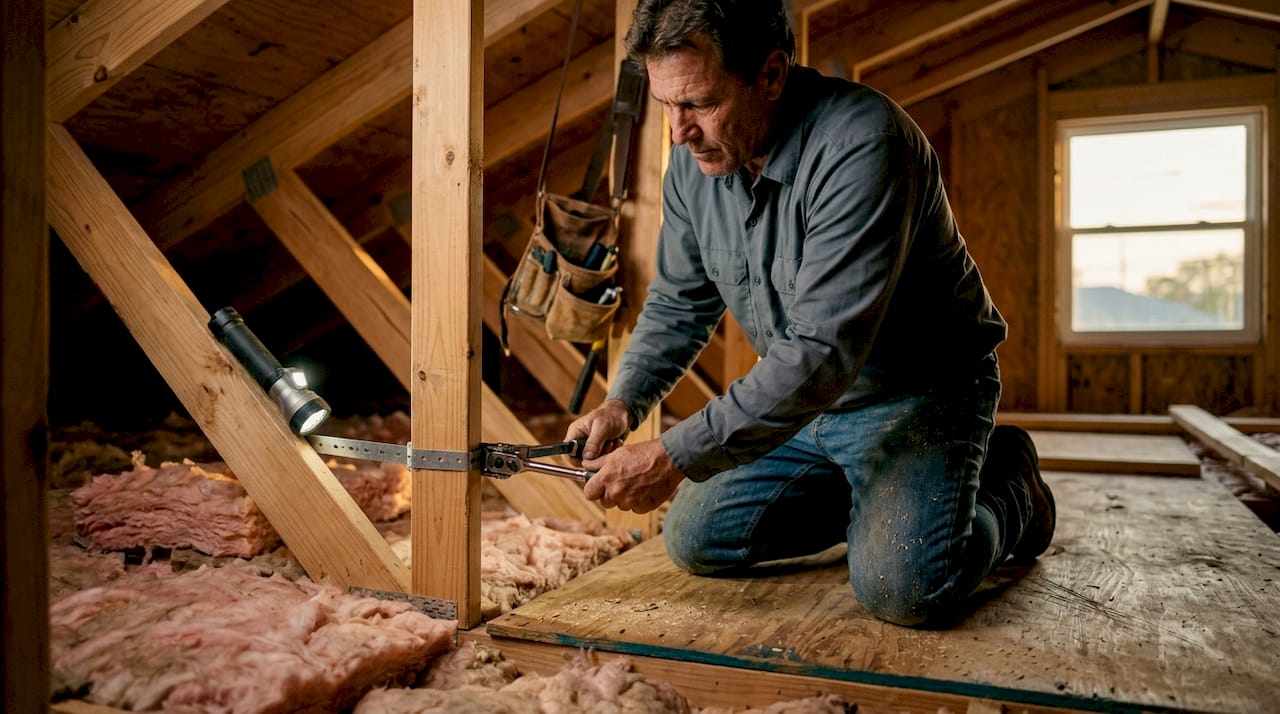
- Hurricane straps and clips: These metal connectors tie the roof framing directly to the wall framing, forming a structural load path. Hurricane straps and clips are critical for resisting uplift forces. Without them, even a perfectly installed roof can separate from the walls.
- Deck condition: Rotted or delaminated sheathing will not hold nails regardless of what is installed on top.
The frustrating part about hurricane straps is that you cannot see them from outside the house. Verifying them requires attic access. Many Florida homes built before the 1990s do not have them, or have them installed improperly.
Pro Tip: Before hurricane season, go into your attic with a flashlight and look where the roof trusses meet the top of the exterior walls. You should see metal plates or straps connecting the two. If you see nothing, or just a single nail toenailed in, schedule an inspection with a qualified contractor before June.
Comparing roofing materials for Central Florida wind zones
Not all roofing materials perform equally when the wind picks up, and the differences matter a lot here. Winds above 50 to 60 mph can begin causing roof damage. Category 5 hurricanes exceed 157 mph sustained, which puts severe demands on every component of the system.
Here is how the most common Central Florida roofing materials compare:
| Material | Typical Wind Rating | Lifespan | Impact Resistance | HVHZ Compliant |
|---|---|---|---|---|
| 3-tab asphalt shingles | 60 to 70 mph | 15 to 20 years | Low | No |
| Architectural shingles | 110 to 130 mph | 25 to 30 years | Moderate | With Class H rating |
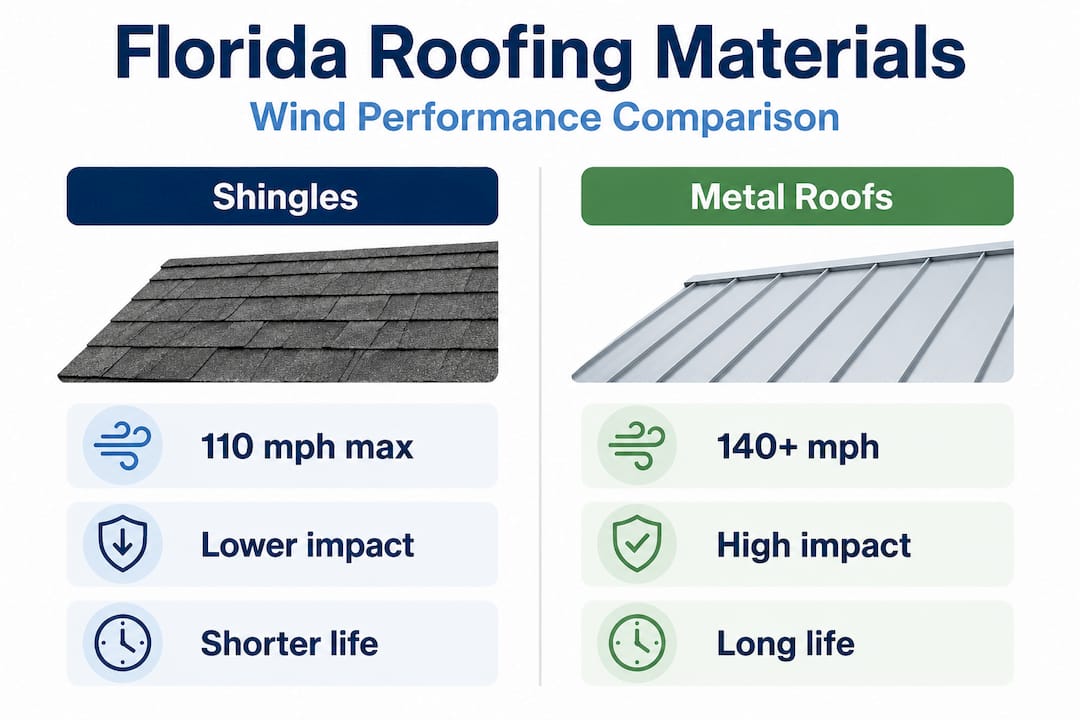
| Metal roofing | 140+ mph | 40 to 70 years | High | Yes (concealed fastener) |
| Concrete tile | 150+ mph | 30 to 50 years | High | Yes |
| Synthetic composite | 110 to 150 mph | 30 to 50 years | Class 4 available | Varies by product |
Standard 3-tab shingles are being phased out across hurricane-prone regions for good reason. Their low wind rating makes them a liability in Central Florida. Architectural shingles with a Class H rating are the current minimum worth considering for a new installation here.
Metal roofing exceeding 140 mph with lifespans up to 70 years is one of the strongest performers in HVHZ areas, especially with concealed fastener systems that eliminate the exposed screws that can back out and fail under uplift. Concrete tile performs similarly well structurally, though its weight requires verified structural capacity before installation.
Class 4 impact resistance, tested under UL 2218, is worth seeking out regardless of material type. It primarily addresses hail, but the same material toughness translates to better wind debris resistance. Many Florida insurers reduce premiums for homes with Class 4 rated materials. For a fuller breakdown of material options suited to Florida’s climate, the guide on top Florida roofing options covers current recommendations in detail.
Florida building code wind requirements
Central Florida roofing is not just a matter of personal preference. The Florida Building Code sets specific minimum wind design standards that determine which products can legally be installed and how they must be fastened.
The baseline wind design speed for most of Central Florida is 130 mph. Every roofing product installed on a permitted project must have documented approval showing it meets or exceeds that threshold. Here is what compliance looks like in practice:
- Florida Product Approval: Products must be tested and listed in Florida’s statewide product approval database. Approval under Miami-Dade NOA represents the highest wind uplift certification recognized for hurricane zones and is required for legal installation in Central Florida’s storm zones.
- Secondary water barriers: The Florida Building Code mandates self-adhering peel-and-stick membranes beneath shingles in hurricane zones. This layer prevents wind-driven water intrusion when shingles are damaged or lifted. It is mandatory for new installations.
- Fastener specifications: Code prescribes nail type, gauge, length, and spacing for each roofing assembly. These specs are not suggestions.
- Permitting and inspection: Roofing work in Central Florida typically requires a permit and scheduled inspections. This process exists to verify code compliance. Skipping it creates liability and can complicate insurance claims after a storm.
For the complete current code breakdown, the 2026 code requirements page on the Thomasroofingandrepair website covers the 130 mph standard and what it means for your specific project.
Pro Tip: When reviewing a contractor bid, ask specifically which Florida Product Approval number applies to the shingles or panels they plan to install. If they cannot answer that question immediately, that is a red flag.
Strengthening your existing roof before storm season
A full roof replacement is not always necessary or practical before hurricane season. There are targeted retrofits that make a real difference.
- Re-nail the roof deck. Older homes often have decks fastened with smooth-shank nails at wide spacing. Re-nailing to current code with ring-shank nails at 6 inches on center can improve wind resistance measurably without removing your existing roofing.
- Install or upgrade hurricane straps. Retrofit costs for hurricane straps typically range from $800 to $1,500 depending on attic access and truss spacing. That cost is minimal compared to post-storm repairs.
- Add a secondary water barrier. If your existing roof lacks peel-and-stick underlayment, it can be added during a re-roofing project. It is not practical to add beneath an intact existing roof, but it should be specified at every re-roofing or replacement.
Together, these three upgrades can improve wind resistance 20 to 30 percent without full replacement. That said, retrofits have limits. If your roof deck is delaminating, if shingles are cracked and brittle, or if the structure itself shows rot or damage, retrofitting on top of that is not a substitute for replacement.
Hurricane season starts June 1. Contractors in Central Florida book up fast in April and May. Complete any inspections or retrofit work before then to avoid being pushed to post-storm emergency timelines. Choose contractors who know HVHZ standards and can pull permits for the work. Someone who offers to skip the permit to save time is not saving you anything.
My take on wind ratings after years in Florida roofing
I have sat in attics with homeowners who were convinced their roof was fine because they replaced their shingles with “130 mph rated” material two years ago. Then I show them the trusses with nothing but toenailed nails connecting them to the top plate. No straps. No clips. A beautiful roof on top of a structure with zero continuous load path.
Wind ratings are benchmarks, and benchmarks only matter when the system supporting them is sound. I have seen high-rated metal panels come off roofs because the installer used the wrong fastener spacing. I have seen newer roofs with good shingles fail because the secondary water barrier was never installed. The label on the product bundle means almost nothing if the installation deviates from the tested assembly.
What I tell every homeowner: the rating on your material is the ceiling, not the floor. You have to earn that number with correct installation at every layer. Building codes represent minimums. If you live near the coast or in a storm-dense corridor like Brevard or Volusia county, you should be exceeding those minimums, not just meeting them. Document everything. Keep your permit records. Get attic inspections before buying or selling. Those habits are worth more than any single product rating.
— Thomasroofingandrepair
Get your roof rated for what Florida actually throws at it
If reading this made you realize you are not sure what your roof is actually rated for, or whether it was installed to code, Thomasroofingandrepair can answer those questions with a thorough inspection.

The team at Thomasroofingandrepair works throughout Central Florida including Brevard, Volusia, and Orange counties, specializing in code-compliant installations that meet the 130 mph wind design standard. Whether you need professional installation in Horizon West, storm damage repair in Titusville, or a pre-season inspection to verify your hurricane straps and fastening, the schedule fills up fast before June. Financing options are available, and many clients see insurance savings after upgrading to properly rated systems. Request your free estimate today and know exactly where your roof stands before the next storm does.
FAQ
What does a wind rating on roofing actually mean?
A wind rating tells you the maximum wind speed or uplift pressure a roofing material or assembly was tested to withstand under controlled lab conditions. It is not a guarantee of performance unless the full system is installed correctly to match those tested conditions.
What wind rating does my Central Florida roof need?
Central Florida homes must meet a minimum 130 mph wind design speed under the Florida Building Code. Materials must carry Florida Product Approval or Miami-Dade NOA documentation showing they meet this standard.
Is metal roofing the best choice for high winds in Florida?
Metal roofing with concealed fasteners is one of the top performers, with wind ratings exceeding 140 mph and lifespans of 40 to 70 years. Concrete tile is also highly rated. The best choice depends on your structure, budget, and insurance situation.
Can I improve my roof’s wind resistance without replacing it?
Yes. Re-nailing the deck with ring-shank nails, installing hurricane straps, and adding a secondary water barrier can improve wind resistance by 20 to 30 percent. These retrofits work best on roofs that are structurally sound and not significantly aged.
Do wind ratings affect my homeowner’s insurance in Florida?
Yes. Wind-rated and impact-resistant roofing materials, particularly those with Class 4 ratings, can qualify homeowners for premium reductions. Florida insurers often offer credits for documented wind-mitigation features verified through a wind mitigation inspection report.