
TL;DR:
- Central Florida homes require a system-based insulation approach that combines material selection, placement, and air sealing to combat intense solar radiation and high humidity. Properly integrated insulation systems, including bulk insulation, radiant barriers, and reflective surfaces, reduce attic temperatures, lower cooling costs, and improve home comfort. Addressing assembly design, duct placement, and moisture management are essential to maximize energy savings and prevent performance issues.
Most Central Florida homeowners think roof insulation is simple: add more of it and your home stays cooler. That’s only part of the story. Florida’s intense solar radiation, year-round humidity, and long cooling seasons create a unique set of demands that basic insulation alone cannot fully address. The right insulation strategy combines material selection, placement, and air sealing into a system that works together. Get it right and you’ll feel the difference in every room, every month, on every utility bill.
Table of Contents
- Why roofing insulation matters in Central Florida
- Types of roofing insulation: Bulk, radiant, and reflective systems
- Assembly design: Why placement, air sealing, and duct location matter
- Energy savings, comfort, and cost: What Central Florida homeowners can expect
- The biggest insulation mistake most Central Florida homeowners make
- Take the next step toward a more energy-efficient home
- Frequently asked questions
Key Takeaways
| Point | Details |
|---|---|
| Layered insulation works best | Combining radiant barriers and bulk insulation maximizes efficiency in Central Florida’s climate. |
| Air sealing is critical | Without proper air sealing, insulation alone won’t deliver the energy savings you expect. |
| HVAC duct placement matters | Ducts or HVAC units in the attic require strategic insulation and air sealing to avoid wasted energy. |
| Savings depend on your setup | Energy savings vary based on insulation amount, system efficiency, and overall roof assembly design. |
Why roofing insulation matters in Central Florida
Central Florida sits in one of the most thermally aggressive climates in the United States. The sun beats down on your roof for hundreds of hours each year, and the heat doesn’t just conduct through your shingles. It radiates downward into your attic space, warming the air and every surface below it. That radiant heat is invisible, relentless, and surprisingly powerful.
There are two distinct ways heat moves through a roof assembly. The first is conductive and convective transfer, which is what R-value measures. R-value is a number that describes how well a material resists the flow of heat through direct contact and air movement. The higher the R-value, the better the resistance. The second is radiant transfer, where heat moves as infrared energy across an air space without needing to touch a surface at all. Standard bulk insulation, such as fiberglass batts or blown-in cellulose, handles the first type well but has limited impact on radiant energy.
That distinction matters enormously in Florida. Radiant barriers can play a complementary role in Florida roof assemblies by targeting radiant heat transfer that traditional bulk insulation may not address as effectively on its own. A radiant barrier is a reflective material, typically foil-faced, installed in your attic to bounce that infrared heat back toward the roof deck before it can warm your living space.
“In a Florida attic, radiant heat is often the dominant driver of summer heat gain. Ignoring it while stacking up R-value is like putting on a thick coat but leaving the window open.”
A well-insulated roof working as a true system reduces how hard your air conditioner has to work. That matters in Brevard, Volusia, and Orange counties, where cooling costs can dominate your annual utility bill. Pairing proper bulk insulation with cool roofs in Florida and reflective roofing surfaces gives you the most complete defense against Florida’s heat.
Key reasons why insulation is especially critical here:
- Florida’s sun angle means roofs absorb heat for more hours per day than northern states
- High humidity makes moisture management a critical part of any insulation decision
- Central Florida homes often run air conditioning nine or more months per year
- Energy costs for cooling make up a larger share of household budgets than in cooler climates
- Many older homes in the area were built before modern energy codes required adequate insulation levels
Types of roofing insulation: Bulk, radiant, and reflective systems
With Florida’s unique demands in mind, understanding the available insulation types is the next step. Each type works differently, performs differently, and fits different home setups.
Bulk insulation includes fiberglass batts, blown-in fiberglass, spray foam, and cellulose. These materials resist conductive and convective heat transfer. They work by trapping air in tiny pockets, slowing the movement of heat through the material. Spray foam also provides an air seal, which gives it an advantage over loose-fill options. Cellulose, made from recycled paper, is eco-friendly and performs well when installed correctly.
Radiant barriers are reflective foil products installed in the attic, usually on the underside of the roof deck or draped over attic joists. DOE guidance distinguishes radiant barriers (which reflect emissive radiation) from R-value insulation (which resists conductive and convective transfer). They are not rated by R-value because they work through reflection, not resistance. In Florida’s sunny climate, radiant barriers can noticeably reduce attic temperatures.
Reflective insulation systems combine a radiant barrier with a layer of bulk insulation, giving you resistance against both types of heat transfer in a single product.
| Insulation type | Best use case | R-value contribution | Radiant control |
|---|---|---|---|
| Fiberglass batts | Attic floor, standard framing | High | None |
| Blown-in cellulose | Attic floor, hard-to-reach spaces | High | None |
| Spray foam (closed-cell) | Roof deck underside, conditioned attic | Very high | Partial (air seal) |
| Radiant barrier foil | Attic rafters, roof deck underside | None | Excellent |
| Reflective insulation | Combined applications | Moderate | Excellent |
Choosing the right insulation for your home involves a few clear steps:
- Assess your current attic setup. Is your attic vented or unvented? Where are your HVAC ducts located? These factors shape which approach will work best.
- Identify your dominant heat problem. If your attic runs extremely hot in summer, radiant heat is likely the main culprit. If your home feels drafty in winter, bulk R-value and air sealing are the priorities.
- Select your primary insulation. For most Central Florida homes, blown-in fiberglass or cellulose on the attic floor combined with a radiant barrier on the roof deck is a proven starting point.
- Consider spray foam for conditioned attics. If your HVAC equipment is in the attic, creating a conditioned (unvented) attic with spray foam on the roof deck keeps ducts in a controlled environment.
- Plan for moisture. In Florida’s humid climate, vapor management is not optional. Your insulation professional should address this during design.
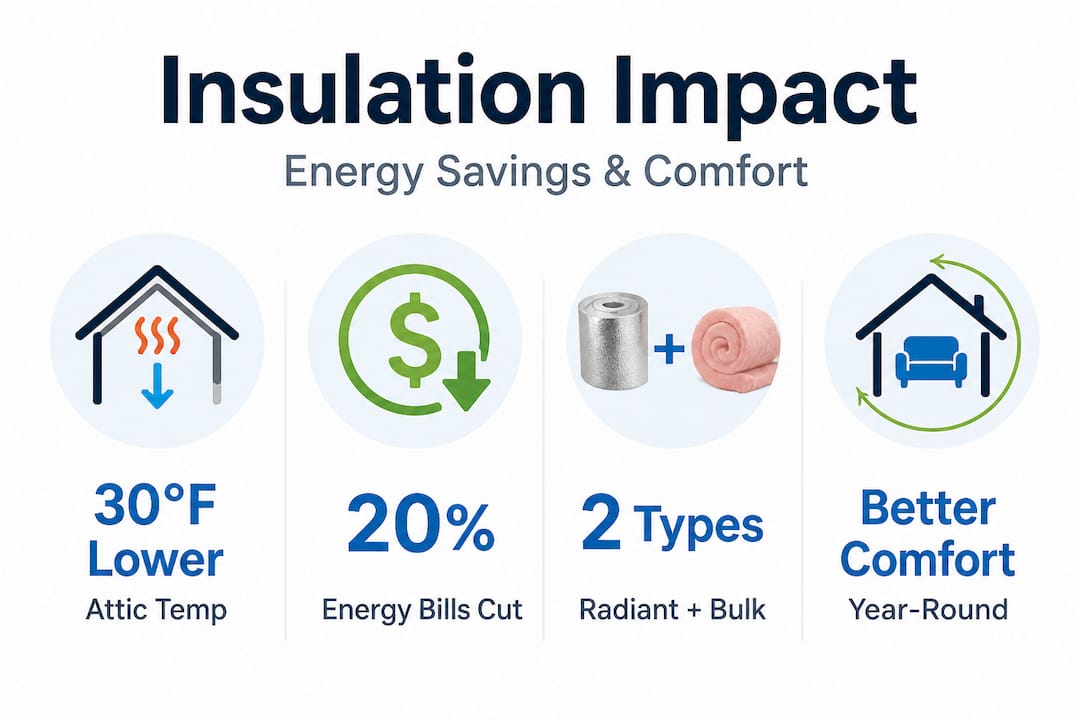
Pro Tip: Combining a radiant barrier with bulk insulation can reduce attic temperatures by up to 30 degrees Fahrenheit in peak summer, which directly reduces air conditioning load and extends equipment life. This combination approach is one of the smartest roof upgrade options available to Central Florida homeowners. For a detailed comparison of materials, reviewing current roofing materials guides designed for Florida’s climate is a helpful starting point.
Assembly design: Why placement, air sealing, and duct location matter
Knowing which insulation works best is only part of the equation. How your whole attic and roof assembly is put together determines whether your insulation actually performs the way it should.
One of the most overlooked factors is where your HVAC ducts and air handler are located. If your ducts run through an unconditioned attic (the standard setup in many older Florida homes), every bit of air flowing through those ducts picks up heat from the surrounding attic air. Selecting vented versus unvented conditioned attic strategies based on HVAC and duct location and moisture control is a critical decision that shapes your entire insulation plan. An unvented, conditioned attic brings ducts inside the thermal envelope, reducing losses dramatically.
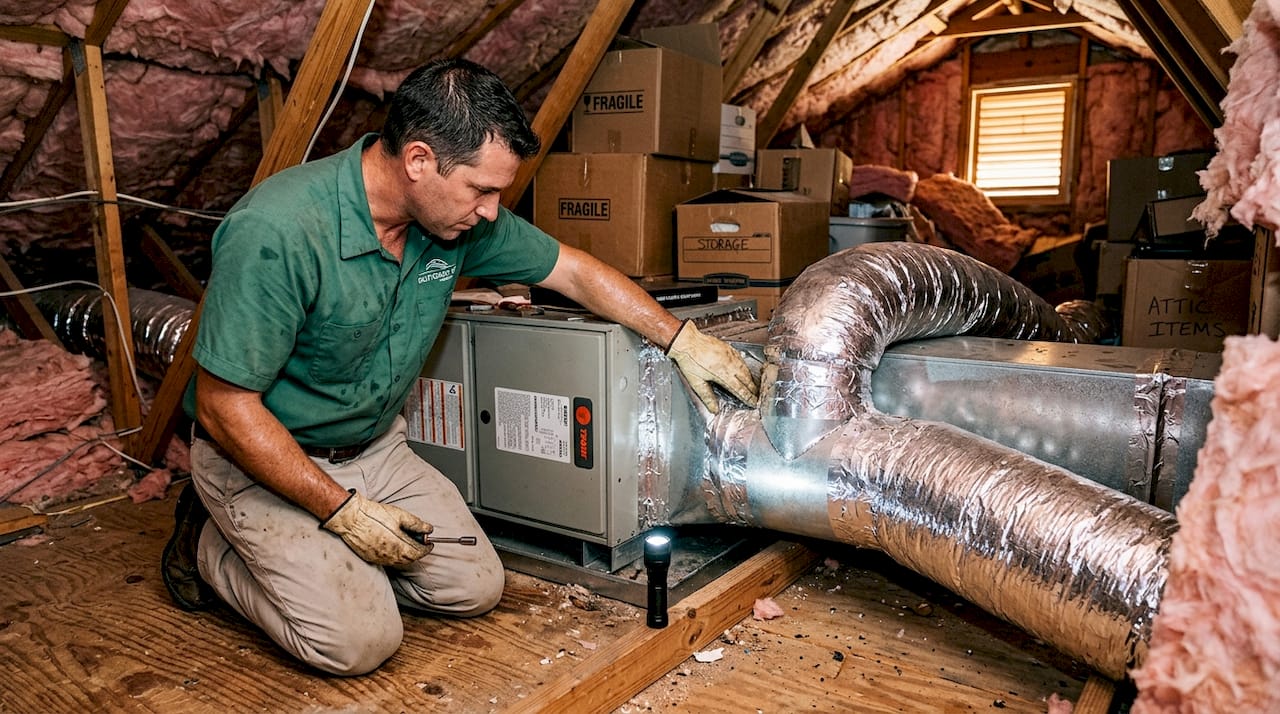
Air sealing is equally important. Convection and air movement are primary drivers of heat gain and loss, which means that sealing gaps, penetrations, and bypasses gives you results that insulation alone cannot. Every light fixture, plumbing stack, or wire penetration in your ceiling is a potential air leak path. Even a small gap can allow significant airflow that carries heat or humidity right past your insulation.
| Attic assembly type | Best for | Key benefit | Key risk |
|---|---|---|---|
| Vented attic with attic floor insulation | Ducts inside conditioned space | Lower cost, proven moisture control | Ducts exposed to attic heat |
| Unvented conditioned attic with spray foam deck | Ducts in attic, hot climates | Ducts stay in conditioned space | Higher upfront cost |
Common mistakes to avoid when insulating roofs in Central Florida:
- Adding insulation without first air-sealing ceiling penetrations
- Choosing insulation based only on R-value without considering radiant heat
- Blocking soffit vents in a vented attic, which destroys moisture control
- Installing radiant barriers without an air space below them (they require an air gap to work)
- Ignoring duct condition and leakage before upgrading insulation
- Using products designed for northern climates that don’t account for Florida’s humidity
Pro Tip: Before investing in new insulation, have a professional check your existing ductwork for leaks. Leaky ducts in an unconditioned attic can waste 20 to 30 percent of the conditioned air your system produces, and no amount of insulation will fix that. Exploring energy-efficient roofing options alongside proper assembly design gives you the most complete solution.
Energy savings, comfort, and cost: What Central Florida homeowners can expect
You’ve seen how technical choices play out. Now let’s look at real benefits in everyday life for homeowners here in Central Florida.
The honest answer to “how much will I save?” is: it depends. Energy savings depend on multiple factors including how much the roof assembly is insulated and the efficiency of your HVAC system. A home that currently has minimal insulation will see bigger gains than one that already meets modern code. A home with a newer, efficient air conditioner will convert those gains into bigger dollar savings than one running an older unit.
That said, here is what most homeowners report after a proper roofing insulation upgrade in Florida’s climate:
- Lower monthly cooling bills, often in the range of 10 to 25 percent depending on starting conditions
- More even temperatures throughout the home, especially in rooms directly under the roof
- Reduced humidity levels indoors, because a tighter, well-insulated assembly limits moisture infiltration
- Less frequent air conditioner cycling, which extends equipment life and reduces maintenance costs
- Improved comfort during power outages, because a well-insulated home retains conditioned air longer
- Longer roof life, because a cooler attic means less thermal stress on roofing materials and decking
Your results are shaped by four key variables. First, the current insulation level in your attic and what you add. Second, the quality of air sealing throughout the ceiling and attic. Third, the efficiency of your HVAC system and the condition of your ductwork. Fourth, the type of roofing material above, since a cool roof surface combined with good insulation below creates a powerful pairing. Keeping an eye on roofing trends for 2026 can help you understand which surface and insulation combinations are becoming the standard for Florida homes.
The biggest insulation mistake most Central Florida homeowners make
Here’s what most guides won’t tell you about roofing insulation in Central Florida.
We’ve seen hundreds of attic inspections across Brevard, Volusia, and Orange counties. The single most common pattern is this: a homeowner spent money adding insulation, and the home is still uncomfortable and expensive to cool. When we dig into why, the answer is almost never the wrong product. It’s the wrong approach.
Most people treat insulation as a material decision. They pick a product, check the R-value, and call it done. But insulation is a system decision. Don’t treat roof insulation as a single-material decision: outcomes depend on correct assembly design, layer placement on the roof deck versus the attic floor, air sealing to control convection and air leakage, and whether radiant pathways dominate under Florida’s solar conditions.
A home with R-38 insulation and unaddressed air leaks will underperform a home with R-30 insulation and thorough air sealing. Every time. Florida’s solar exposure means radiant heat often dominates. If you put in excellent bulk insulation and ignore the radiant pathway, you’ve left the biggest problem unsolved.
The other mistake we see is treating a re-roofing project and an insulation upgrade as completely separate events. When your roof comes off, you have a rare opportunity to address deck-level insulation, radiant barriers, and air sealing in ways that aren’t possible without opening the assembly. Homeowners who miss that window end up paying twice: once for the roof and once for an attic retrofit later. Looking at roof overlay strategies that incorporate insulation improvements at the same time is always worth the conversation.
Our advice is simple: check all the layers, not just the R-value on the bag. Ask how air is sealed. Ask where the ducts are and whether they’re in the thermal envelope. Ask whether radiant heat has been addressed. Those questions will tell you more about your future comfort and savings than any single spec sheet.
Take the next step toward a more energy-efficient home
Armed with this knowledge, you’re ready to make the smartest choice for your roof and your wallet. Knowing what to look for is the first step, but putting it into practice takes a local professional who understands Central Florida’s specific climate demands, building codes, and material options.

At Thomas Roofing and Repair, we work with homeowners across Brevard, Volusia, and Orange counties to design insulation strategies that actually deliver on their promise. Whether you’re replacing a roof, upgrading an aging attic, or just trying to understand why your energy bills keep climbing, our team brings the expertise to evaluate every layer of your roof assembly. From University roofing services to residential roofing Orlando, we tailor our approach to your home’s specific needs. Contact us today for a free estimate and let’s build a system that works.
Frequently asked questions
What type of insulation gives the best energy savings for Florida homes?
A combination of radiant barrier and bulk insulation typically provides the best results because radiant barriers play a complementary role alongside R-value materials in Florida’s high-solar climate. Neither type alone addresses both radiant and conductive heat transfer.
Do I need to consider air sealing if I upgrade my roof insulation?
Yes, air sealing is essential. Convection and air movement are primary heat transfer drivers, meaning that gaps and penetrations in your ceiling can undermine even the best insulation if left unaddressed.
How does the location of my HVAC equipment affect my insulation needs?
If your ducts or air handler are in the attic, insulating approach and air-sealing become far more critical, since exposed ductwork in a hot, unconditioned attic loses significant energy before conditioned air ever reaches your living space.
Will upgrading insulation always lower my energy bills?
Savings are real but not guaranteed at a fixed amount. Energy savings depend on multiple factors including your starting insulation level, HVAC system efficiency, and how well air sealing and assembly design are handled alongside the insulation itself.