 407-408-0577
TL;DR:
- Roof certification confirms a roof’s current condition and remaining lifespan, not a warranty.
- Certified roofs are protected from non-renewal due to age under Florida law, aiding insurance stability.
- Valid certifications and inspections can significantly lower insurance premiums and boost home resale value.
Your roof might look fine from the street, but that hasn’t stopped Florida insurance companies from canceling coverage, refusing renewals, or hiking premiums on homes across Brevard, Volusia, and Orange counties. A roof certification can be the difference between affordable, continuous coverage and a sudden, expensive crisis. Florida Statute §627.7011 protects certified roofs from denial solely based on age, yet most homeowners don’t realize a simple document could protect their finances, their coverage, and their home’s resale value all at once.
Table of Contents
- What is a roof certification? Key components and process
- Why roof certifications are indispensable in Central Florida
- Cost benefits: Insurance savings and value boosts
- Choosing the right inspector: Avoid common pitfalls
- The hard truth: Roof certification isn’t just a checkbox
- How to get reliable roof certification and repairs in Central Florida
- Frequently asked questions
Key Takeaways
| Point | Details |
|---|---|
| Essential for insurance | Roof certification is often required to keep or renew homeowner insurance in Florida. |
| Saves you money | Certifications and wind mitigation can reduce insurance premiums by hundreds or thousands each year. |
| Choose qualified inspectors | Only licensed professionals using proper forms provide certifications accepted by insurers. |
| Best done proactively | Certify your roof before problems or renewal deadlines for maximum protection and peace of mind. |
What is a roof certification? Key components and process
A roof certification is not a warranty. That distinction matters more than most people think. A warranty promises future performance from a manufacturer or contractor. A certification, on the other hand, is a licensed professional’s written assessment of your roof’s current condition and estimated remaining useful life. It’s a snapshot of where your roof stands today, backed by physical evidence, photos, and documentation.
The inspection process that leads to a certification covers several critical areas. According to industry standards, inspections involve exterior visual assessment, including checks of shingles, flashing, gutters, and drainage systems from multiple angles. Inspectors look for curling shingles, granule loss, cracked or missing tiles, and compromised flashing around chimneys and vents. They also inspect the attic for signs of moisture intrusion, structural sagging, and ventilation problems. Many licensed professionals use modern tools including drones for hard-to-reach angles and infrared cameras to detect hidden moisture trapped under roofing materials.
Here’s what a typical certification process covers:
- Exterior visual inspection from the ground and rooftop
- Shingle or tile condition assessment, including granule loss, curling, or brittleness
- Flashing evaluation at all penetrations, edges, and transitions
- Attic inspection for moisture, mold, structural integrity, and ventilation
- Photo documentation of all findings, organized by location
- Written report estimating remaining life expectancy
Florida law requires that these certifications come from licensed professionals only. That means state-licensed roofing contractors, professional engineers, or certified home inspectors. You want to familiarize yourself with roof inspection terminology before meeting with any inspector, so you can ask the right questions. Choosing an unqualified or out-of-state inspector can result in a certification that your insurance company simply rejects, costing you time and money with nothing to show for it.
Pro Tip: Ask your inspector specifically which insurance forms they complete. Citizens Property Insurance uses its own form, the RCF-1, and not every inspector knows how to fill it out correctly. A thorough Central Florida roof inspection from a local professional who understands Florida’s forms will save you significant headaches later.
Why roof certifications are indispensable in Central Florida
Central Florida is not an average place to own a home. The region sits squarely in a corridor hammered by tropical storms, hurricanes, and severe afternoon thunderstorms from June through November each year. That level of weather exposure makes roof condition a live, pressing issue year-round. But even beyond storm risk, the insurance landscape here makes certifications non-negotiable for most homeowners.
Here’s the core problem: Florida Statute §627.7011 prohibits insurers from denying coverage solely based on a roof’s age if a licensed inspector certifies it has five or more years of remaining life. Without that certification, your insurer can legally refuse to renew your policy the moment your roof crosses the 15-year mark. This isn’t a hypothetical scenario. Thousands of Florida homeowners have faced non-renewal letters with almost no warning.
Citizens Property Insurance, Florida’s state-backed insurer of last resort, actively requires roof certifications for aging roofs. If you’re covered through Citizens or seeking to join, no certification often means no coverage. Private carriers follow similar standards, and many use the roof’s certified status to determine whether they’ll offer a new policy at all.
| Roof condition | Without certification | With valid certification |
|---|---|---|
| 15+ year-old roof | Renewal refusal possible | Protected under §627.7011 |
| Post-storm damage | Claim disputes more likely | Documented baseline aids claim |
| Pre-sale inspection | Buyer concerns unresolved | Adds credibility and value |
| Wind mitigation combined | No premium discount | 20 to 40% premium reduction possible |
Beyond insurance, certified roofers in Florida consistently report that homes with current certifications sell faster and with fewer buyer objections. A buyer’s lender may require a certification before approving a mortgage. Real estate agents in Brevard and Orange counties will tell you that a stack of current roofing documents is one of the most powerful tools a seller can offer.
“Your roof is the number one item insurance companies scrutinize when writing new policies in Florida. A current certification isn’t just paperwork—it’s proof of value.”
Certifications also protect your Central Florida home by catching problems before they become catastrophic. A small leak identified during a certification inspection might cost a few hundred dollars to fix. That same leak, undiscovered for another two years, can lead to tens of thousands in structural repairs and mold remediation. The certification process essentially forces a thorough review on a schedule, rather than waiting until something goes visibly and expensively wrong.
Regular certifications also mean you’re never caught off guard when your policy renewal arrives. Homes with fewer roof defects documented through consistent inspections have a much cleaner claim history, making them far more attractive to insurers at renewal time.
Cost benefits: Insurance savings and value boosts
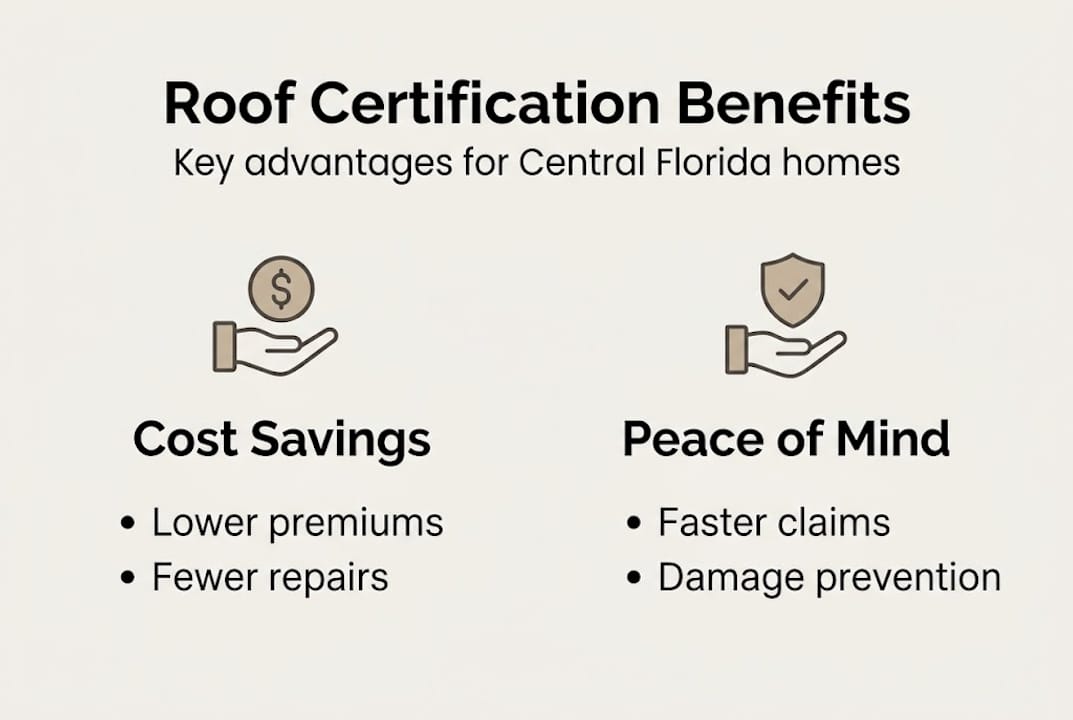
Let’s talk dollars, because the numbers here are genuinely striking. The upfront cost of a roof certification typically runs between $150 and $400 depending on roof complexity and the professional you hire. That’s a modest investment. What you get back in insurance savings alone can be many times that amount.
When you combine a roof certification with a wind mitigation inspection, which documents storm-resistant features like hurricane straps and impact-resistant materials, certifications and wind mitigation enable 20 to 40 percent premium reductions. In real numbers, that works out to $500 to $2,800 per year in savings depending on your coverage level and home value. For a homeowner paying $3,500 annually in premiums, a $300 certification could directly unlock over $1,000 in annual savings. That’s a return most financial investments can’t touch.
| Investment | Approximate cost | Potential annual savings |
|---|---|---|
| Roof certification alone | $150 to $400 | Varies by insurer |
| Wind mitigation inspection | $75 to $150 | $500 to $2,800 per year |
| FORTIFIED roof upgrade | Higher upfront | 73% fewer claims, 72% lower losses |
| No certification (older roof) | $0 now | Risk of full policy cancellation |
The data on FORTIFIED-certified roofs is particularly compelling. FORTIFIED is a voluntary building standard developed by the Insurance Institute for Business and Home Safety (IBHS). Homes that meet FORTIFIED standards see a 73% drop in claim frequency and a 72% reduction in loss ratios compared to non-certified homes. That’s not marketing language. That’s empirical data from actual claims across storm-prone states like Florida.
Pro Tip: Stack your certification with a wind mitigation inspection at the same appointment when possible. Many licensed roofers complete both during the same visit, and insurers apply better insurance claims outcomes and premium discounts when both reports are on file. This combination is the single most cost-effective thing most Central Florida homeowners can do for their insurance situation.
The financial case doesn’t end with premiums. A certified roof reduces your risk of a denied or disputed claim after a storm. Without a documented baseline condition, an insurance adjuster can argue that pre-existing damage contributed to the loss, which gives them grounds to reduce or reject your claim. A current certification removes that ambiguity.
Choosing the right inspector: Avoid common pitfalls
Not every inspector is equally qualified, and in Florida’s insurance market, the difference between a good certification and a flawed one can mean thousands of dollars. Choosing the right professional is worth deliberate attention.
Here’s a step-by-step approach to making a smart hiring decision:
- Verify state licensing. Florida requires that roof certifications come from licensed roofing contractors, professional engineers, or certified home inspectors. Ask for their license number and verify it through the Florida Department of Business and Professional Regulation.
- Confirm familiarity with insurer forms. Prioritize licensed inspectors familiar with insurer forms like the Citizens RCF-1 and the OIR-B1-1802 wind mitigation form. An inspector who fills these out incorrectly means your results won’t be accepted.
- Ask about documentation practices. A valid certification should include time-stamped photos of every inspection area, written condition notes, and a clear estimated remaining life statement. Anything less may not satisfy your insurer.
- Check local experience. An inspector who works regularly in Brevard, Volusia, and Orange counties understands regional codes, typical storm damage patterns, and local insurer expectations.
- Schedule appropriate frequency. For roofs ten years and older, schedule re-certification every two to three years, especially after any storm event.
Red flags to watch for include inspectors who complete the certification without actually walking the roof, those who can’t name the specific forms your insurer requires, and anyone who gives you a verbal certification without written documentation. When it comes to licensed roofers in Central Florida, there are quality providers available, but there are also unscrupulous operators who produce paperwork that falls apart the moment an insurer looks closely.
The qualities of reputable roofers include transparency about their process, a clear willingness to explain findings, and no pressure tactics around upselling repairs. A good inspector tells you what they found, good and bad, and leaves the decision-making in your hands.
When and how often to certify your roof
Timing your certification strategically makes a real difference. The most costly mistake homeowners make is waiting until an insurance letter forces their hand. By that point, your options narrow dramatically and your leverage disappears.
Here are the best times to schedule a roof certification:
- Before your policy renewal date, typically 60 to 90 days in advance, so any required repairs can be completed without rushing
- Immediately after any significant storm, including tropical storms, hurricanes, or severe hail events, to document post-storm condition before any coverage dispute arises
- Before listing your home for sale, since buyers, lenders, and real estate agents increasingly expect current documentation
- When your roof crosses the ten to twelve year mark, even if it still appears sound, to establish a documented baseline
- Alongside a wind mitigation inspection, to maximize your insurer benefit in a single visit
Certifications are not permanent, and insurers have specific thresholds for how recent a certification must be to satisfy their requirements. Some insurers require certifications no older than two years for aging roofs. Others accept up to five years. Confirm with your specific carrier what they need, and schedule proactively.
The importance of regular roof inspections goes beyond compliance. They build a paper trail that works in your favor over time, showing consistent maintenance and professional oversight. That documentation history is one of the strongest assets a homeowner can have when negotiating with an insurer or selling a property.
The hard truth: Roof certification isn’t just a checkbox
Here’s what years of working with Central Florida homeowners have taught us. Most people don’t think about their roof until they have to. A leak shows up, or an insurance letter arrives, or a potential buyer’s lender raises a red flag. By that point, the certification isn’t a tool anymore. It’s an emergency.
The homeowners who come to us most stressed are not the ones with genuinely bad roofs. They’re the ones who never got around to documenting what they had. They have a perfectly serviceable 14-year-old shingle roof that an inspector would likely certify for another five to seven years, but because they never got the paperwork, their insurer is now threatening non-renewal. The roof itself isn’t the problem. The absence of documentation is.
What we’ve seen work consistently is a proactive approach. Schedule a certification, keep copies of every report, store them digitally somewhere you can find them, and treat the process like a regular part of home maintenance. Pair each certification with a wind mitigation inspection and you’re not just staying compliant, you’re actively lowering your annual costs year over year. The certified roofing investment advice we give every homeowner is simple: spend a few hundred dollars now to protect thousands in coverage and equity later.
The peace of mind that comes from knowing exactly what condition your roof is in, documented and on file, is worth considerably more than the cost of the inspection itself. Informed homeowners make better decisions, negotiate from strength, and don’t panic when storm season arrives.
How to get reliable roof certification and repairs in Central Florida
Knowing what certifications do is one thing. Getting the right team to execute the process is where it becomes real.

At Thomas Roofing and Repair, we serve homeowners across Brevard, Volusia, and Orange counties with licensed inspections, roof certifications, and complete storm damage documentation. Whether you need a certification ahead of your next insurance renewal, a thorough review after a recent storm, or guidance on combining wind mitigation with your certification for maximum premium savings, our team has the local knowledge and licensing to get it done right. Explore our detailed storm damage repair guide for post-storm steps, or schedule a Central Florida roof inspection directly with our certified team. Getting started takes minutes, and the protection it provides lasts for years.
Frequently asked questions
Is a roof certification the same as a warranty?
No, a roof certification confirms your roof’s current condition and remaining life expectancy, while a warranty is a separate promise of future performance under specific terms from a manufacturer or contractor.
What happens if my roof fails certification?
You may be required to complete specific repairs or a full replacement before insurers will accept or renew your policy, particularly with Citizens Property Insurance using the RCF-1 form.
How long is a roof certification valid in Florida?
Most certifications are valid for two to five years, but §627.7011 protects certified roofs showing five-plus years of remaining life, so confirm your specific insurer’s requirements before assuming validity.
Do insurance companies accept any inspector’s certification?
No. Insurers require certification from state-licensed professionals who follow Florida standards, and licensed professionals only including contractors, engineers, and certified inspectors qualify under §627.7011.
Can roof certification lower my insurance premium?
Yes, especially when combined with a wind mitigation inspection. Certifications with wind mitigation typically unlock 20 to 40 percent premium reductions, saving Central Florida homeowners $500 to $2,800 per year.