
Expect to pay roughly a range of several hundred to a few thousand dollars for hurricane straps depending on whether you’re building new, reroofing, or retrofitting an existing attic. New construction runs cheapest per connection, retrofits cost the most because of limited access, and in many hurricane-prone states insurance credits or grant programs can recover a big chunk of that spend within one to three years. For most homeowners, the straps pay for themselves faster than almost any other roofing upgrade.
TL;DR:
- Retrofit hurricane strap costs typically range from $850 to $4,500 depending on attics access, roof complexity, and home size, with higher prices for retrofit installations.
- The price per connection varies from $8 to over $600, depending on whether the work is during new construction, reroof, or standalone retrofit.
- Insurance credits and grants, such as wind-mitigation inspections, can offset up to 50% of costs and generally pay for themselves within one to three years through premium reductions.
- Proper documentation, quality hardware, and licensed contractors are essential to ensure eligibility for insurance credits and code compliance, especially for DIY projects.
Table of Contents
- What does hurricane strap installation actually cost?
- New construction vs. reroof vs. standalone retrofit: how pricing changes
- What cost factors actually drive your estimate?
- How do you estimate strap count and total cost yourself?
- How much can insurance credits and grants offset the cost?
- DIY vs. hiring a licensed contractor: what should you know?
- Why we recommend straps and how we approach estimates
- Get a straps estimate that actually reflects your roof
- Sources
What does hurricane strap installation actually cost?
Most homeowners land somewhere between $1,000 and $2,500 for a full-home retrofit, with smaller or easier-access homes closer to $850 and larger, harder-access homes climbing toward $4,500. That figure covers hardware, labor, and the inspection paperwork you’ll need to show your insurer. Local Florida contractor pricing consistently clusters in the $850 to $2,500 band for a standard single-family retrofit, while broader homeowner guides peg a typical project closer to $1,000 to $1,500 for average-sized homes with reasonable attic access.
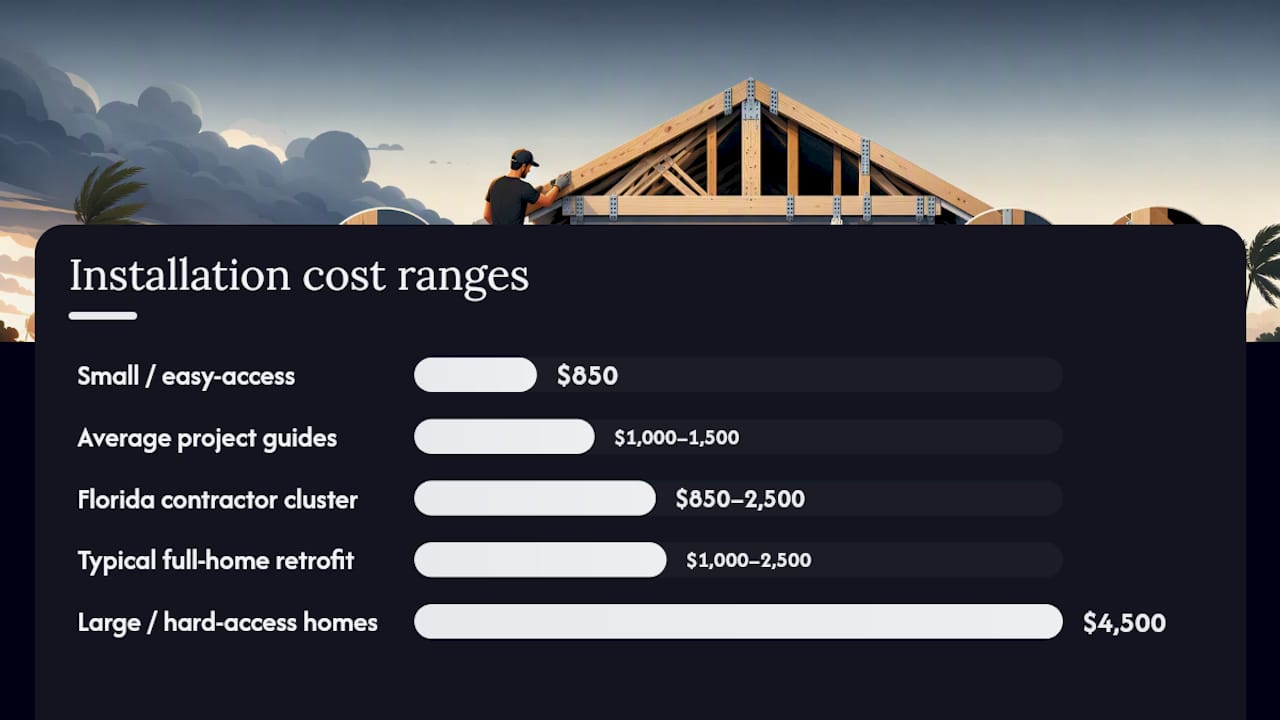
A 2,000 to 2,500 square foot home with a simple gable roof and open attic access tends to sit at the low end of that range. Add a hip roof, multiple roof planes, or blown-in insulation covering the truss connections, and labor time (not hardware) drives the total up fast. Coastal Florida markets, along with parts of the Gulf Coast and Carolinas, often run higher than the national average simply because demand for licensed wind-mitigation work spikes every hurricane season.
Here’s what typically makes up that total:
- Hardware: metal connectors, usually $0.80 to $2.50 per piece depending on the model
- Labor: the largest line item, varying by access difficulty and roof type
- Permit fees: required in most jurisdictions for structural roof work
- Wind-mitigation inspection: the paperwork that unlocks your insurance credit
- Contingency costs: hidden attic conditions that add time on-site
If you’re comparing quotes and one number looks dramatically lower than another, ask what’s included. A price that skips the inspection or permit isn’t a lower cost, it’s an incomplete one.
New construction vs. reroof vs. standalone retrofit: how pricing changes
The single biggest factor in your hurricane strap cost isn’t the hardware, it’s when in the construction timeline the work happens. The same connector can cost $10 or $400 depending on whether the roof deck is already open.
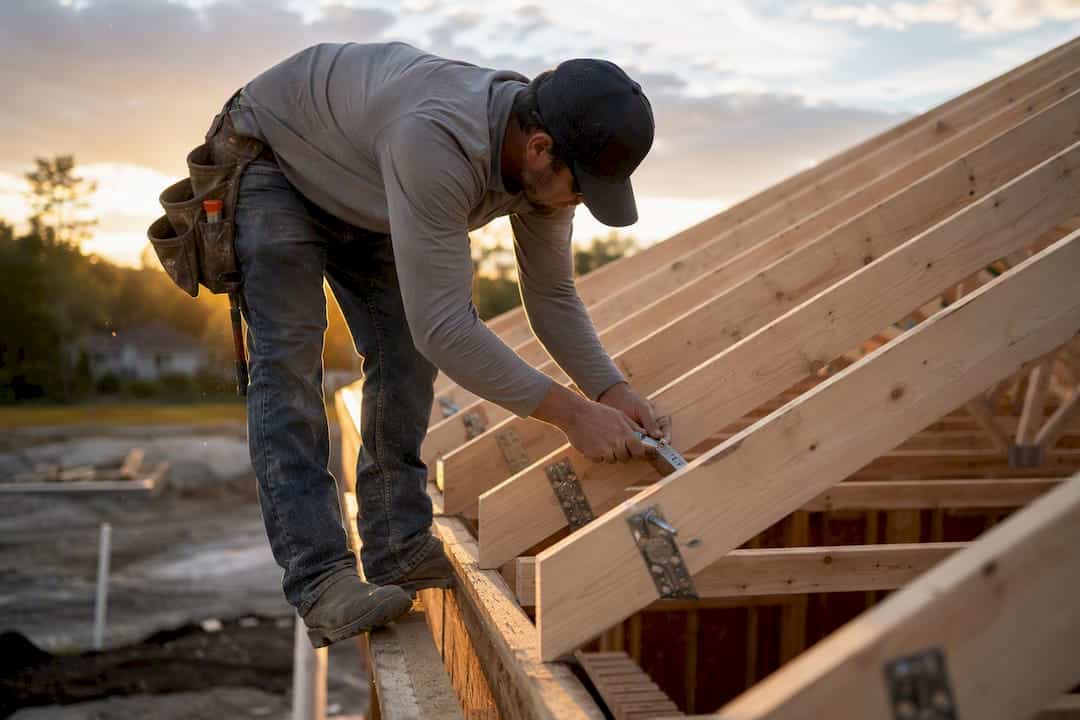
New construction is by far the cheapest scenario. Straps get nailed in during framing, before drywall, insulation, or roofing exist to get in the way. Per-connection costs typically run $8 to $20 including labor, since a framer is already up there with a nail gun.
Reroof with deck removal falls in the middle. When shingles and decking come off for a full roof replacement, crews can access the truss-to-wall connections from above without tearing into the attic from below. This is the smart window to add straps if you’re already replacing your roof, and it’s a moment worth flagging to your contractor before work starts.
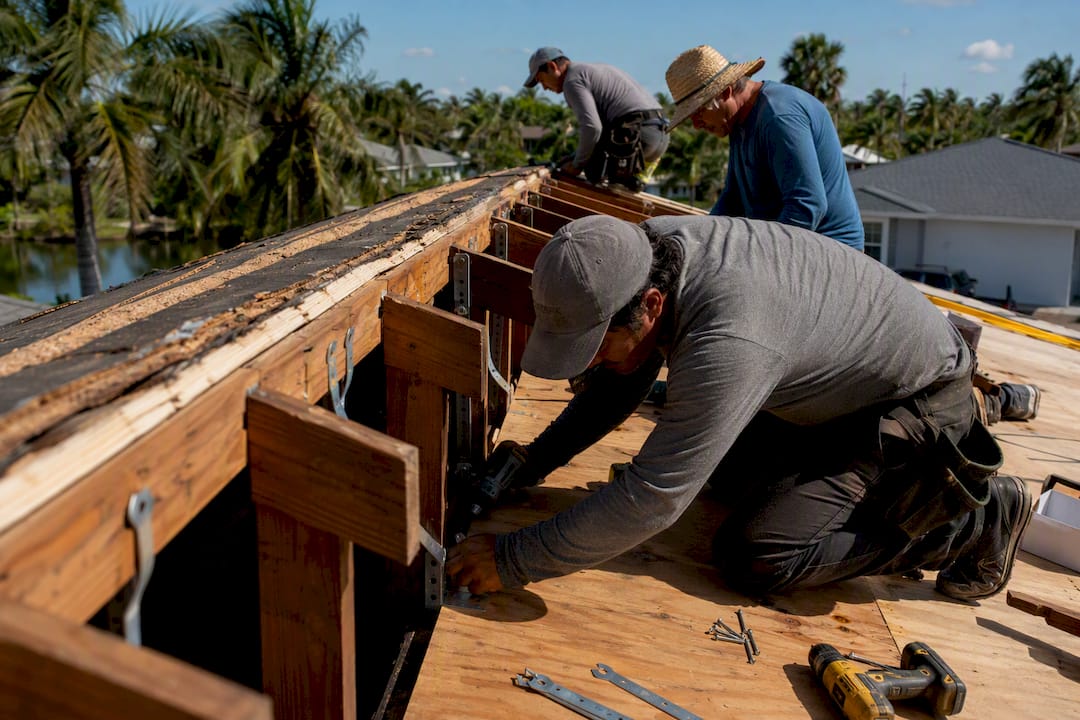
Standalone retrofit costs the most. Without an open roof deck, a crew has to work through the attic, often squeezing through insulation, low clearances, and framing that wasn’t designed with future access in mind.
Typical per-strap pricing looks like this:
- New construction: $8 to $20 per connection
- Reroof (deck removed): $50 to $150 per connection
- Standalone attic retrofit: $150 to $600+ per connection, depending on access
If you’re already scheduling a reroof, that’s the moment to add strap upgrades. Waiting until afterward means paying retrofit prices for work that could have happened at reroof prices.
What cost factors actually drive your estimate?
Six variables explain almost all the price variation between quotes:
- Attic accessibility: cramped, low-clearance attics with blown insulation slow crews down significantly
- Roof geometry: hip roofs and multiple roof planes have more connection points than a simple gable
- Wall construction: wood-frame walls take standard straps; concrete block (CMU) construction needs specialty fasteners and anchors, which cost more per connection
- Existing connection type: homes built with only toenailed rafters need full retrofits, while homes with older, undersized clips may only need upgrades
- Local labor rates and permit fees: these vary by county and can shift totals by hundreds of dollars
- Number of stories and roof complexity: a two-story home with a complex roofline multiplies labor time, not just adds to it
Practitioners in this trade note that retrofit attic work regularly runs into hidden conditions, insulation hiding the connection points, obstructed access panels, older truss geometries that don’t match modern hardware, and these surprises are exactly why some retrofit quotes come in well above the average range.
Pro Tip: Ask your contractor to physically check attic access before quoting a firm price. A phone estimate based on square footage alone almost always misses the access issues that end up costing you the most.
How do you estimate strap count and total cost yourself?
You can build a reasonable budget estimate before ever calling a contractor. The formula homeowner-facing calculators use is straightforward: total connections equal your rafter or truss count multiplied by connections needed per rafter, with an adjustment for gable ends where bracing needs differ.
Here’s how to run your own numbers:
- Count your trusses or rafters. Most homes space these 24 inches apart, so divide your roof’s linear length by 2 to estimate the count.
- Multiply by connections per truss. Standard installs use one connector per truss-to-wall connection, sometimes two on gable ends for added bracing.
- Apply unit hardware pricing. Basic connectors like the Simpson H1 run about $0.80, mid-grade H2.5A connectors around $1.50, and heavier H10 models near $2.50 each.
- Add labor per connection based on your scenario (new construction, reroof, or retrofit ranges above).
- Add the wind-mitigation inspection fee, typically $75 to $200.
A worked example: a home with 26 trusses needing standalone attic retrofit work might use 28 connectors (26 trusses plus 2 gable-end connections) at an average $1.50 each, roughly $42 in hardware. Labor at $150 per connection for full retrofit access adds $4,200. Add a $150 inspection fee, and you land near $4,392, near the top of the typical retrofit range. That same home, if straps were added during a reroof instead, would likely total closer to $1,000 to $1,500 for labor alone.
How much can insurance credits and grants offset the cost?
A wind-mitigation inspection, using the standard OIR-B1-1802 form in Florida, documents your roof-to-wall connection type, roof shape, and opening protection for your insurer. That inspection typically costs $75 to $200 and is the single document that unlocks your credit.
The payoff can be significant. Homes with properly documented hurricane straps can see wind insurance premium reductions of 10% to 50%, depending on the insurer and the home’s overall wind rating. On a typical Florida wind premium, that discount alone can offset a $1,500 retrofit within one to three years.
Programs like My Safe Florida Home add another layer, offering matching grants toward qualifying mitigation upgrades for eligible homeowners, which can cut your out-of-pocket cost well before insurance savings even kick in.
- Inspection cost: $75 to $200
- Insurance premium reduction: 10% to 50%
- Typical payback window: 1 to 3 years on many retrofit projects
The catch is the paperwork has to be right. Roofing and insurance specialists emphasize that meeting insurer criteria exactly, correct connector model, correct nail count, documented inspection, is what determines whether you actually get the credit. A sloppy install that technically has straps but wasn’t done to code can pay zero credit.
DIY vs. hiring a licensed contractor: what should you know?
A DIY retrofit is reasonable only if your attic has generous, unobstructed access and you’re comfortable with structural fastening work. It’s not reasonable if your home has vaulted ceilings, minimal attic clearance, or concrete block walls requiring specialty anchors.
The real risk isn’t the labor, it’s the documentation. Using undersized nails, the wrong connector model, or an incorrect nail count can void your uplift rating entirely, which means no insurance credit even though the straps are physically installed.
Before hiring anyone, check these five things:
- Valid roofing license and liability insurance for your state
- Documented experience with wind-mitigation installs specifically, not just general roofing
- Willingness to handle permit filing on your behalf
- A clear plan to document the work for your insurer’s wind-mitigation form
- Verifiable references from recent wind-mitigation clients
Red flags include contractors who won’t pull permits, can’t explain which connector model they’re using, or quote a price far below the typical range without explaining why.
Pro Tip: Always get the wind-mitigation inspection completed and filed with your insurer after installation, not just the installation itself. Straps that aren’t documented on file earn you zero premium credit.
Why we recommend straps and how we approach estimates
Thomas Roofing and Repair has spent years working roofs across Brevard, Volusia, and Orange counties, and we’ve seen firsthand how often “the roof survived, the straps held” is the difference between a repair job and a total loss claim. We build our estimates around dependability and craftsmanship first, not the cheapest possible number, because a hurricane strap install that doesn’t meet code documentation requirements isn’t worth doing at all.
When we complete strap work, we document connector models, nail counts, and roof geometry the same way an insurance wind-mitigation inspector would, so homeowners walk away with paperwork ready to file, not a scramble afterward. That system-level thinking matters. Specialists who study wind mitigation as a whole system point out that straps alone won’t save a roof if garage doors, windows, or soffits fail first.
— Results
Get a straps estimate that actually reflects your roof
Thomas Roofing and Repair gives Central Florida homeowners something most retrofit quotes skip: a physical attic and roof assessment before we quote a price, not a phone estimate based on square footage guesswork.
We handle the full scope, hardware selection, permit filing, and the documentation your insurer needs for wind-mitigation credit, so you’re not stuck chasing paperwork after the crew leaves. If you’re already planning a reroof, that’s the ideal time to fold strap upgrades into the same job at a lower per-connection cost, and we’ll walk you through exactly how that pricing shifts compared to a standalone retrofit. Financing options are available if you’d rather spread the cost rather than pay it upfront. Our code-aware installation approach covers everything from strap counts to final inspection sign-off. Request a free estimate today and find out what your specific roof geometry and attic access actually mean for your number, not a generic average.
Sources
- Hurricane Roof Straps: 2026 Florida Code Guide | The Roofing Brief
- Hurricane Strap Calculator — Rafter Tie-Down Count, Type & Cost (2026)
- Cost to Install Hurricane Straps in Jupiter, FL | 2026 Guide
- Can Roof Clips Protect Your Home During a Major Storm?