
Electronic leak detection (ELD) locates roof membrane breaches by measuring electrical conductance, pinpointing the exact hole rather than showing where water pooled after the fact, which is the core problem with flood testing. It works on most new roof installations and on many existing roofs during forensic leak tracing, but only when the assembly meets a few conditions.
- The substrate needs a conductive return path (a wet membrane, conductive deck, or added conductive layer).
- The membrane must be exposed or dry enough for the chosen method, and overburden usually has to come off first.
- Testing follows ASTM D7877 or ASTM D8231, performed by a technician using calibrated equipment at documented sensitivity, per IIBEC’s technical advisory.
Key Takeaways
Electronic leak detection works by completing an electrical circuit through membrane breaches, requiring a conductive substrate, calibrated equipment, and ASTM-aligned method selection to produce results a warranty or insurance claim can rely on.
| Point | Details |
|---|---|
| Conductive path required | ELD needs a conductive return beneath the membrane; conductive black EPDM and insulating decks need special handling. |
| Match method to roof type | Use EFVM for open fields, low-voltage scanning for green/ballasted roofs, high-voltage for verticals and transitions. |
| Insist on calibration records | Valid tests follow ASTM D7877 or D8231 with documented equipment calibration and sensitivity levels. |
| Remove overburden before testing | Green roofs and ballasted systems test unreliably with overburden in place; test before installation when possible. |
| Repair, then retest | Every breach repair needs a follow-up test at the same location before filing warranty or insurance documentation. |
| Work with a full-service coordinator | Thomas Roofing and Repair inspects, coordinates ELD testing, and handles repair and retest under one contract. |
Table of Contents
- How Does Electronic Leak Detection Work on a Roof?
- Which ELD Method Fits Your Roof: Low-Voltage or High-Voltage?
- What Do ASTM and IIBEC Require for a Valid Test?
- Why Won’t ELD Work on Every Roof?
- How Do You Prepare for an ELD Survey?
- What Should You Look for When Hiring an ELD Technician?
- What Happens After a Breach Is Found?
- Why We Treat ELD as Standard Practice, Not an Upsell
- Get Your Roof Tested and Repaired the Right Way
- Frequently Asked Questions
- Sources
How Does Electronic Leak Detection Work on a Roof?
The physics is simpler than the name suggests. One electrode creates a low or high voltage field across the top of the membrane. A second conductive path sits below it, either the roof deck itself, a wet substrate, or a conductive layer installed for this purpose. Roofing membranes are electrical insulators. Water and metal are not. When a gap exists in the membrane, whether a puncture, a seam failure, or a fastener backing out, the circuit completes through that exact spot and the equipment registers it.
That is why ELD finds breaches instead of just wet insulation. A moisture scan with infrared or capacitance can tell you a section of roof holds water. It cannot tell you where the water got in. ELD closes that gap:
- The technician sweeps the field across the membrane in overlapping passes.
- A signal spike marks a specific coordinate, not a general zone.
- Crews mark it, cut a small inspection area, confirm the breach, and repair only that spot.
Calibration matters here more than most property owners realize. ASTM D7877 requires equipment sensitivity to be verified before and during testing, because a poorly calibrated unit either misses small breaches or flags membrane thin spots that were never actual leaks.
Which ELD Method Fits Your Roof: Low-Voltage or High-Voltage?
Three methods dominate the field, and each one suits a different roof geometry.
Low-voltage electric field vector mapping (EFVM) floods the membrane surface with water and runs a low-voltage current through it, using the water film as the conductor. It excels on large, open, flat fields like commercial single-ply roofs, because a single technician can cover thousands of square feet efficiently.
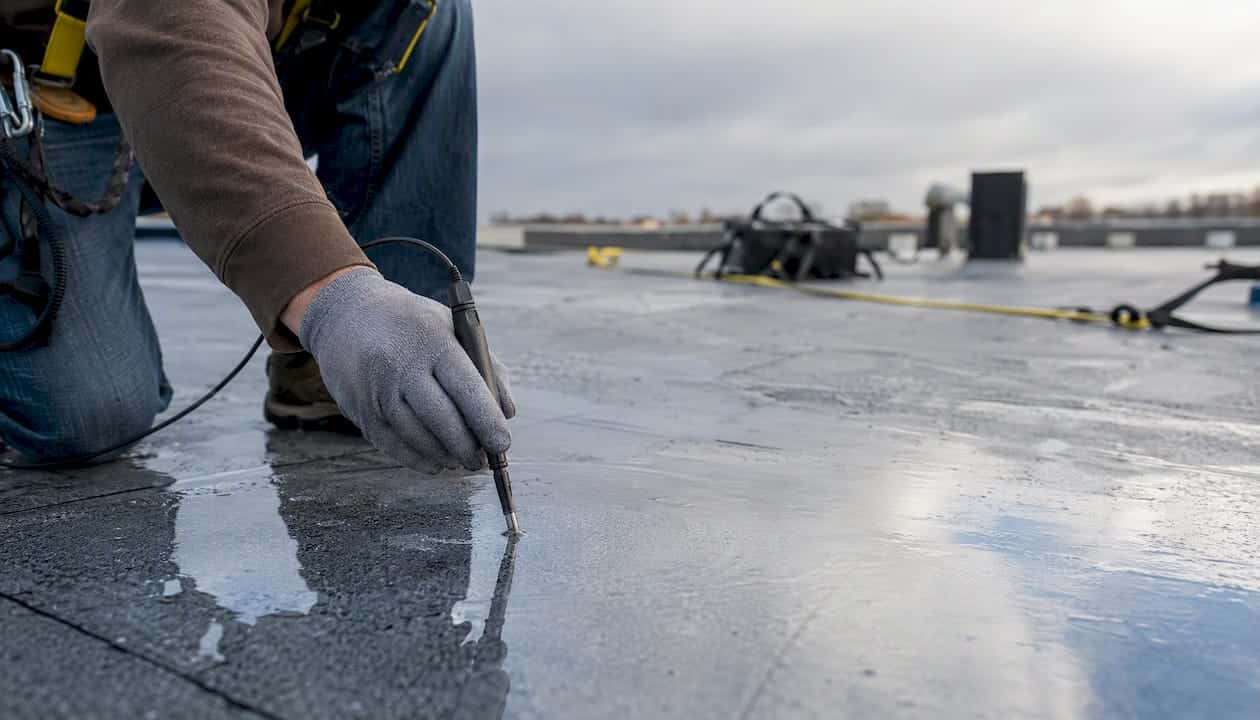
Low-voltage scanning, governed by ASTM D8231, uses a dual-sweep platform instead of standing water. It works well on green roofs, ballasted assemblies, and situations where flooding the surface isn’t practical, and it handles both horizontal and vertical transitions in the same pass.
High-voltage spark testing applies a higher voltage through a wand or broom electrode and needs no surface water at all. It’s the go-to choice for vertical walls, parapets, drains, and penetration details where low-voltage water films won’t sit still, and it performs reliably in dry climates where standing water evaporates too fast for EFVM.
- EFVM: best for open commercial fields
- Low-voltage scanning: best for green/ballasted roofs and mixed surfaces
- High-voltage: best for verticals, transitions, and dry conditions
Many providers combine methods, sometimes called ELD fusion, running EFVM across the field and high-voltage around every penetration and seam intersection.
Pro Tip: Ask your provider which method they’re using and why before the crew arrives. A roof with a green assembly tested only with standing-water EFVM is a red flag for an incomplete survey.
What Do ASTM and IIBEC Require for a Valid Test?
Two ASTM documents govern how these tests get performed, and both matter if you plan to use results for warranty claims or insurance documentation. ASTM D7877 sets the general framework: calibrated equipment, documented sensitivity, and confirmation that a conductive return path exists beneath the membrane before testing begins. ASTM D8231 covers low-voltage scanning platforms specifically, including the dual-sweep procedure for horizontal and vertical surfaces.
IIBEC’s technical advisory goes a step further, recommending ELD as standard quality control during new roof installation, not just as a forensic tool after a leak shows up. The advisory also flags a real problem: technician training varies widely across the industry, and a test performed by an undertrained crew can produce results nobody should trust.
A defensible test report needs three things at minimum:
- Calibration records showing the equipment was verified before use
- The specific ASTM method followed and any deviations noted
- Documented sensitivity settings tied to the membrane type tested
Why Won’t ELD Work on Every Roof?
ELD depends on a membrane acting as an electrical insulator against a conductive layer underneath. Some common assemblies break that assumption outright. Black EPDM, for instance, contains enough carbon that it conducts electricity itself, which defeats the basic principle the test relies on. Testing that membrane with standard equipment and no adjustment produces unreliable data, whatever the results claim.
Overburden creates a separate problem. Green roofs, ballasted systems, and pavers sitting on top of a membrane interrupt the electrical path and produce inconclusive readings. The most reliable approach, per industry guidance on high versus low voltage methods, is testing before the overburden goes down, not after.
- Conductive membranes need a modified approach or a different test entirely.
- Overburden should come off, or testing should happen pre-installation.
- Insulating decks can be made testable with a conductive primer or conductive glass felt installed directly under the membrane during construction.
Pro Tip: If you’re specifying a green roof or a conductive membrane for new construction, talk to your roofer about conductive media before installation starts. Retrofitting that capability later is far more disruptive.
How Do You Prepare for an ELD Survey?
A survey runs faster and produces cleaner results when the roof is ready before the crew shows up.
- Confirm the membrane is exposed. Remove pavers, gravel ballast, or planting trays if the method requires direct access.
- Isolate active penetrations, drains, and equipment curbs so technicians can test around them without interference.
- Schedule around weather. EFVM needs dry conditions for accurate water application; high-voltage testing tolerates more variability.
- Confirm site access, fall protection, and any permits needed for rooftop work in advance.
A full scan on an open commercial roof typically moves faster per square foot than a targeted forensic search around a single known leak, since forensic work often means testing several suspect zones in detail rather than sweeping a wide field. Cost depends on total roof area, which method or combination gets used, how much documentation you need, and whether access challenges (parapet height, rooftop equipment, restricted hours) slow the crew down. Budget for a retest after any repair; a single pass rarely closes the loop on its own.
What Should You Look for When Hiring an ELD Technician?
Not every crew that owns ELD equipment runs a test worth trusting. The gap between a real survey and a check-the-box exercise usually shows up in the paperwork.
Ask for these deliverables before you sign anything:
- Calibration certificates for the specific equipment used on your job, dated close to the test date
- A written method description citing the ASTM standard followed
- Documented sensitivity levels appropriate to your membrane type
- An annotated breach map showing exact locations, not a general “problems found in this area” summary
Technician experience with your specific roof assembly matters more than years in business alone. A crew that’s tested dozens of ballasted EPDM roofs may still be unfamiliar with green roof assemblies or metal panel transitions.
Pro Tip: Walk away from any provider who can’t produce calibration records on request, describes their method only as “we scan for leaks,” or resists retesting after a repair. Documented false claims in this industry usually trace back to exactly these gaps.
What Happens After a Breach Is Found?
A usable report names the method, includes calibration data, marks every breach on a scaled map, states the sensitivity level used, and recommends specific repairs, not general observations.
The workflow after that is straightforward:
- Crews repair the exact location flagged, not the surrounding area on a guess.
- The same spot gets retested with the same method to confirm the fix holds.
- Results get filed for warranty or insurance documentation, tied to the original scope of work.
Not every situation resolves this cleanly. Complex assemblies, layered retrofits, or roofs with multiple leak paths sometimes need infrared thermography or a targeted flood test alongside ELD to fully map the problem before repairs start. For most roofs, though, one repair and retest cycle closes the loop, and a step-by-step repair approach keeps that cycle tight.
Why We Treat ELD as Standard Practice, Not an Upsell
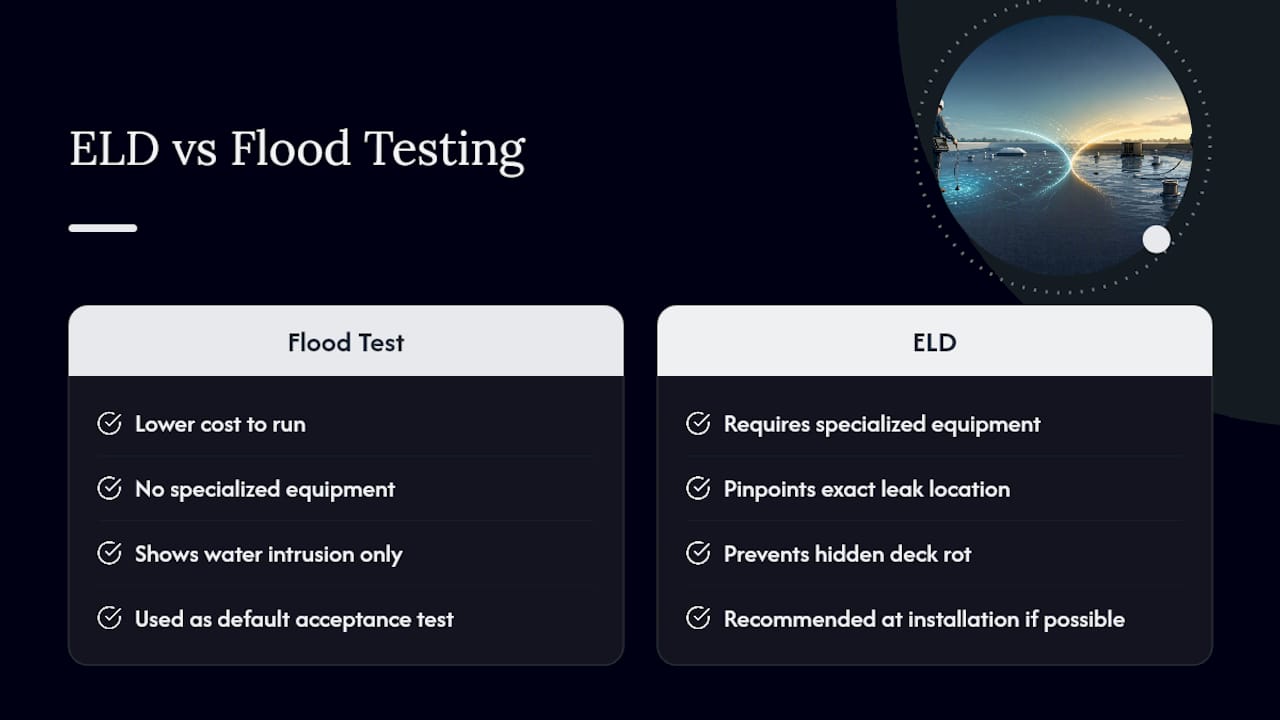
Most roofers still sell flood testing as the default acceptance test, mainly because it’s cheaper to run and doesn’t require specialized equipment. That’s backward for anything with a manufacturer warranty riding on it. A flood test tells you water got in somewhere on a section; ELD tells you exactly where, before the deck rots underneath it.
Our position on Central Florida projects: if the assembly supports it, we push for ELD at installation, not just after a leak call comes in.
Get Your Roof Tested and Repaired the Right Way
Thomas Roofing and Repair coordinates the full process so property owners in Central Florida aren’t left managing separate testing crews and repair contractors. We inspect the roof, arrange the appropriate ELD method for your assembly, and move straight into targeted repair and retest once breaches are confirmed.
That single point of contact matters most on jobs where overburden, tight access, or a warranty deadline complicates scheduling; follow these temporary roof leak fixes to manage leaks before professional repairs are arranged. A typical service call starts with an inspection to confirm the roof meets ELD prerequisites, then we walk you through method selection, cost factors, and a documentation package suited to your insurance carrier or manufacturer warranty. If we’re coordinating a new install, testing gets built into the installation process itself rather than bolted on afterward. Ready to see if your roof qualifies? Request a roof installation estimate and we’ll walk you through what testing looks like for your specific assembly.
Frequently Asked Questions
Does electronic leak detection work on every roof type?
No. It requires a conductive substrate and a membrane that isn’t itself conductive. Conductive black EPDM and heavily insulated decks need a modified approach or added conductive media to produce valid results.
How is ELD different from flood testing?
Flood testing shows that water entered a general area over time. ELD pinpoints the exact breach location using electrical conductance, which means repairs target the actual hole instead of an entire suspect zone.
Can ELD test through green roof overburden?
Generally no. Overburden interrupts the electrical path and produces inconclusive readings. Testing before overburden installation, per industry guidance, gives far more reliable results.
How long does an ELD survey take?
It depends on roof size, method, and site access. Open commercial fields scan efficiently with EFVM; forensic surveys chasing a specific leak often take longer per square foot because technicians test multiple suspect zones in detail.
Should I request a copy of the calibration certificate?
Yes, always. A report without documented calibration and sensitivity data isn’t defensible for warranty claims, and false claims in this industry usually trace back to skipped calibration steps.
Sources
Specify testing against ASTM D7877 for general electronic leak detection methods and ASTM D8231 for low-voltage scanning platforms. IIBEC’s technical advisory adds practical guidance on training and design coordination. Reference all three directly in test specifications and repair contracts, not just in general correspondence.
- D7877 Standard Guide for Electronic Methods for Detecting and Locating Leaks in Roofing and Waterproofing Membranes
- Electronic Leak Detection | IIBEC technical advisory
- Electronic leak detection facts, physics, and false claims | Detec Systems