
Ponding water is a problem when it sticks around, not just when it shows up. The industry benchmark is the 48-hour rule: if water is still sitting on your flat or low-slope roof two full days after rain, under otherwise normal drying conditions, that’s ponding, not just wetness. Repeat or persistent ponding in the same spot means action, not patience. Here’s what to do before you read another word:
- Photograph the pooled area and measure its approximate depth with a tape measure or yardstick.
- Clear any visible debris from drains, scuppers, and gutters right now.
- Mark the waterline with chalk or tape so you can check it again in 48 hours.
Key Takeaways
Ponding that lasts more than 48 hours after rain signals a drainage or slope problem that gets more expensive the longer it’s ignored.
| Point | Details |
|---|---|
| Use the 48-hour rule | Mark the waterline after rain; water still standing two days later counts as ponding, not normal drying. |
| Match the fix to the cause | Clogged drains need clearing; sagging decks or missing slope need tapered insulation or structural review. |
| Weigh the added load | One inch of standing water adds about 5.2 pounds per square foot, which compounds fast on a growing pond. |
| Escalate at the right threshold | Ponds over 3 inches, growing footprints, or visible deflection call for a structural engineer, not just a roofer. |
| Get a documented assessment | Thomas Roofing and Repair provides drain maps, elevation data, and cost estimates so remediation decisions rest on real numbers. |
Table of Contents
- What Counts as Roof Ponding Water and Why 48 Hours Matters
- Common Causes Behind Water Pooling on Rooftops
- The Real Damage Ponding Water Does to a Roof
- How to Inspect and Document Roof Water Damage
- Fixing Roof Ponding: From Quick Maintenance to Permanent Repair
- Roofer or Engineer? Knowing Who to Call
- What a Proper Roof Inspection Report Should Include
- The Overlooked Part of Ponding Water Nobody Talks About
- Get a Documented Ponding Assessment From Thomas Roofing and Repair
- Sources
What Counts as Roof Ponding Water and Why 48 Hours Matters
The 48 hour threshold isn’t arbitrary. It’s the point at which most industry groups, including the Asphalt Roofing Manufacturers Association, say water pooling on a rooftop has stopped being incidental and started being a drainage failure. Model building codes and NRCA guidance point to a minimum slope of 1/4 inch per foot as the baseline for positive drainage. Below that slope, water has nowhere to go and gravity simply loses.
There are legitimate exceptions. Blue roofs and other engineered stormwater retention systems are designed to hold water temporarily by intent, and vegetative or ballasted roofs behave differently than a standard membrane. If your roof wasn’t built as one of those systems and water is still standing after two dry days, you’re looking at a flat roof drainage issue, not a feature.
Common Causes Behind Water Pooling on Rooftops
Most roof water retention problems trace back to one of a handful of culprits, and they split into two categories: the ones you can fix with a hose and a Saturday, and the ones that need a professional to diagnose properly.
Maintenance-level causes:
- Clogged drains, scuppers, or strainers packed with leaves, granules, and windblown debris
- Sediment buildup that slows drainage even when the drain itself isn’t fully blocked
Design and structural causes:
- Insufficient slope or missing tapered insulation from the original installation
- Insulation that’s been compacted or crushed under HVAC units, generators, or repeated foot traffic
- Deck deflection, where the roof structure itself has started to sag under sustained load
- Drains placed in the wrong location relative to the roof’s actual low points, or rooftop equipment blocking natural flow paths
The first group is a maintenance call. The second group is a conversation about the roof’s underlying geometry, and that distinction shapes almost everything else in this article.
The Real Damage Ponding Water Does to a Roof
Standing water doesn’t just sit there looking bad. It actively works against the roof system in ways that compound over time. Membrane material ages faster under constant moisture and UV exposure at the water’s edge, and repeated wet/dry cycling stresses seams until they start to fail. Insulation beneath the membrane absorbs moisture it was never designed to hold, and once it’s saturated, it loses thermal efficiency long before anyone sees a drip inside the building.

One inch of standing water adds roughly 5.2 pounds per square foot of load to the roof deck. That sounds modest until you multiply it across a 10,000 square foot commercial roof and realize you’re carrying an extra 26 tons that the original structural design never accounted for. That added weight can accelerate deflection in a deck that’s already sagging, and the deeper the pond, the deeper it can get, since a slightly lower spot collects slightly more water, which adds slightly more weight, which lowers the spot further.
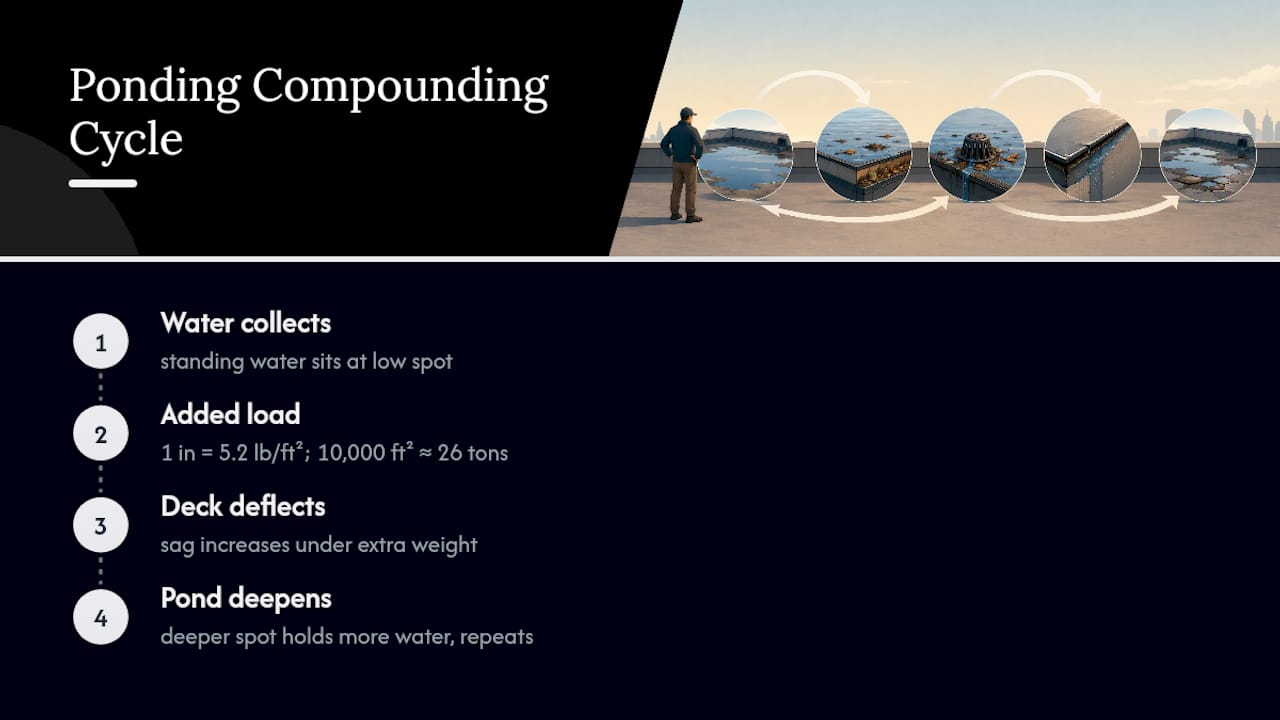
Ponding also invites algae, moss, and windblown seeds. A green ring around a low spot is not cosmetic. It’s a sign that water has been sitting long enough to support biological growth, and it usually means the ponding has been happening for months, not days.
How to Inspect and Document Roof Water Damage
A useful inspection starts inside the building, not on the roof. Walk the top floor and look for water stains, discoloration, or soft spots in ceiling tiles before you climb up. Interior leak mapping tells you where water is actually getting through, which often doesn’t match where it’s pooling on the surface.
Once you’re on the roof, work through this sequence:
- Check drain bowls and scuppers first. Look for standing debris, rust, or gaps between the drain and the membrane.
- Look for tide lines. Dirt rings or discoloration around a pooled area show you how large the pond gets at its worst, even if it’s partially drained the day you inspect.
- Note algae rings and membrane condition. Blistering, cracking, or granule loss near a pond edge signals accelerated wear.
- Mark the waterline with chalk or tape during or right after a rain event, then return in 48 hours to see how much, if any, water remains.
- Use a laser level and grid pattern for a more precise reading. Professionals commonly measure elevations at set intervals to map exactly where the roof deck dips relative to the drains.
- Consider infrared thermography or core sampling if you suspect saturated insulation beneath an intact-looking membrane. Measurement methods like these confirm what a visual check alone can’t.
The depth and duration you measure should drive your next move, not just your gut feeling about how bad it looks.
| Pond Depth / Duration | Signal | Recommended Action |
|---|---|---|
| Under 1 inch, gone within 48 hours | Normal drainage lag | Monitor, recheck after next rain |
| 1 to 3 inches, or recurring in the same spot | Drainage or slope issue developing | Schedule a professional evaluation |
| Over 3 inches, growing pond area, or visible deflection | Structural or safety concern | Treat as urgent, involve an engineer |
That severity scale mirrors the decision framework most roofing professionals use to triage which roofs need a truck this week versus which ones need a plan for next quarter.
Fixing Roof Ponding: From Quick Maintenance to Permanent Repair
Not every ponding problem needs the same fix, and matching the scope of the repair to the actual cause saves money and prevents redoing work later.
Low-cost, immediate steps handle the maintenance-level causes:
- Clear drains, scuppers, and strainers of debris
- Install drain domes or upgraded strainers to keep them clear longer
- Remove accumulated sediment and organic growth
- Set up a temporary pump if water is actively threatening interior spaces during an active repair
Medium-cost corrections address minor slope or geometry problems:
- Add crickets or saddles to redirect water around rooftop equipment
- Install localized tapered insulation to eliminate a specific low spot
- Re-slope a section with rigid tapered boards
- Relocate or resize scuppers that were never positioned at the roof’s true low point
Higher-cost, permanent solutions solve structural or design-level ponding:
- A full tapered insulation retrofit across the entire roof plane
- Additional internal drains where the original drainage design was simply insufficient
- Full membrane replacement paired with corrected slope
- Structural reinforcement where deck deflection has progressed
Pro Tip: Don’t patch a membrane over a roof that still has a slope problem. A new membrane on a low spot just gives you a newer surface for the same water to sit on, and you’ll be back here in two or three years asking the same questions.
Tapered insulation, crickets, and correctly placed drains remain the standard long-term fix recommended by ARMA because they correct the geometry instead of masking the symptom.
Roofer or Engineer? Knowing Who to Call
A licensed roofing contractor can handle drain clearing, drain upgrades, localized tapered insulation, and membrane repair. That covers the large majority of ponding cases, especially the maintenance-driven ones.
Bring in a licensed structural engineer when you see:
- Progressive deck deflection that’s visibly worse than the last inspection
- A pond that’s growing in depth or footprint year over year
- Any concern about the deck’s ability to safely carry the added load
Reconfiguring drainage or reroofing a significant portion of the building typically requires permits, and a contractor should be able to verify the fix worked with a flood test once the work is done. On timelines: routine maintenance runs days and stays cheap, a tapered insulation retrofit runs weeks at a moderate cost, and membrane replacement paired with structural work can stretch from several weeks to a few months depending on scope.
What a Proper Roof Inspection Report Should Include
A qualified contractor doesn’t just tell you “it’s fine” or “it needs work.” A real assessment delivers a drain map, elevation grid data showing where the low spots actually sit, and a written scope of recommended repairs with cost estimates attached. Thomas Roofing and Repair documents inspections this way for Central Florida property owners, backing the work with clear guarantees and financing options so a diagnosis doesn’t sit on a shelf while the ponding gets worse. A documented report also protects you later, whether that’s with an insurer or a future buyer.
The Overlooked Part of Ponding Water Nobody Talks About
Most advice on this topic treats ponding as a binary: either it’s a problem or it isn’t. That framing misses the more useful question, which is how fast is it changing? A pond that’s been the same size and depth for three years is a different animal than one that grew an inch this year and another inch last year. The static pond is often a maintenance issue with a known ceiling. The growing pond is a structural conversation, because it means the deck itself is moving, and that’s the scenario conventional “just clear your drains” advice never quite addresses.
The other gap in typical guidance is cost sequencing. Property managers get told to fix ponding, but rarely get told to fix it in the cheapest order that actually works. Clear the drains first. Recheck in 48 hours. Only escalate to tapered insulation or structural review once you’ve confirmed the simple fix didn’t solve it. Skipping straight to a full membrane replacement because ponding looks alarming wastes money when the actual cause was a strainer full of leaves.
If there’s one thing worth prioritizing above all else, it’s measurement over instinct. A chalk mark and a return visit in two days tells you more than a worried glance at a puddle ever will.
— Results
Get a Documented Ponding Assessment From Thomas Roofing and Repair
Thomas Roofing and Repair gives Central Florida property owners something most ponding advice skips entirely: a written assessment with drain maps, elevation data, and a cost estimate tied to your actual roof geometry, not a generic recommendation. That matters when you’re deciding between a $200 drain clearing and a $20,000 tapered insulation retrofit, and you need real numbers before you commit either way.

Whether your building sits in Brevard, Volusia, or Orange County, our team inspects drains, scuppers, slope, and deck condition, then walks you through exactly what’s causing the pooling and what it costs to fix at each level, from a strainer swap to a full tapered insulation retrofit. If your roof has visible ponding right now or you’ve had recurring wet spots after every storm, request a free inspection and get a documented plan before the next heavy rain finds the same low spot.
Sources
For definitions and slope standards, see ARMA’s ponding water basics and NRCA’s guidance on roof ponding. For hands-on next steps, review Thomas Roofing and Repair’s commercial roof drainage solutions and roof inspection checklist.
- Ponding Water Basics – Asphalt Roofing Manufacturers Association (ARMA)
- Roof ponding water guide — RoofEval
- Mitigating water on roofs — GAF
- Ponding water on flat roof — The Roofing Brief