
Water sitting on your flat roof for more than 48 hours after the rain stops is what the roofing industry defines as ponding, and it is a real problem, not a cosmetic nuisance. Go up and check it today.
- Measure the depth with a tape measure or ruler at the deepest point.
- Photograph it with a timestamp, then check again in two days.
- Clear visible debris from drains and strainers before you do anything else.
Pro Tip: Standing water weighs about 5.2 pounds per square foot for every inch of depth. A pond about 2 inches deep across a 20 by 30 foot section adds significant weight to your roof deck. If you see any sag near the puddle, back off the roof and call a professional.
Key Takeaways
Flat roof ponding that persists 48 hours or longer after rainfall signals a drainage failure that worsens with every cycle of added weight and delayed repair.
| Point | Details |
|---|---|
| Know the 48-hour rule | Water still standing 48 hours after rain, with no new precipitation, counts as ponding by industry definition. |
| Watch the weight | Each inch of standing water adds about 5.2 pounds per square foot, accelerating structural deflection. |
| Fix drainage before materials | Clearing drains and restoring slope solves the root cause; coatings alone only protect the membrane. |
| Know your escalation triggers | Repeated ponding, half-inch-plus depth, or visible sagging all mean it’s time to call a professional. |
| Get a professional assessment | Thomas Roofing and Repair inspects drainage, insulation, and slope, then scopes tapered insulation or drain corrections when ponding is structural. |
Table of Contents
- What Flat Roof Ponding Actually Means (And a Test You Can Run Yourself)
- Why Is Water Pooling on Your Flat Roof?
- The Long-Term Damage Ponding Water Causes
- When to Call a Roofing Professional
- Fixing and Preventing Flat Roof Ponding: A Step-by-Step Approach
- What a Professional Ponding Inspection Looks Like
- Tracking Ponding Over Time Instead of Guessing
- Budgeting for Ponding Repairs Before They Become Emergencies
- Choosing Roofing Materials That Resist Ponding
- Two Ponding Scenarios and How They Get Resolved
- What Most Ponding Advice Gets Backward
- Get Standing Water Off Your Roof for Good
- Sources
What Flat Roof Ponding Actually Means (And a Test You Can Run Yourself)
Roofers don’t call every puddle “ponding.” The industry threshold is 48 hours: if water is still sitting on your roof two full days after the last rain, with no new precipitation in between, that’s ponding. Water that drains within a day is just normal short-term pooling on a roof doing its job.
Here’s a field test any homeowner can run safely from a ladder or roof hatch, without walking onto a wet or slippery surface unnecessarily:
- Mark the puddle’s edge with chalk or tape right after a rain.
- Return in 48 hours and note whether the water line has moved.
- Measure the depth with a level laid across the puddle and a tape measure dropped to the deck.
- Photograph the puddle next to the tape measure for a dated record.
Anything deeper than about half an inch that’s still there after two days is generally treated as a defect worth addressing, not a quirk of the weather.
Why Is Water Pooling on Your Flat Roof?
Most flat roof drainage issues trace back to one of five root causes, and figuring out which one you’re dealing with determines whether this is a Saturday afternoon fix or a call to a structural engineer.
- Blocked or undersized drains. Leaves, granules, and roofing debris choke strainers, and some older buildings simply have too few drains for the roof area they serve.
- Lost or insufficient slope. Flat roofs still need drainage, and building codes typically call for a minimum of 1/4 inch of fall per foot. Re-roofing over old layers without correcting slope is a common way that fall disappears over time.
- Structural deflection. Aging trusses or joists sag under years of load, creating a bowl in the deck that no amount of drain cleaning will fix.
- Compressed or waterlogged insulation. Insulation boards crush under foot traffic or rooftop equipment, or they absorb water and never fully dry, both of which create low spots.
- Rooftop obstructions. HVAC units, satellite dishes, and even solar mounts installed without accounting for water flow can dam water against curbs and parapets.
Pro Tip: If the ponding is one small, isolated puddle near a drain, suspect a clog. If it’s a broad, shallow lake covering a third of the roof, suspect structural deflection or lost slope instead, and treat it as a bigger project.
The Long-Term Damage Ponding Water Causes
A puddle that never quite dries out does more than look bad. It actively works against your roof membrane, your insulation, and eventually your building’s frame.
Asphalt and modified bitumen membranes lose plasticizing oils when they sit under standing water, which makes the surface brittle and prone to cracking at seams. Insulation board that stays wet loses R-value permanently once it’s saturated, and that moisture often migrates into the building before anyone notices a ceiling stain. The structural math is unforgiving: each inch of ponded water adds roughly 5.2 pounds per square foot, and that added weight can deepen the depression it’s sitting in, which holds more water, which adds more weight. Engineers call this progressive deflection, and left unchecked it’s a cycle that ends with a sagging deck or worse.
- Repeated freeze-thaw cycles crack membranes from the inside out in colder climates.
- Standing water breeds algae and moss, which trap moisture against the surface even longer.
- Wet, slippery roof surfaces become a slip hazard for maintenance crews.
- Every month ponding continues, the eventual repair moves further from “patch and monitor” and closer to “replace the section.”
When to Call a Roofing Professional
Some ponding situations are a weekend fix. Others are a sign your roof structure needs an engineer’s eyes on it before anyone touches the membrane. Here’s how to tell the difference.
Call a professional when you see:
- Ponding that’s still visible 48 hours or more after rain, on more than one occasion.
- Standing water deeper than half an inch anywhere on the roof.
- Visible sagging, a soft spot underfoot, or a ceiling stain inside the building below.
- The same puddle reappearing in the same spot after every rain, no matter how often you clear the drains.
Before the contractor arrives, put together a simple packet that saves everyone time on-site:
- Dated photos of the ponding at its worst and after it should have drained.
- Depth measurements from your field test.
- Any history of roof replacement, recoating, or added equipment.
- Notes on where HVAC units or other rooftop gear sit relative to the wet area.
A roofing contractor can usually resolve drain and slope issues directly. If the ponding is widespread and traces back to deck deflection, a structural assessment becomes necessary before any membrane work makes sense, because coating over a sagging deck just delays the real fix.
Fixing and Preventing Flat Roof Ponding: A Step-by-Step Approach
Not every ponding problem needs the same level of intervention. Work through these in order, from cheapest to most permanent, and stop once the puddle actually stays gone.
Start immediate maintenance today. Clear drains and strainers of leaves and grit, confirm HVAC condensate lines aren’t dumping extra water onto the roof surface, and sweep off loose debris that’s damming water in low spots. This alone resolves a disproportionate share of ponding complaints.
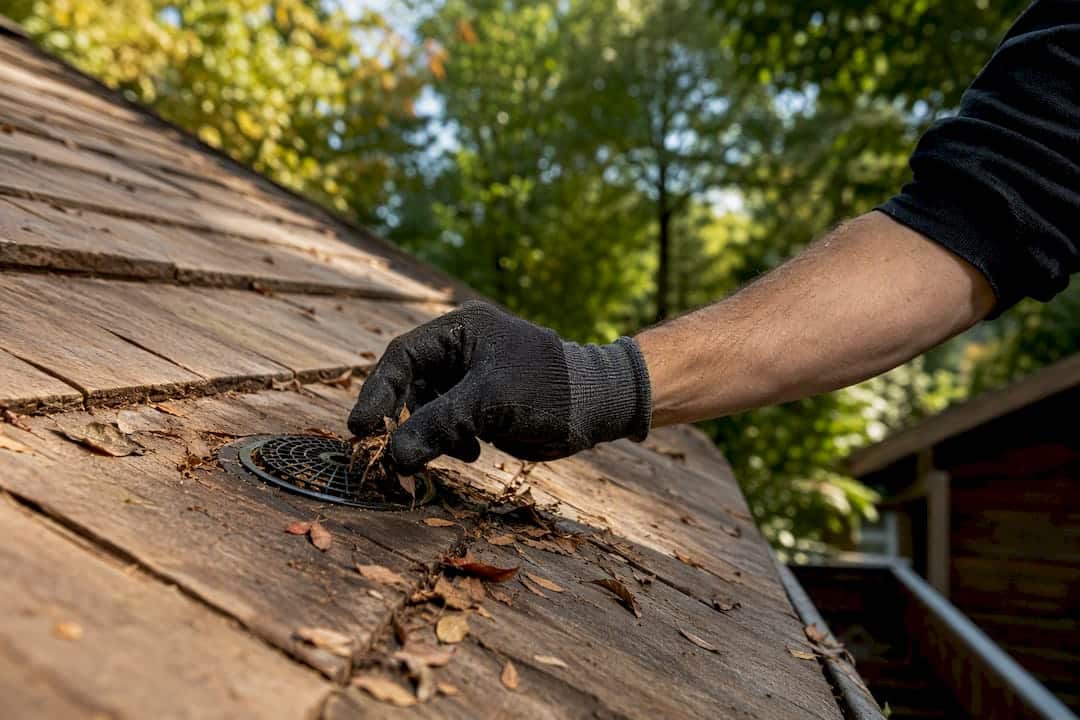
Move to emergency measures if water is already sitting. A submersible pump or a temporary sump can pull standing water off the roof fast, and a properly applied temporary patch can stabilize a small depression until permanent work is scheduled. Our emergency roof repair workflow covers what a same-day response actually looks like.
Plan permanent correction once the pattern is clear. This usually means adding or repositioning drains and scuppers, or installing tapered insulation panels built up in graduated thicknesses to restore the quarter-inch-per-foot slope the deck lost. Crickets, which are small tapered saddles built around obstructions like HVAC curbs, redirect water that would otherwise dam up. Where re-sloping isn’t feasible, a silicone coating rated for continuous ponding can protect the membrane, though it treats the symptom rather than the drainage failure itself.
| Fix Type | Typical Cost Range | Best For |
|---|---|---|
| Drain/strainer cleaning | Low | Isolated puddles near a single drain |
| Temporary patch or pump | Low to moderate | Active leak or emergency depression |
| Tapered insulation/crickets | Moderate to high | Widespread ponding from lost slope |
| Additional drains/scuppers | Moderate | Undersized drainage for roof area |
Pro Tip: Set a quarterly reminder to walk the roof and check every drain, plus one extra walk within 48 hours of any major storm. This cadence catches most drainage problems before they become standing water.
What a Professional Ponding Inspection Looks Like
A thorough inspection follows a specific sequence, and knowing it helps you evaluate whether a contractor is doing a real assessment or just glancing at the roof.
- Run a drain flow test, timing how fast water clears to establish a baseline against future checks.
- Map every puddle location and measure depth, cross-referencing against the roof’s slope design.
- Inspect the membrane and probe insulation for saturation near ponded areas.
- Build a dated photo log tied to each measurement for the file.
Thomas Roofing and Repair performs this kind of inspection across Central Florida, and depending on what we find, the scope of work can range from a straightforward roof inspection to tapered insulation and drain correction during a larger roof replacement. Whatever the fix, ask for a written scope that names the drainage correction specifically, not just “recoat and monitor,” and confirm the warranty covers the corrected area under continued exposure.
| Inspection Step | What It Reveals |
|---|---|
| Drain flow test | Whether outlets are undersized or clogged |
| Puddle mapping | Whether the problem is localized or structural |
| Membrane/insulation probe | Hidden saturation and R-value loss |
| Photo log | A dated record for warranty and insurance purposes |
Tracking Ponding Over Time Instead of Guessing
A single inspection tells you what’s happening right now. It doesn’t tell you whether the problem is stable or getting worse, and that distinction changes how urgently you need to act.
The simplest monitoring system is a logbook, digital or paper, where you record puddle location, depth, and the date after every significant rain. Over two or three storm cycles, a pattern emerges. If the same puddle shows up in the same spot at roughly the same depth every time, you’re likely looking at a fixed slope or drainage issue that a targeted repair will solve. If the depth is increasing or the puddle is spreading to new areas, that’s the signature of progressive structural deflection, and it belongs in front of a professional sooner rather than later.
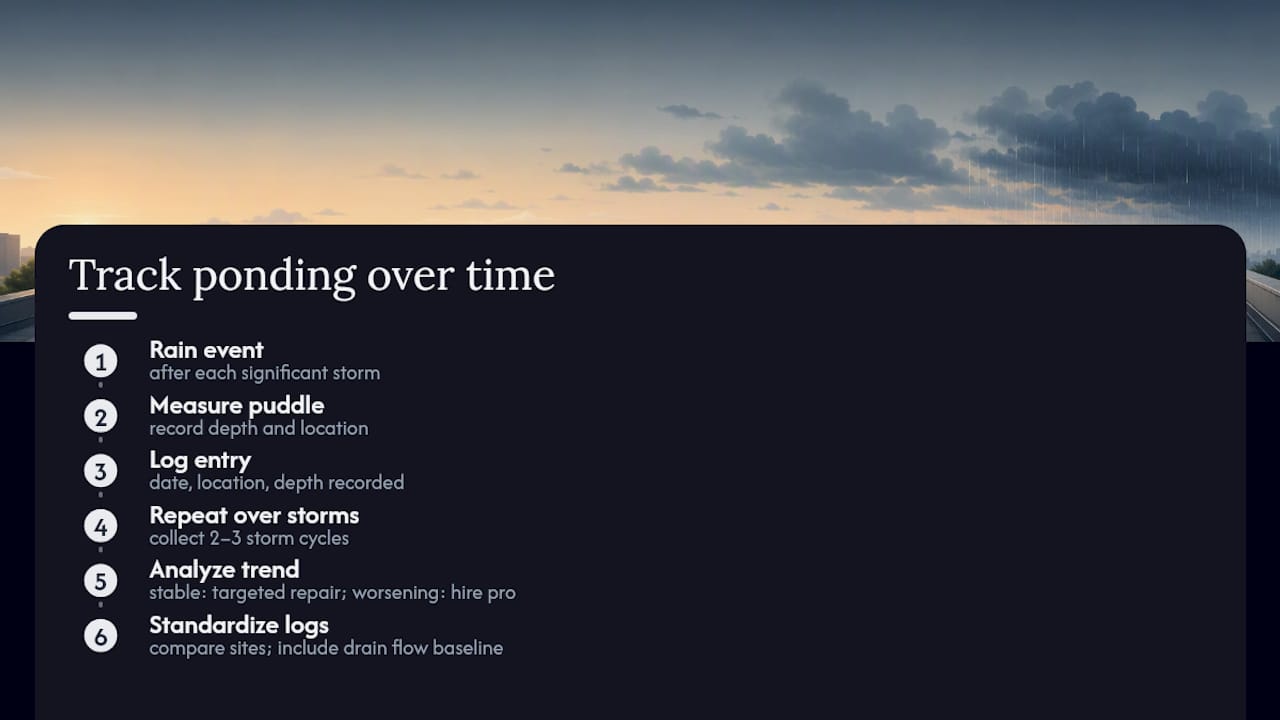
Property managers overseeing multiple buildings benefit from standardizing this log across properties, since it turns a subjective “the roof looks wet again” into comparable data across sites and seasons. Include the drain flow baseline from your last professional inspection in that same file. A flow rate that’s dropped noticeably from the baseline, even before visible ponding worsens, is an early warning that a drain is silting up or a strainer needs clearing.
For commercial properties with multiple roof sections, this kind of tracking also supports capital planning. Knowing which roof section has ponded in three of the last four storms, versus one that’s ponded once, tells you where to prioritize the next budget cycle. It turns roof maintenance from a reactive scramble after every storm into a plan you control on your own schedule.
Budgeting for Ponding Repairs Before They Become Emergencies
The cost of fixing ponding water scales directly with how long you wait, which makes budgeting for it early one of the more useful things a property owner can do. A cleared drain and a sweep of debris costs next to nothing and often solves the problem outright. Once ponding has caused membrane damage or saturated insulation, you’re looking at a section repair. Once it’s caused structural deflection, you’re into a much larger conversation involving deck reinforcement or full replacement.
Smart budgeting means separating routine maintenance from capital repair. Routine maintenance, drain clearing, strainer checks, minor debris removal, should be a small recurring line item, ideally scheduled quarterly. Capital repairs, tapered insulation, new drains or scuppers, membrane replacement over a corrected slope, are larger, less frequent expenses that are easier to plan for when you’re not also dealing with an active leak.
Insurance sometimes covers storm-related ponding damage but rarely covers ponding caused by design flaws like insufficient slope, since that’s treated as a pre-existing condition rather than storm damage. That distinction matters when you’re filing a claim, and it’s worth clarifying with your adjuster before repairs begin rather than after. For property owners weighing a full recovery, our storm damage repair guide walks through how insurance and timing interact.
Financing exists for property owners who need to move on a larger correction, like tapered insulation across an entire roof section, without waiting for a full capital budget cycle to catch up. Getting a written scope with itemized costs upfront makes that financing decision easier and keeps you from paying twice for a repair that only addresses symptoms the first time around.
Choosing Roofing Materials That Resist Ponding
Not every low-slope roofing material handles standing water the same way, and picking the right one matters if ponding has been a recurring issue on your property.
TPO and PVC single-ply membranes handle occasional ponding reasonably well thanks to heat-welded seams that resist the seam stress ponding causes on older systems, though manufacturers still specify a slope target rather than approving indefinite ponding. Modified bitumen performs adequately in dry conditions but is more vulnerable to the oil leaching and brittleness that standing water accelerates over time. Built-up roofing (BUR), the multi-ply asphalt and gravel system common on older commercial buildings, tends to hold water in the gravel ballast, which can mask ponding until a probe reveals saturated felts underneath.
Silicone-coated systems stand out as the one category manufacturers explicitly rate for continuous ponding exposure in some formulations, making them a reasonable choice when re-sloping the whole deck isn’t practical. Even then, a coating is protecting the membrane from water damage, not eliminating the drainage failure that put the water there. If you’re re-roofing a section that has ponded repeatedly, that’s the moment to specify tapered insulation underneath the new membrane rather than simply matching what failed before, a detail our roof installation best practices guide covers for property owners planning a full replacement. For a lower-cost building envelope perspective on low-slope material choices generally, Smart Roofing & Restoration’s low-slope guidance is a useful outside reference.
Two Ponding Scenarios and How They Get Resolved
A single clogged drain on a small residential flat roof addition is the most common ponding call. Debris builds up in one strainer over a season, water backs up behind it, and the fix is a fifteen-minute cleaning plus a strainer guard to prevent the repeat. No slope correction, no structural review, just routine maintenance that should have happened on the quarterly schedule in the first place.
A more involved case looks like a commercial building where ponding has been showing up in the same broad area for several years, moved on by successive owners who each recoated the surface without asking why the water kept returning. A drain flow test and puddle mapping across that section typically reveals either an original slope that never met the quarter-inch-per-foot standard, or insulation that’s compressed unevenly under years of rooftop foot traffic. The lasting fix in that scenario is tapered insulation installed to correct the slope during the next re-roof, not another coating cycle. The pattern holds across both scale extremes: small, isolated ponding usually means a maintenance gap, while recurring, widespread ponding almost always points back to a design or structural issue that a coating alone won’t solve.
What Most Ponding Advice Gets Backward
Most articles on this topic lead with materials, coatings, membranes, sealants, as if the fix starts with what’s on top of the roof. It doesn’t. Ponding is a drainage failure first, and every credible technical source treats it that way. A brand-new silicone coating over a roof that still has no positive slope will pond again, because the coating never addressed why the water stopped moving in the first place.
The bigger blind spot is how homeowners read isolated versus widespread ponding. A single puddle near one drain feels alarming, but it’s usually the cheapest problem you’ll ever have on a flat roof, a clogged strainer, fifteen minutes, done. A shallow lake spread across a third of the roof feels less dramatic because there’s no single obvious cause, and that’s exactly why it gets ignored longest. That’s backward. Broad, low-depth ponding is far more likely to mean structural deflection than a single deep puddle ever is.
If you take one thing from this, prioritize documentation over speculation. A photo log and a depth measurement taken consistently over two or three storms tells you more than any guess about whether you’re dealing with a maintenance item or a structural one, and it makes a professional’s job faster and cheaper when you do call.
— Results
Get Standing Water Off Your Roof for Good
Coatings and patches can buy time, but they don’t fix a roof that was never sloped right in the first place, and that’s the gap Thomas Roofing and Repair closes for property owners across Central Florida. We inspect the drainage system, measure the actual slope against the quarter-inch-per-foot standard, and scope tapered insulation or drain corrections that solve the problem at the source instead of masking it for another storm season.

If your roof has ponded more than once, or you’ve inherited a building with a recoating history and no clear fix, our emergency roof repair workflow covers urgent situations, and financing is available for larger corrections like full tapered insulation installs. Request a free roof inspection and get a written scope that names the actual fix, not just another coat, before your next storm cycle tests the same low spot again.
Sources
- Effects of Ponding Water on Low-Slope Roof Systems (ARMA / technical bulletin)
- Managing Ponding Water on Flat Roof: Causes and Solutions (Polyglass)
- Why does my roof pond? (IIBEC)
- Ponding Water on Commercial Roofs: Causes, Costs, and Permanent Solutions (Certified Roofing Inc.)