
Roof decking is the unsung foundation of every roofing system, yet most Central Florida homeowners never think about it until something goes wrong. It sits between your rafters and your shingles, quietly holding everything together through summer downpours, tropical storms, and the relentless humidity that defines life in Brevard, Volusia, and Orange counties. Choosing the wrong decking material can mean leaks, structural failure, and insurance headaches after just one bad storm season. In this guide, we break down what roof decking is, how the two main materials compare, what proper installation looks like, and which choice makes the most sense for your Central Florida property.
Table of Contents
- Understanding roof decking: What it is and why it matters
- Types of roof decking: Plywood vs. OSB for Florida homes
- Roof decking installation and maintenance essentials
- How to choose: Recommendations for Central Florida properties
- Why most Florida roof projects go wrong—and what savvy owners do differently
- Ready to upgrade your roof? Trust Central Florida’s experts
- Frequently asked questions
Key Takeaways
| Point | Details |
|---|---|
| Roof decking is crucial | It forms the backbone of your roof, directly affecting your home’s safety and storm resistance. |
| Plywood outperforms OSB in Florida | CDX plywood withstands humidity and hurricanes better, even though it costs more than OSB up front. |
| Installation and code matter | Proper installation and compliance with wind codes increase safety and insurance eligibility. |
| Inspect often | Annual and post-storm inspections can catch decking issues early, saving big on repairs. |
Understanding roof decking: What it is and why it matters
Roof decking, sometimes called roof sheathing, is the flat panel layer nailed directly to your roof’s rafters or trusses. It forms the rigid surface onto which your contractor applies underlayment, waterproofing membranes, and finally your shingles or tiles. Think of it as the subfloor of your roof. Without it, there is nothing solid to anchor the rest of the system.
Beyond just providing a nailing surface, decking distributes the weight of your entire roof assembly evenly across the structural frame. It also transfers wind loads and impact forces down into the walls and foundation. In Central Florida, where roof decking function means it “provides structural support and acts as a crucial base for waterproofing,” this load-bearing role is not optional. It is the difference between a roof that survives a Category 2 storm and one that peels away.
Florida’s climate creates specific threats that make decking quality especially important. High humidity accelerates wood decay. Frequent afternoon thunderstorms push water into the smallest gaps. Hurricane-force winds create uplift pressure that tries to rip the entire roof assembly off the structure. If your decking is compromised in any of these ways, every layer above it becomes vulnerable.
Common decking problems Central Florida homeowners face include:
- Moisture absorption and rot from persistent humidity or slow roof leaks
- Warping and delamination when panels expand and contract through wet and dry cycles
- Pest intrusion, particularly from termites and carpenter ants that tunnel into weakened wood
- Mold and mildew growth that weakens the wood fibers over time
- Nail pull-through when softened decking can no longer hold fasteners securely
“Decking is where your roof’s durability actually starts. If it fails, no amount of premium shingles or high-end underlayment will save you from leaks, structural damage, or insurance claim denials.” — Experienced Florida roofing professional
Insurance companies in Florida are also paying closer attention to decking. Many policies now require proof that decking meets current wind uplift standards before they will write or renew a policy. Getting this layer right from the start protects your coverage, not just your home.
Types of roof decking: Plywood vs. OSB for Florida homes
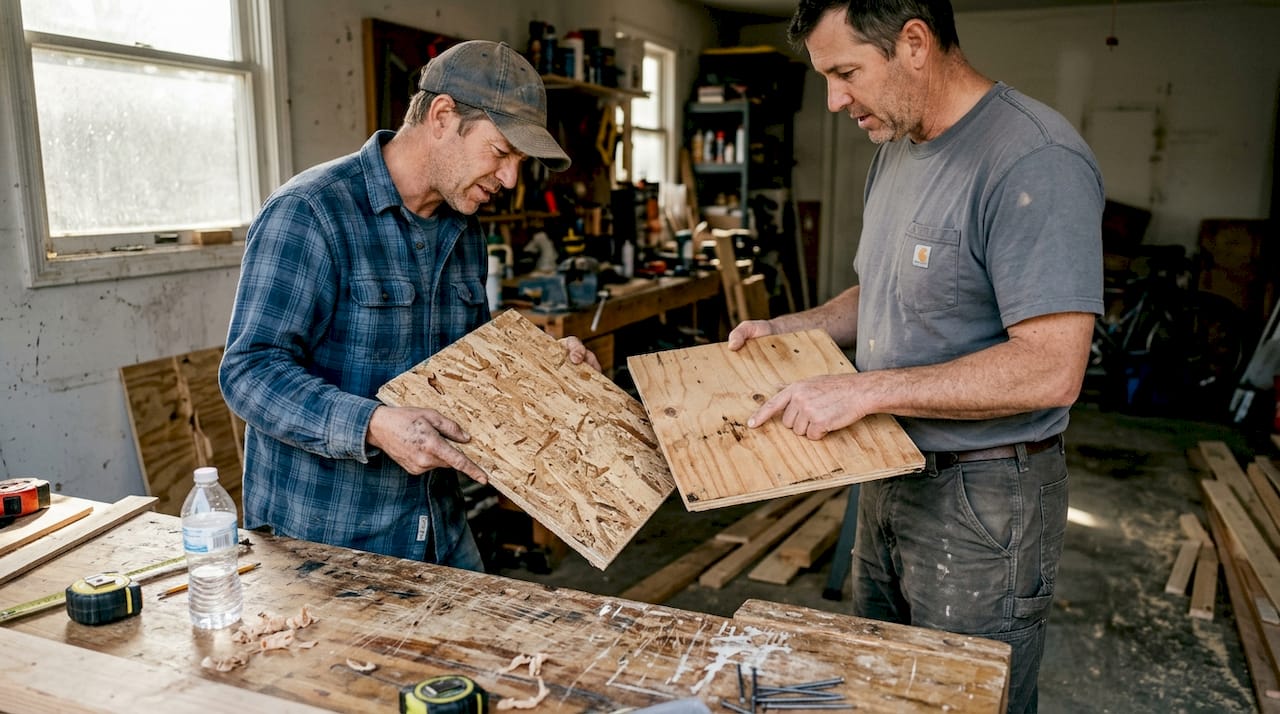
With a clear picture of why decking matters, let’s look at the materials Central Florida homeowners need to consider. The two dominant options are CDX plywood and oriented strand board, commonly called OSB. Both are engineered wood panels, but they behave very differently under Florida conditions.
CDX plywood is made from thin wood veneers glued together in alternating grain directions. The “C” and “D” refer to the grades of each face, and the “X” means it uses exterior-grade adhesive. That glue is the key. It holds the layers together even after repeated exposure to moisture, which is exactly what you need in a climate like ours.
OSB is made from compressed wood strands and resin. It is strong, consistent, and less expensive than plywood. In dry climates, it performs well. But OSB absorbs moisture at its edges and cut ends much faster than plywood does, and once it swells, it rarely returns to its original shape. In Central Florida’s humidity, that is a real liability.
| Feature | CDX plywood | OSB |
|—|—|—|
| Strength | High | High |
| Moisture resistance | Superior | Moderate |
| Hurricane performance | Excellent | Fair |
| Warping risk | Low | Higher |
| Expected lifespan (FL) | 25 to 30 years | 15 to 20 years |
| Cost per panel | Higher | Lower |
| Regional suitability | Best for Florida | Acceptable with precautions |
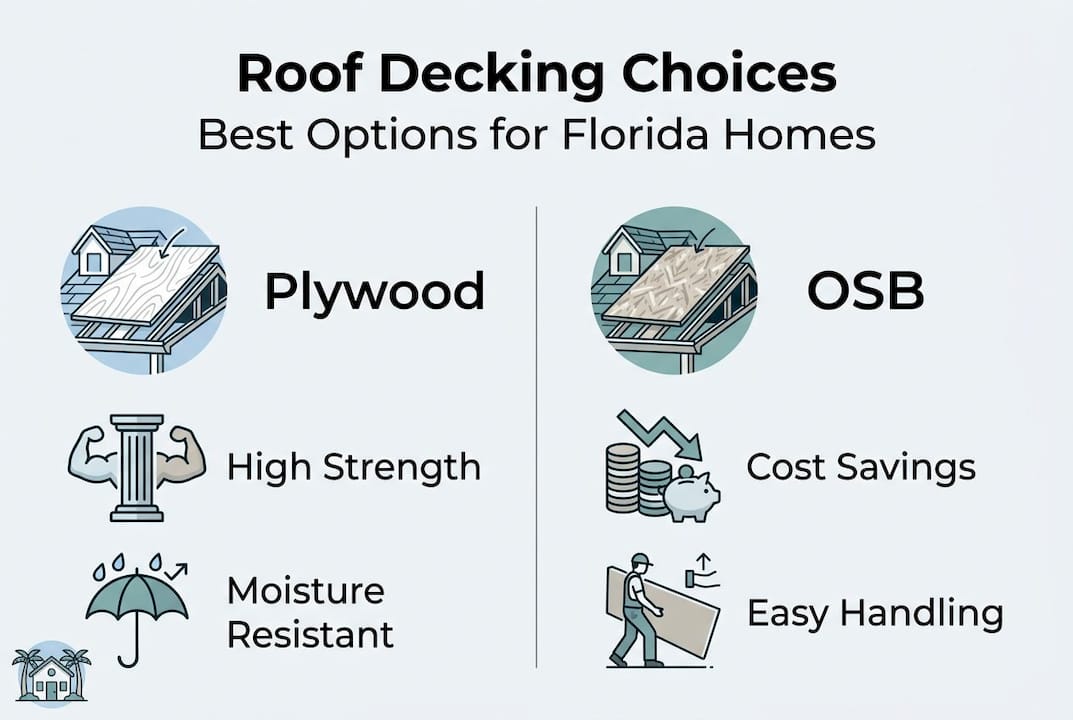
As CDX plywood is recommended for new installs and repairs in humid, hurricane-prone regions like Central Florida, most experienced roofers default to it for good reason. And while OSB carries risks in wet climates that budget-conscious installers sometimes overlook, it is not automatically disqualified.
For homeowners weighing roof replacement guidance or deciding whether to replace or repair roofs, the decking choice is one of the first conversations worth having with your contractor.
Pro Tip: If budget truly requires OSB, pair it with a high-quality peel-and-stick underlayment and make sure your attic ventilation is excellent. Cutting corners on either of those will shorten OSB’s lifespan significantly in Central Florida.
Roof decking installation and maintenance essentials
Once you’ve picked the right decking, careful installation and maintenance make all the difference. Even the best plywood panel will fail early if it is installed incorrectly or neglected after the fact.
Here is how a proper decking installation unfolds:
- Inspect the existing structure. Before any new panels go down, a qualified roofer checks rafters and trusses for damage, rot, or inadequate spacing.
- Remove damaged or outdated decking. Old, soft, or delaminated panels come off completely. Partial patches over compromised areas are a shortcut that causes problems later.
- Install new panels with proper fastening. Florida building code requires specific nail patterns and ring-shank or screw-shank nails to meet wind uplift resistance standards. Panels must be staggered and gapped slightly to allow for expansion.
- Seal edges and penetrations. All cut edges, nail heads, and any penetrations get sealed to block moisture entry before underlayment goes on.
- Apply underlayment immediately. Leaving bare decking exposed to weather, even overnight, invites moisture absorption that shortens its lifespan.
Florida’s building codes are among the strictest in the country for good reason. Most Florida experts recommend plywood for longevity given the high humidity and frequent storms, and that recommendation aligns with what the roof replacement process and roofing code standards require for wind resistance in our region.
Signs that your decking needs attention include interior ceiling leaks, visible sagging between rafters, spongy spots when walking on the roof, and any visible mold or dark staining in the attic. Catching these early saves significant money compared to addressing them after a major storm.
Pro Tip: Keep your attic vents clear year-round. Blocked soffit or ridge vents trap heat and moisture against the underside of your decking, accelerating rot even when the roof surface looks perfectly fine from the outside.
How to choose: Recommendations for Central Florida properties
With an understanding of installation and risks, here is how to make your best choice for Central Florida conditions.
For the vast majority of Central Florida homeowners and property managers, CDX plywood is the right answer. It holds up to the humidity, performs under hurricane-force wind loads, and gives you the longest service life relative to its cost over time. When you factor in avoided repairs and insurance compliance, the higher upfront price pays for itself.
| Factor | CDX plywood | OSB |
|---|---|---|
| Material cost | Higher | Lower |
| Minimum ventilation code | Required | Required |
| Expected FL lifespan | 25 to 30 years | 15 to 20 years |
| Hurricane resistance | High | Moderate |
| Insurance acceptance | Widely accepted | Varies by insurer |
OSB might be acceptable in a narrow set of circumstances:
- Tight budget projects where every dollar is accounted for and there is no flexibility
- Installations under close professional supervision with premium underlayment specified from the start
- Lower-slope sections of a roof that see less direct weather exposure
- Outbuildings or non-primary structures where the risk profile is lower
For older homes or roofs with complicated geometries, a professional consultation is not optional. Older framing may not meet current code, and the decking choice intersects with ventilation design, truss spacing, and fastener schedules in ways that require an expert eye. Roof replacement tips for Florida homeowners consistently point to getting a thorough inspection before committing to any material.
As OSB can be used with robust underlayment and excellent ventilation on a tight budget, plywood remains the preferred standard. Your insurer and your future self will thank you for choosing it.
Why most Florida roof projects go wrong—and what savvy owners do differently
After years of working on roofs across Central Florida, the pattern is clear. The projects that fail almost always trace back to one decision: skimping on decking. A homeowner chooses OSB to save a few hundred dollars, the installer skips the premium underlayment to stay on budget, and the attic vents get partially blocked during the job. Everything looks fine for two or three years. Then a tropical storm rolls through, and suddenly there is water in the living room.
We have seen the contrast firsthand. A well-installed plywood deck from the late 1990s, properly ventilated and maintained, still holding solid after multiple named storms. Right next door, an OSB deck installed just eight years ago, already soft in the corners and showing mold staining in the attic. Same neighborhood, same storms, very different outcomes.
Savvy property owners treat quality decking the same way they treat a good foundation. It is not a sunk cost. It is the reason everything else lasts. Understanding the impact of roof replacement decisions helps frame decking as the investment it truly is. When the next hurricane season arrives, and in Central Florida it always does, you want the confidence that your roof’s foundation is solid.
Ready to upgrade your roof? Trust Central Florida’s experts
Choosing the right decking material is one of the most important decisions you will make for your home’s long-term protection. Getting it right means working with professionals who understand Florida’s specific code requirements, weather patterns, and material performance.

At Thomas Roofing and Repair, we serve homeowners and property managers across Brevard, Volusia, and Orange counties with the expertise to make every layer of your roof count. Whether you need help after storm damage using our storm damage repair guide, are planning a full replacement with our roof installation experts, or just want to understand what you have with a professional roof inspection, we are ready to help. Reach out today for a free estimate and let’s make sure your decking is built to last.
Frequently asked questions
What is the main purpose of roof decking?
Roof decking provides structural support for shingles and waterproofing layers, creating the solid base that protects your home from wind, rain, and storm damage.
Is plywood or OSB better for roof decking in Florida?
Plywood, specifically CDX grade, is the preferred choice in Florida because it handles humidity, repeated moisture exposure, and hurricane-force winds far better than OSB.
How can I tell if my roof decking needs repair or replacement?
Look for interior ceiling leaks, sagging between rafters, soft or spongy spots on the roof surface, or visible rot and mold in the attic. Any of these signs means you need an inspection right away.
Does roof decking affect my homeowner’s insurance?
Yes. Florida insurers often require that decking meets current wind uplift and building code standards, and using non-approved materials can affect your coverage or result in claim denials.
How often should I inspect my roof decking?
Inspect after every major storm and at least once a year, ideally before hurricane season starts, to catch early damage before it becomes a costly structural problem.
Recommended
- Roofing Materials: Choosing Wisely in Central Florida
- Roof Replacement in Central Florida – What Homeowners Need to Know
- Roofing Materials – Protecting Your Florida Home
- Why Choose Professional Roofing for Florida Homes
- Roofing Company Orlando, FL
- Roofing Company Titusville, FL
- Roofing Company DeLand, FL