Don’t sign anything with a roofer who knocks on your door after a storm. Your first move is a phone call to your insurer and, if the roof is actively leaking, a temporary tarp from a local contractor you can verify. Watch for two specific traps: any contractor who offers to cover your deductible, and any request to sign an Assignment of Benefits form. Both are common tools storm chaser roofers use, and both can leave you legally and financially exposed long after the crew has left town.
TL;DR:
- Storm chaser roofers often arrive within 24 to 72 hours after a storm and pressure homeowners to sign contracts immediately, which is atypical for reputable local contractors.
- Offering to waive or pay your deductible is illegal in at least 28 states and can lead to insurance fraud exposure for homeowners who agree to it.
- Signing an Assignment of Benefits form transfers control of your insurance claim to the contractor, increasing the risk of claim delays, denials, or liens.
- Verifying a contractor’s license, insurance, local references, and manufacturer certifications is essential before signing any roofing contract.
- Acting quickly by rescinding within your state’s window, documenting damage, and reporting suspected fraud can protect you if you’ve contracted with storm chasers.
Table of Contents
- What Storm Chaser Roofers Actually Are
- 8 Red Flags That Signal a Storm Chaser Roofer
- Why These Tactics Put Homeowners at Legal Risk
- How to Vet Any Roofer Before You Sign a Contract
- What to Do If You Already Signed With a Storm Chaser
- Why Local Accountability Beats a Fast Knock on the Door
- A Verified Local Option When You’re Deciding Who to Call
- Where to Verify Licenses and Report Suspected Fraud
- Sources
What Storm Chaser Roofers Actually Are
A storm chaser roofer is an out-of-state or transient contractor who follows severe weather across the country, sets up shop for a few weeks, and moves on once the local market dries up. They’re not licensed local businesses with a permanent office. They’re operations built for volume and speed, not long-term accountability.
You can usually spot the operating model before you spot the pitch. Look for these signals:
- Vehicles with out-of-state license plates parked in the neighborhood
- Magnetic door signs instead of a permanent company logo
- Rental ladders and borrowed equipment rather than owned trucks and gear
- A business address that turns out to be a PO box or a hotel
- A crew that’s gone from the area within a few months
That short shelf life is the real problem. If your shingles fail in three years, the company that installed them may no longer exist in that state, and any workmanship warranty they promised is worthless. Reputable local contractors invest in permanent offices and staff because they plan to serve the same storm damage repair customers for years, not weeks.
8 Red Flags That Signal a Storm Chaser Roofer
Most predatory contractors give themselves away within the first conversation, if you know what to watch for.
- They’re on your porch within 24 to 72 hours of the storm. Legitimate local roofers are usually swamped with existing customers right after a major storm; door-to-door solicitors who show up instantly are often working off a storm-tracking app, not a service area.
- They pressure you to sign on the spot, often an Assignment of Benefits contract that hands them direct control of your insurance claim.
- They offer to pay or waive your deductible. This is one of the clearest signs of fraud in the entire industry, and it’s illegal in a growing number of states.
- They show up with out-of-state plates, magnetic signage, rental ladders, or a PO-box address instead of a verifiable local presence.
- They won’t give you a line-item estimate. A vague lump-sum number with no breakdown of materials, labor, and disposal costs is a red flag on any home improvement contract.
- They can’t produce a current Certificate of Insurance or their workers’ comp coverage has gaps, which leaves you liable if a worker is hurt on your property.
- They promise a vague “lifetime” warranty that’s never actually registered with the manufacturer.
- They ask to speak directly to your insurance adjuster or control claim payments themselves.
Pro Tip: Ask every roofer who approaches you, “How many local jobs have you completed in this county in the past three years?” A legitimate contractor answers instantly. A storm chaser fumbles, because the honest answer is zero.
Why These Tactics Put Homeowners at Legal Risk
The deductible offer that sounds like a favor is usually the first sign of trouble. Waiving or rebating a deductible is illegal in at least 28 states, and homeowners who go along with it can face insurance fraud exposure themselves, not just the contractor. Minnesota takes it a step further: contractors there who offer to cover a deductible face fines up to $10,000 per violation under state law.
Assignment of Benefits contracts create a separate problem. Signing one hands your contractor direct control over your insurance claim, including the right to bill your insurer directly and negotiate on your behalf.
Here’s what tends to happen when either tactic goes wrong:
- Your insurer flags the claim, delays payment, or denies it outright
- The contractor’s state license faces disciplinary review, but you’re still stuck with the roof
- You face civil recovery action from your insurer for the waived deductible amount
- An unpaid subcontractor files a mechanic’s lien against your property, even if you paid the general contractor in full
The National Insurance Crime Bureau tracks these schemes specifically because they spike after every major hailstorm or hurricane season.
How to Vet Any Roofer Before You Sign a Contract
Run this checklist on any contractor, storm chaser or not, before a single signature hits paper.
- Verify the state contractor license. Every state licensing board has an online lookup. Confirm the license is active, matches the business name on the estimate, and hasn’t racked up recent violations.
- Request the Certificate of Insurance directly from the insurer or broker, not from the contractor. Paperwork handed over by the roofer itself can be forged or expired, so call the issuing agency to confirm coverage limits for general liability and workers’ comp.
- Ask for three local references and actually visit the listed business address. A real office beats a phone number every time.
- Demand a line-item estimate that breaks out materials, labor, permits, and disposal, and refuse to sign any Assignment of Benefits form, no exceptions.
- Check manufacturer certification directories. GAF, CertainTeed, and Owens Corning all maintain searchable installer databases by ZIP code, which takes less than five minutes to check.
- Pull the company’s BBB profile and state attorney general complaint history before agreeing to anything.
Before you finalize anything, review the questions to ask roofers before you sign, and require photo documentation of pre-existing conditions plus proof the manufacturer warranty will be registered in your name, not the contractor’s.
What to Do If You Already Signed With a Storm Chaser
If you’ve already put your name on a contract, act fast. Most states give you a short right-of-rescission window, often three business days, so check your state’s specific rule and cancel in writing by certified mail if you’re still inside it.
- Notify your insurer immediately and disclose any deductible offer or AOB you signed
- Get an independent inspection from a local, licensed roofer to document the actual scope of damage
- Report the contractor to your state attorney general, the state contractor licensing board, the NICB, and the BBB
- Hold off on any additional payments beyond a reasonable deposit until you’ve confirmed the work matches the contract
Pro Tip: Photograph everything before any tarping or repair work starts. A time-stamped photo record is often the single most useful thing you can hand an insurance adjuster or an attorney later. For a full walkthrough of what to document and when, see this storm damage workflow guide.
Why Local Accountability Beats a Fast Knock on the Door
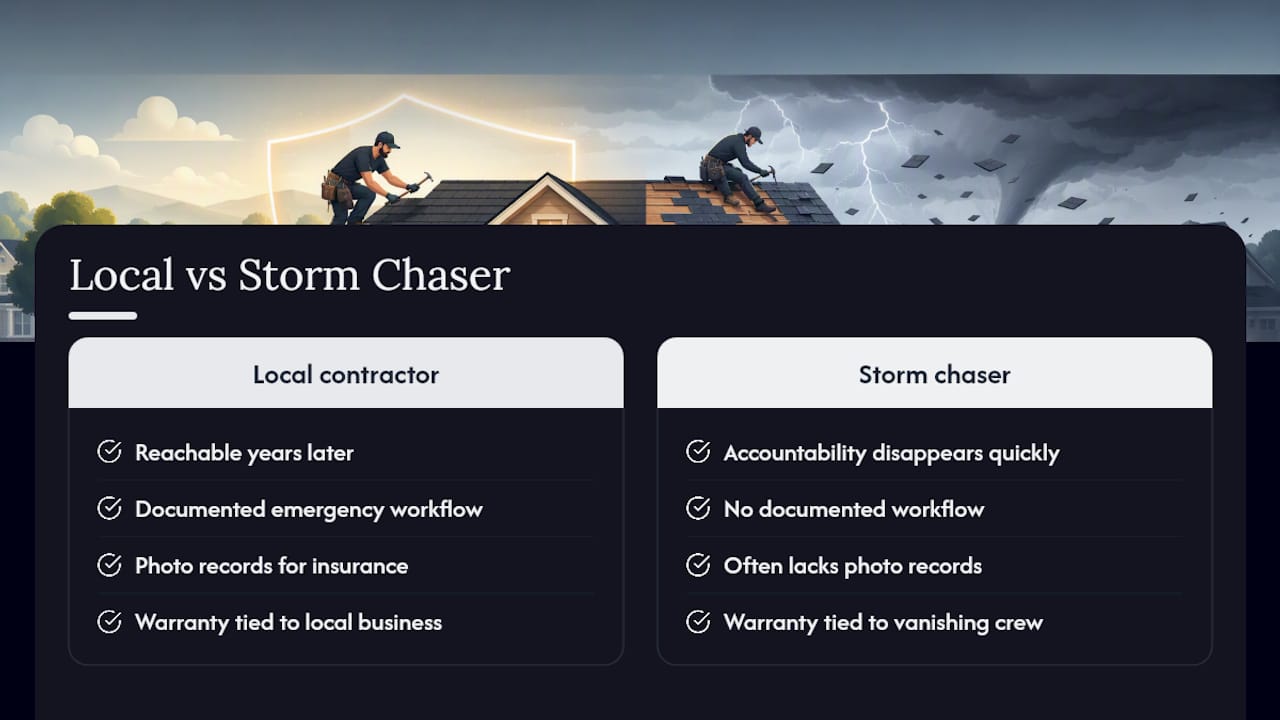
Every red flag in this article traces back to one thing: accountability that disappears once the crew leaves the county. A contractor who’s still answering the phone in three years is the one who stands behind a leak, a warranty claim, or an insurance dispute that surfaces long after the shingles go on.
Thomas Roofing and Repair runs storm response the opposite way a storm chaser does. Every job follows a documented emergency repair workflow, with photo records for your insurance file and manufacturer warranty registration tied to a permanent local business, not a magnetic sign that vanishes by fall.
— Results
A Verified Local Option When You’re Deciding Who to Call
There are other routes homeowners take after a storm: the door-to-door crew already parked outside, a national franchise dispatched from another state, or waiting weeks for whoever answers the phone first. None of those give you a contractor who’s still local when your roof needs a warranty check in year four.
Thomas Roofing and Repair works Central Florida year-round, which means the crew tarping your roof today is reachable next season if something goes wrong. The process starts with emergency tarping and temporary protection, followed by full photo documentation your insurer can actually use. There’s no Assignment of Benefits requirement here. Thomas Roofing and Repair helps homeowners work through the insurance claim process without ever taking control of your claim rights.
If your roof took a hit this season, start with the emergency roof repair workflow to get a temporary fix scheduled and a documented inspection on the calendar before you talk to anyone else.
Where to Verify Licenses and Report Suspected Fraud
A few minutes on these sites can save you thousands of dollars.
- Your state’s contractor licensing board, for active license status and disciplinary history
- Your state insurance department’s consumer division, for deductible-waiver rules and to file complaints
- The NAIC’s consumer guidance on Assignment of Benefits contracts
- The NICB’s disaster fraud reporting page, for suspected post-storm scams
- Your state attorney general’s consumer protection division, such as North Carolina’s roofer guidance, for state-specific advisories
- Manufacturer directories from GAF, CertainTeed, and Owens Corning, and your local Better Business Bureau chapter
Sources
- Can a contractor waive my deductible? — Texas Department of Insurance (consumer tips)
- Contractors and insurance deductibles — Minnesota Department of Labor and Industry
- Assignment of benefits: consumer beware — NAIC
- Disaster fraud prevention — NICB