
Walking on a tile roof breaks tiles more often than most homeowners realize, because a footstep concentrates far more force into one small spot than the roof was engineered to handle. If you have no choice but to get up there, step only on the bottom portion of each tile where it has full support, spread your weight with a plywood sheet or crawl board, and call a trained roofing professional when the job involves height, repeated trips, or equipment installation.
TL;DR:
- Walking on tile roofs can cause hidden cracks that allow water infiltration, leading to underlayment damage and potential leaks over time.
- The safest practice involves stepping only on the support zone at the tile’s headlap, spreading weight, and avoiding unsupported areas such as the center or top.
- Employing plywood sheets or crawl boards to distribute weight reduces the risk of cracking tiles during repairs or inspections.
- Foot traffic on a tile roof voids warranty coverage, making quick replacement of cracked tiles essential to prevent more extensive damage.
- Professional inspection and carefully staged access are recommended for any maintenance or work, especially on steep, aged, or weather-vulnerable roofs.
Table of Contents
- Why Tiles Crack Under Foot Traffic
- What Tile Manufacturers and TRI Recommend About Walking on Tile Roofs
- Safe Techniques for Walking on Tile Roofs When Access Is Unavoidable
- Protecting Tiles With Plywood, Crawl Boards, and Careful Staging
- OSHA Fall Protection Rules Every Homeowner Should Know Before Climbing a Tile Roof
- When to Call a Roofing Professional and What to Ask Them
- How to Spot Existing or Developing Tile Damage From the Ground
- How to Repair Cracked or Broken Tiles Caused by Foot Traffic
- Preventive Maintenance That Cuts Future Walking Damage
- Why Weather Makes Tile Roofs More Vulnerable to Foot Traffic
- Clay, Concrete, and Slate: How Walking Risk Differs by Material
- What Happens If Walking Damage Goes Unaddressed
- Balancing Safety, Cost, and Convenience on a Tile Roof
- Get a Tile Roof Inspection Before Small Cracks Become Big Repairs
- Sources
Why Tiles Crack Under Foot Traffic
Tile roofs are built to shed rain and wind loads spread evenly across the whole surface, not to take a 180-pound person balancing on one tile. A footstep concentrates that weight into a few square inches, and clay and concrete tiles handle compression well but resist bending far less. That mismatch is what breaks them.
The failure usually starts where you can’t see it. Flexural stress from a concentrated step can exceed a tile’s tensile capacity on the underside, producing a crack that never shows on top. You walk across, the tile looks fine, and weeks later a stain appears on a ceiling below.
What one careless step sets in motion:
- A hairline fracture on the tile’s underside, invisible from the ground or even up close
- Water working into that crack during the next rain and reaching the underlayment
- Underlayment breaking down faster than it should, years before its expected service life ends
- A small repair turning into a deck-level leak if nobody catches it early
Statistic Callout: Industry sources point to concentrated body weight, not the tile’s overall load rating, as the primary cause of breakage on tile roofs. A tile that could theoretically support hundreds of pounds spread evenly can still crack under one poorly placed foot.
What Tile Manufacturers and TRI Recommend About Walking on Tile Roofs
The Tile Roofing Industry Alliance publishes walkability guidance that every homeowner considering DIY roof access should read before stepping on a ladder. The core rule is simple to state and easy to get wrong in practice.
- Step only on the headlap, the bottom 3 to 4 inches of an installed tile, where the tile has full support from the tile beneath it
- Never step near the center or top of a tile, where it’s unsupported and flexes under load
- Expect your manufacturer’s warranty to exclude foot-traffic breakage, since most tile warranties don’t cover cracks caused by walking
That warranty gap matters more than it sounds. If you crack a tile while cleaning gutters or hanging holiday lights, you’re paying for that repair out of pocket, not filing a claim. Replace a broken tile quickly, since a delayed fix lets water reach the underlayment underneath.
Safe Techniques for Walking on Tile Roofs When Access Is Unavoidable
Sometimes you genuinely need to get on the roof, maybe to check a vent boot or retrieve a fallen branch. When that happens, technique determines whether you come down with the roof intact or with a stack of cracked tiles to explain.
- Locate the headlap on each tile before stepping. That’s the bottom 3 to 4 inches, the only zone with solid support underneath.
- Turn your feet parallel to the ridge line, not perpendicular to it, so your weight lands along the tile’s supported edge rather than across its weakest point.
- Spread your weight across two tiles at once whenever the tile profile allows it, using a heel-and-toe stance on high-profile barrel or S-shaped tiles instead of planting your full weight on one ridge.
- Move slowly and avoid quick pivots or sudden shifts. A fast twist concentrates torque exactly where a tile can’t absorb it.
- Drop to a crawl for detail work. Kneeling or crawling distributes your weight across a wider area than standing ever will.
- Wear soft-soled, grippy shoes. Hard heels and stiff work boots dig into tile edges and chip glaze or corners.
- Skip cut tiles, hips, and valleys entirely unless they’re mortared in place or specifically cleared for foot traffic. Full, uncut tiles on your planned path hold up far better than fragments near a hip or valley.
Pro Tip: Before you climb up, walk the roofline from the ground with binoculars and mentally map out which tiles look intact and which show hairline cracks or chips. Plan your route to those solid tiles before you ever set foot on a ladder.
Protecting Tiles With Plywood, Crawl Boards, and Careful Staging
When a job requires more than a quick look, a couple of loose footsteps, standing tools, spreading equipment, or crew traffic, temporary protection matters more than perfect foot placement. Secured plywood sheets or padded crawl boards spread out the load and keep any single tile from taking a concentrated hit.
Setup matters as much as the material itself:
- Lay plywood or crawl boards across multiple tiles, never resting the full weight on one point
- Block or secure the boards so they can’t slide once someone puts weight on them
- Position boards so their load lands over rafters or battens below, not on unsupported tile spans
- Reserve mortared valleys or hips for foot traffic only when they were built and finished for that purpose
- Stage tools, shingle bundles, and equipment on the boards themselves, not dragged directly across bare tile
Pro Tip: If you’re staging materials for a DIY project, carry them up one piece at a time rather than piling everything on a single board. A concentrated stack of tools can crack a tile through the board just as easily as a boot can.
OSHA Fall Protection Rules Every Homeowner Should Know Before Climbing a Tile Roof
Tile damage is only half the risk. OSHA requires fall protection for any worker exposed to a fall of 6 feet or more, a threshold most residential roofs clear immediately given typical eave heights and pitch.
- Anchors for personal fall arrest systems need to meet 5,000-pound capacity guidance or a qualified-person alternative evaluation
- Anchors belong on structural framing, trusses or rafters, never on sheathing alone, since sheathing can’t reliably hold a fall-arrest load
- Scaffolds, aerial lifts, and pump jacks offer safer access than walking the tile field for extended work
- A written site-specific fall protection plan is standard practice before a crew starts on a steep or high tile roof
This is exactly why licensed roofers don’t just wander onto a roof and start working. They plan the access route, set anchors on structural members, and often leave those anchor points in place for future service calls.
When to Call a Roofing Professional and What to Ask Them
Some jobs are worth doing yourself. Most tile roof access isn’t one of them. Call a professional when any of these apply:
- The roof is steep, or you’re not confident on a ladder above one story. Fall risk climbs fast with pitch.
- You need to check something more than once, like a recurring leak or a vent that keeps loosening. Repeated trips multiply your odds of cracking a tile.
- You’re planning solar panels, satellite dishes, or antennas. Equipment installers need to route wiring and anchor mounts without turning your roof into a walking path for years to come.
- The tiles already look aged, chalky, or brittle, common signs of a roof nearing the end of its service life.
When you interview a contractor, ask specifically about tile experience, not just general roofing background. Request their written fall-protection plan, proof of insurance, and the exact method they use to protect tiles during the job, whether that’s crawl boards, plywood, or a route mapped to the headlap zones. Ask for references from other tile roof jobs, and get it in writing that they’ll replace any tile they crack. A professional roof inspection before major work also catches existing damage before your crew adds to it.
How to Spot Existing or Developing Tile Damage From the Ground
You don’t need to climb up to catch most tile roof problems early. Start with binoculars from the ground on a clear day and scan for tiles that sit noticeably lower or higher than their neighbors, a sign the fastener or batten underneath has shifted or the tile itself cracked and settled.

Look for hairline cracks running across a tile’s surface, especially near the center where flexing concentrates stress. Chalky white residue or color fading points to weathering that’s making tiles more brittle and easier to crack underfoot. Check for small chips along tile edges and corners, often left by hard-soled shoes or dropped tools during past roof access.
From inside the attic, a flashlight scan after a rain reveals water stains, damp insulation, or daylight coming through gaps you can’t see from the ground. These interior signs often show up before any visible exterior clue does, because the crack that let water in started on a tile’s underside where nobody could see it form.
Photograph anything suspicious and note its location relative to a chimney, valley, or roof edge. That record helps a roofing professional zero in on problem areas fast instead of inspecting the entire roof from scratch, and it gives you a before-and-after reference if you file an insurance claim later.
How to Repair Cracked or Broken Tiles Caused by Foot Traffic
A single cracked tile from an afternoon of gutter cleaning doesn’t require a full roof replacement, but it does require prompt attention. Broken tiles should be replaced as soon as possible to prevent water intrusion and UV exposure from degrading the underlayment beneath them.
The repair process starts with carefully lifting the tiles surrounding the damaged one, since tile roofs interlock and you can’t simply pull one piece out without disturbing its neighbors. The cracked tile gets removed, the underlayment beneath it gets inspected for water damage or wear, and a matching replacement tile goes in following the same fastening pattern as the original installation.
Matching matters more with tile than with almost any other roofing material. Clay and concrete tiles fade and weather over years, so a brand-new replacement can stand out visibly against surrounding tiles until it weathers in. Professional crews often keep a small inventory of aged or reclaimed tiles specifically for repairs like this, or source a close color match from the manufacturer’s current line.
Skip the repair, and that hairline crack becomes an entry point every time it rains. Water tracks down the underlayment, finds a fastener hole or seam, and shows up as a ceiling stain in a spot that has nothing to do with where the original crack occurred. A concrete tile repair walkthrough shows how a straightforward fix stays straightforward only when it happens quickly.
Preventive Maintenance That Cuts Future Walking Damage
The single most effective prevention strategy is reducing how often anyone walks the roof at all. Planning solar panels, antennas, or other roof-mounted equipment placement in advance minimizes long-term foot traffic on tile fields, since a well-placed install needs far fewer future service trips than one crammed wherever’s convenient.
Schedule a professional inspection once a year, ideally before storm season, so a trained eye catches loose, cracked, or aging tiles before they need to bear anyone’s weight. Trim overhanging branches that force you or a landscaper onto the roof to clear debris manually. Keep gutters clean enough that you’re not tempted to climb up for a quick check between scheduled cleanings.
When you do need roof access for something minor, like resetting a satellite dish or checking a vent cap, batch every task into one trip instead of climbing up separately for each small job. Every additional ascent is another chance to place a foot wrong on a tile that was fine an hour earlier. Keep a written log of who accessed the roof and when, especially if you have regular maintenance crews or a security company adjusting equipment, so you know who to ask if a new crack appears.
Why Weather Makes Tile Roofs More Vulnerable to Foot Traffic
Temperature and moisture change how much abuse a tile roof can absorb before something cracks. Cold mornings make clay and concrete more brittle, since the material contracts and loses some of the flexibility it has on a warm afternoon. Stepping on a tile at 6 AM in winter carries more risk than stepping on the same tile at 2 PM in summer heat.
Moisture works differently but just as dangerously. A tile roof that’s wet from overnight dew or recent rain is more slippery underfoot, which raises the odds of a sudden shift in weight, the exact kind of quick, uneven load that cracks tiles even when someone is stepping in a reasonable spot. Wet conditions also mean water is actively available to exploit any crack the moment it forms, cutting the delay between damage and a visible leak.
Freeze-thaw cycles compound the problem in regions that see them, since water trapped in a hairline crack expands when it freezes and widens that crack every cycle. Central Florida doesn’t see the freeze-thaw damage that colder states do, but intense heat cycling, tiles baking under summer sun and cooling fast during afternoon thunderstorms, creates its own version of repeated stress on tile material over time.
The practical takeaway is timing. If roof access is unavoidable, choose a dry, moderate-temperature day whenever the schedule allows it, and skip early morning or post-rain access unless there’s genuinely no other option.
Clay, Concrete, and Slate: How Walking Risk Differs by Material
Not every tile roof carries the same risk profile when someone walks across it. Clay tiles are generally more brittle than concrete, which means they crack with less force but also tend to fracture cleanly rather than crumbling, making repairs somewhat more straightforward once you know a tile needs replacing.
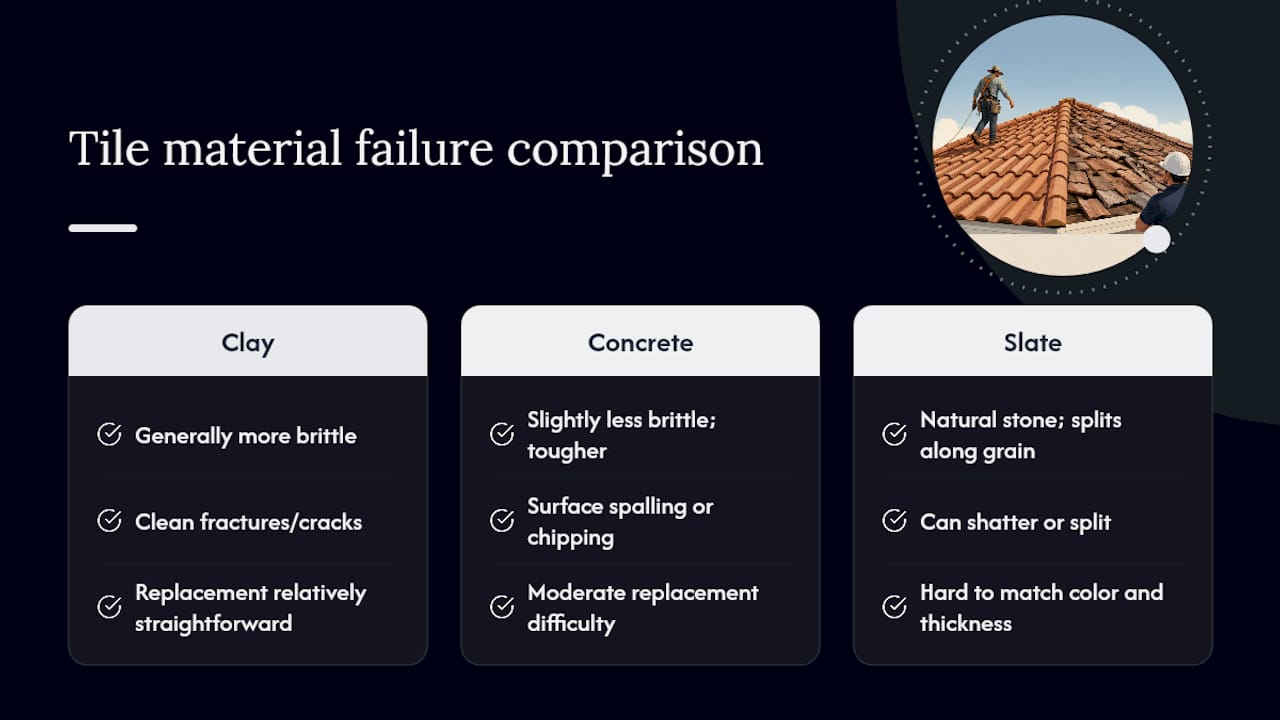
Concrete tiles hold up to foot traffic slightly better than clay in most cases, thanks to a bit more flexibility and toughness in the material itself, but concrete is heavier and shows stress differently, sometimes with surface spalling or chipping rather than a clean crack.
Slate sits in its own category. It’s a natural stone product, not a fired or cast tile, and it splits along its natural grain when overstressed rather than cracking the way clay or concrete does. Slate roofs typically demand even more caution than clay or concrete tile roofs, since a slate tile that’s been stepped on wrong can shatter rather than simply crack, and matching a replacement slate for color and thickness is a more specialized task than sourcing a replacement clay or concrete tile.
Across all three materials, the headlap rule and load-distribution principles from earlier sections still apply. The specific failure mode changes by material, but the underlying cause, concentrated point loads exceeding the tile’s tensile strength, stays the same regardless of what the tile is made from.
What Happens If Walking Damage Goes Unaddressed
A cracked tile left in place doesn’t stay a small problem. Water finds that crack during the next rain, and Florida’s humidity keeps the area under the tile consistently damp, conditions that accelerate underlayment breakdown far faster than a dry climate would.
Underlayment typically has a service life measured in decades, but a persistent leak point ages that material locally at a much faster rate, sometimes reducing usable life to a fraction of what an intact section would deliver in the same span of years. Once the underlayment fails at that spot, water reaches the wood decking underneath, and decking exposed to sustained moisture can rot, warp, or attract mold growth inside the attic space.
By that stage, what started as one cracked tile from a careless step has turned into a repair involving new decking, new underlayment, and new tile, work that costs significantly more than replacing the original tile would have cost the week the crack happened. Left long enough, a small point of water intrusion can also spread laterally under the tile field, damaging a wider section of the roof than the size of the original crack would ever suggest.
The fix is rarely urgent-feeling in the moment, which is exactly why it gets ignored. A hairline crack doesn’t leak on a dry day, so it’s easy to forget about until the first significant storm makes the consequence impossible to ignore.
Balancing Safety, Cost, and Convenience on a Tile Roof
Walking a tile roof yourself always trades a little convenience for real risk to the tiles and to you. If there’s any doubt about the pitch, the tile condition, or your own footing, that’s the moment to call a trained professional instead of testing the headlap rule solo. Get any repair scope and cost in writing before work starts, so a cracked tile discovered mid-job never turns into a surprise line item.

— Results
Get a Tile Roof Inspection Before Small Cracks Become Big Repairs
Thomas Roofing and Repair specializes in residential and commercial roofing across Central Florida, including Brevard, Volusia, and Orange counties, with hands-on experience diagnosing the hidden underside cracks that foot traffic leaves behind. Our crews use documented tile protection methods, crawl boards, mapped headlap routes, and structural anchor placement, on every tile job, so your roof gets the same careful handling described throughout this guide.
Whether you suspect a tile cracked during a recent storm, need a solar installer’s rooftop work checked for damage, or just want peace of mind before selling a property, a professional set of eyes catches problems a ground-level scan misses. We also offer financing options for larger tile repair or replacement projects, so cost doesn’t force a decision to delay a fix that’s only going to get more expensive. Schedule a roof inspection today and get a clear, written assessment of your tile roof’s condition before small cracks turn into decking repairs.
Sources
- Walking on tile roofs (RPA Claims / TRI guidance excerpt)
- Walkability on concrete and clay roof tiles (TRI technical brief)
- Reducing falls during residential construction: Installing tile roofs (OSHA factsheet)