
After a storm passes through Central Florida, many homeowners make a critical mistake by assuming their roof is fine or that damage documentation can wait. This oversight often leads to denied insurance claims, escalating repair costs, and missed opportunities for full coverage. Proper documentation of roof damage is not just a helpful step but a necessary one that protects your investment and ensures you receive the compensation you deserve. Understanding why and how to document damage effectively can mean the difference between a smooth claims process and a frustrating battle with your insurance company.
Table of Contents
- Key takeaways
- Why documenting roof damage matters after a storm
- How to effectively document roof damage for insurance
- Common types of roof damage and what to record
- Using documentation to ensure quality roof repairs
- How Thomas Roofing and Repair supports your documentation needs
- Frequently asked questions
Key Takeaways
| Point | Details |
|---|---|
| Prompt documentation | Documenting roof damage quickly helps ensure insurance claims are supported by concrete evidence of when and how the damage occurred. |
| Photos and notes | High resolution photos with notes provide clear evidence and improve communication with adjusters and contractors. |
| Damage type guidance | Understanding the damage type helps determine whether repair or replacement is the most appropriate option. |
| Cost saving timing | Timely documentation and repairs can reduce storm damage costs by up to 30 percent compared with delaying action. |
Why documenting roof damage matters after a storm
When storm damage strikes your Central Florida home, the clock starts ticking on multiple fronts. Insurance companies require clear, compelling evidence to approve claims, and without proper documentation, you risk having your claim reduced or denied entirely. Many homeowners discover too late that verbal descriptions or vague recollections do not satisfy insurance adjusters who need concrete proof of when and how damage occurred.
Documenting prevents costly disputes about the extent and cause of damage. Insurance adjusters may attribute roof problems to normal wear and tear rather than storm events if you cannot prove otherwise. Your photos, notes, and timestamps become your strongest allies in demonstrating that specific weather events caused specific damage. This evidence eliminates ambiguity and protects you from unfair claim denials.
Early documentation and repair prevent small problems from becoming expensive disasters. A minor leak documented today might cost a few hundred dollars to fix, but that same leak ignored for weeks can lead to thousands in mold remediation, ceiling replacement, and structural repairs. Timely storm damage repair can reduce costs by up to 30% compared to delayed action, making documentation a financially smart decision.
Accurate records help you select appropriate repair or replacement options based on actual damage severity. With clear documentation, you can make informed decisions about whether a simple repair suffices or if replacement makes more sense. This clarity prevents contractors from recommending unnecessary work while ensuring you do not underestimate serious damage.
Key reasons to document thoroughly:
- Insurance claims require photographic and written evidence for approval
- Early documentation prevents disputes about damage causes and timing
- Detailed records help you communicate precisely with contractors
- Proper evidence supports fair compensation for all necessary repairs
- Documentation creates accountability throughout the repair process
How to effectively document roof damage for insurance
Start with high-resolution photos from multiple angles and distances to capture the complete picture. Take wide shots showing your entire roof and its position relative to your property, then move closer for detailed images of specific damage areas. Insurance adjusters need both context and detail, so variety in your photo documentation proves invaluable.
Document both overall roof conditions and close-ups of specific damage types like missing shingles, dents, cracks, or lifted flashing. Each photo should clearly show the problem without ambiguity. If possible, include a measuring tape or common object in close-up shots to provide scale reference for damage size.
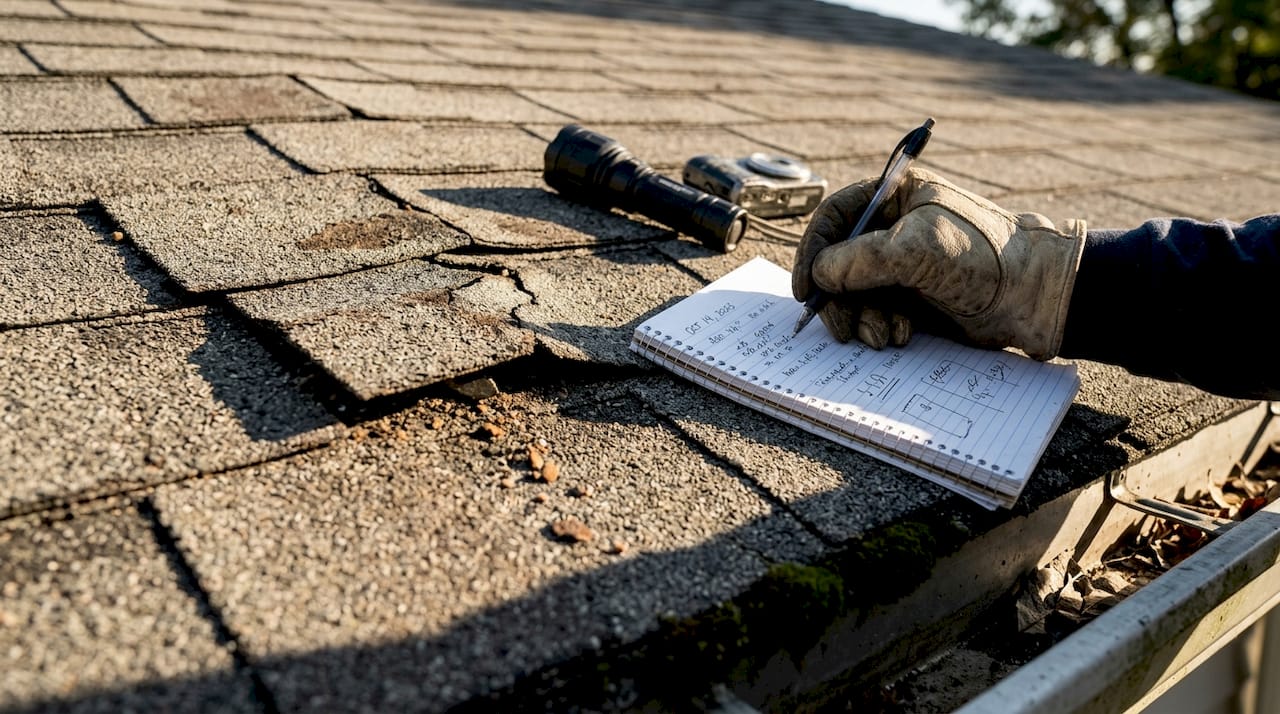
Take comprehensive notes including the exact date, time of day, and weather conditions when you discovered and photographed the damage. Write down what you observed, where damage appears, and any immediate concerns like active leaks or exposed areas. These written records add context that photos alone cannot provide.
Remain safe throughout the documentation process by avoiding climbing onto your roof, especially after storms when surfaces may be wet, unstable, or further damaged. Consider using drones for aerial documentation or hiring professionals who have proper safety equipment and training. Proper photo documentation can speed up insurance claims and avoid claim denials, making professional assistance a worthwhile investment.
Organize your documentation files clearly for easy insurance submission. Create folders labeled by date and damage type, and keep both digital and physical copies. This organization demonstrates professionalism to insurance adjusters and makes it simple to reference specific evidence during the claims process.
Follow this documentation sequence:
- Photograph the entire roof from ground level at multiple angles
- Capture close-up images of each damaged area with clear detail
- Document interior damage like ceiling stains or water intrusion
- Record video walkthroughs narrating what you observe
- Write detailed notes with timestamps and weather information
- Organize all files chronologically with clear labels
- Create backup copies stored in separate locations
Pro Tip: Take video walkthroughs of your roof and attic spaces while narrating what you see. Videos add context that still photos miss, showing how damage areas relate to each other and capturing details you might overlook in individual shots. This extra documentation often proves decisive in insurance negotiations.
For guidance on the complete roof repair process guide homeowners follow, understanding documentation standards helps you meet insurance requirements. When urgent situations arise, knowing the emergency roof repair workflow storm solutions process ensures you document while addressing immediate threats.
Common types of roof damage and what to record
Hail damage appears as dents or cracks in shingles, often in random patterns across your roof surface. Focus your documentation on the size of individual dents, the density of impact marks per square foot, and whether granules have been knocked loose from asphalt shingles. Photograph multiple affected areas to show the spread and severity of hail impact.
Wind damage manifests as lifted, creased, or completely missing shingles, along with damaged flashing around roof penetrations and edges. Document any shingles that appear raised or curled, photograph missing shingle locations, and capture images of bent or displaced flashing. Wind damage often occurs in patterns related to roof orientation and wind direction, so note these relationships in your documentation.
Water intrusion becomes visible through ceiling stains, attic moisture, or mold growth indicating active or recent leaks. Photograph interior damage from multiple angles, document the size and location of stains, and capture any visible mold. These interior photos directly link roof damage to household impact, strengthening insurance claims.
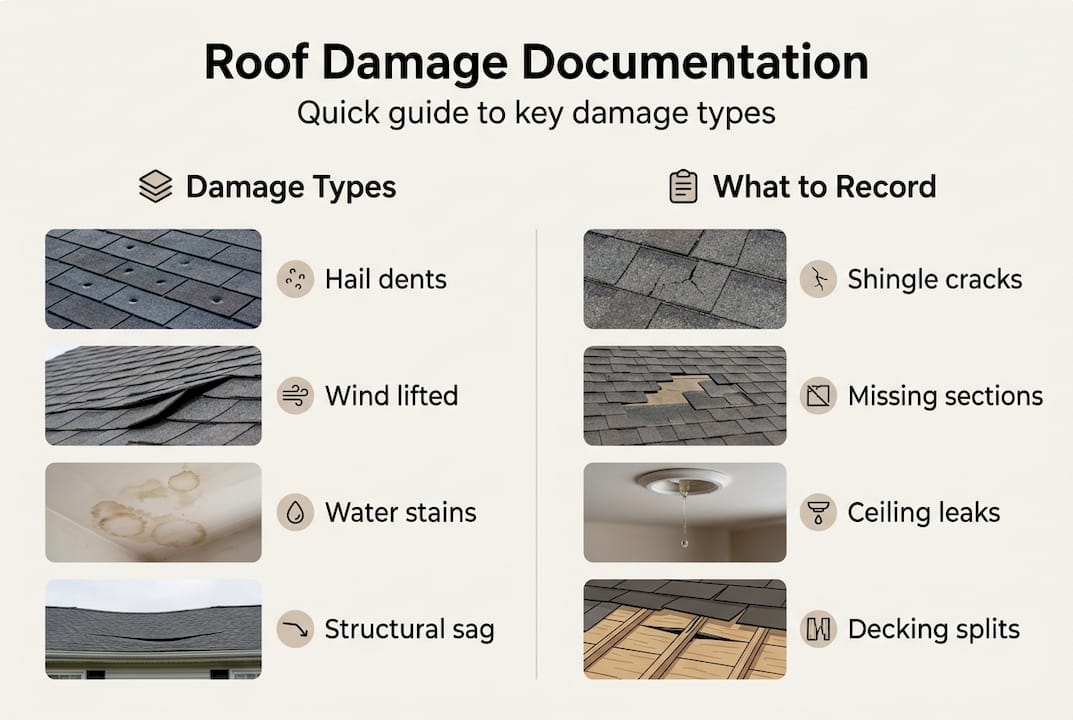
Structural damage includes sagging roof sections, broken or cracked decking visible from inside attics, or compromised support structures. This serious damage requires immediate professional assessment, but your initial documentation should capture any visible deformation, unusual roof lines, or areas where the roof plane appears irregular.
Identifying specific damage types ensures repair accuracy and prevents further problems, making it essential to understand what you are photographing. Familiarizing yourself with common types of roofing damage homeowners should know helps you spot problems others might miss.
| Damage type | What to photograph | Key details to note |
|---|---|---|
| Hail damage | Individual dents, granule loss, cracked shingles | Dent diameter, impact density, affected roof area |
| Wind damage | Missing shingles, lifted edges, damaged flashing | Number of missing shingles, lift height, flashing displacement |
| Water intrusion | Ceiling stains, attic moisture, mold growth | Stain size, leak location, moisture extent |
| Structural damage | Sagging sections, broken decking, irregular roof lines | Sag depth, affected span, visible cracks |
Document each damage type separately but note how different problems may interconnect. Wind damage that lifts shingles often leads to water intrusion, creating a chain of problems that your documentation should clearly illustrate.
Using documentation to ensure quality roof repairs
Your documentation becomes a powerful tool for comparing contractor repair plans to actual damage conditions. When contractors provide estimates, reference your photos and notes to verify they address every documented problem. This comparison prevents contractors from overlooking damage or proposing work that does not match your roof’s actual needs.
Detailed records support accurate estimates that prevent unexpected costs during repairs. Contractors who review your documentation before inspecting can prepare more precise quotes, and you can challenge any significant discrepancies between their proposals and your evidence. This transparency protects you from both underestimated bids that lead to change orders and inflated quotes for unnecessary work.
Clear photographic evidence helps you detect incomplete or substandard repairs by comparing before and after conditions. Take additional photos as repairs progress and after completion, then review them against your original damage documentation. This practice ensures contractors complete all agreed work to proper standards.
Maintain copies of all documentation for future insurance claims, home sales, or warranty issues. Your records prove when damage occurred, what repairs were completed, and that you maintained your roof properly. This documentation history adds value during home sales and protects you if future problems arise.
Written and photographic records help hold contractors accountable and streamline repairs, creating transparency throughout the repair process. Understanding practical examples of roof repairs homeowners face helps you recognize quality work.
Best practices for using documentation during repairs:
- Share complete documentation with contractors before they inspect
- Reference specific photos when discussing repair scope and methods
- Use your records to verify estimate completeness and accuracy
- Document repair progress with additional photos at key stages
- Compare final results against original damage evidence
- Store all documentation securely for future reference
Pro Tip: Share your documentation proactively with contractors during initial consultations rather than waiting for them to request it. This approach demonstrates you are an informed homeowner, encourages detailed proposals, and establishes transparent communication from the start. Contractors appreciate working with prepared clients and often provide better service as a result.
How Thomas Roofing and Repair supports your documentation needs
Navigating storm damage documentation and repairs can feel overwhelming, but you do not have to manage it alone. Thomas Roofing and Repair brings decades of Central Florida roofing expertise to help homeowners document damage accurately and complete repairs efficiently. Our team understands exactly what insurance companies require and how to present evidence that supports your claim.

When storms damage your roof, our expert inspectors provide detailed assessments that complement your initial documentation with professional technical analysis. We photograph damage using industry-standard methods, create comprehensive reports insurance adjusters trust, and explain findings in clear terms you can understand. This professional documentation often makes the difference between claim approval and denial.
Our emergency roof repair workflow storm solutions team responds quickly to prevent further damage while preserving evidence for your claim. We understand the urgency storm damage creates and work efficiently to protect your home without compromising documentation quality. From Titusville to Horizon West, homeowners trust our reliable roof repair in titusville fl services and trusted roof installation pros horizon west fl expertise for complete roofing solutions.
Frequently asked questions
How soon should I document roof damage after a storm?
Document roof damage as soon as it is safe to do so, ideally within 24 to 48 hours after a storm passes. This timing ensures you capture damage while it is fresh and clearly storm-related, before weather conditions change or additional events occur. Quick documentation also allows you to file insurance claims promptly, which can speed up the approval and repair process significantly.
Can I document roof damage myself or do I need a professional?
You can and should document initial roof damage yourself using photos and written notes from safe vantage points. However, professional inspections provide the detailed technical assessments insurance companies often require for claim approval. The best approach combines your immediate documentation with a professional evaluation that identifies hidden damage and provides expert analysis supporting your claim.
What types of damage should I focus on when documenting?
Focus on visible hail impacts, wind-related shingle damage, water intrusion signs, and any structural irregularities like sagging or deformation. Document the size, exact location, and spread of each damage type with both wide-angle and close-up photographs. Pay special attention to areas where different damage types intersect, as these combinations often indicate severe problems requiring immediate attention.
How does documenting roof damage impact insurance claims?
Clear, thorough documentation significantly improves your chances of claim approval by providing undeniable evidence of storm damage. Insurance adjusters rely on photographic proof and detailed records to assess claims fairly, and comprehensive documentation reduces disputes about damage extent or causes. Well-documented claims typically process faster, receive fewer denials, and result in more accurate compensation for necessary repairs.
Recommended
- Roof Repair Process Guide for Homeowners: Step-by-Step Success
- 6 Common Types of Roofing Damage Homeowners Should Know
- Roof Maintenance Guide 2026: Protect Your Florida Home
- Commercial Roof Repair Process: Step-By-Step Success Guide
- Roofing Company Orlando, FL
- Roofing Company Titusville, FL
- Roofing Company DeLand, FL