
Recoverable depreciation on a roof claim is money you’re owed, not money you’re begging for. If your policy pays replacement cost value, that withheld amount gets released once you finish the approved repairs and turn in a paid invoice before your deadline. Start today: pull your declarations page and loss settlement worksheet and look for the words “recoverable depreciation” and a specific deadline date.
TL;DR:
- Recoverable depreciation is paid only after completing repairs, submitting proof, and ensuring the invoice matches the scope approved by the adjuster.
- The typical deadline to claim recoverable depreciation ranges from 180 days up to two years, depending on your policy and state regulations.
- Submitting a complete, organized packet including invoices, photos, permit documents, and a clear cover letter can speed up release within 30 to 90 days.
- Most claim delays occur due to paperwork gaps, missed deadlines, or scope mismatches, not insurer bad faith or reluctance.
- Using a licensed contractor who maps invoices directly to the initial estimate can prevent delays and ensure faster payment.
Table of Contents
- What Is Recoverable Depreciation on a Roof Insurance Claim?
- How to Recover Roof Depreciation: A Step-by-Step Checklist
- Documentation Insurers Actually Require to Release the Holdback
- Why Homeowners Lose the Second Check (And How to Not Be One of Them)
- Calculating Roof Depreciation: The Math Behind Your Check
- Roof Depreciation Deadlines: What the Fine Print Actually Says
- When the Insurer Won’t Release Your Depreciation: Escalation Steps
- How a Licensed Roofer Structures Invoices for Faster Approval
- A Straight Answer From the Publisher’s Desk
- Thomas Roofing and Repair Handles the Paperwork So You Get Paid Faster
- Sources
What Is Recoverable Depreciation on a Roof Insurance Claim?
Every roof claim built on replacement cost value (RCV) gets paid in two pieces. The first check covers actual cash value (ACV), which is the replacement cost minus depreciation for your roof’s age and wear. The second check, the recoverable depreciation, shows up only after you finish the work and prove it.
Non-recoverable depreciation is different, and worth knowing before you get your hopes up. Some policies, especially older ones or those with an ACV roof endorsement, never pay that second check at all. The depreciation is gone for good, regardless of whether you repair anything.
Why do carriers split the payment this way? Two reasons drive it, and neither is personal:
- They want proof the repair actually happened before releasing full replacement value.
- Withholding the difference discourages homeowners from pocketing insurance money without fixing the roof.
Think of ACV as the “we’ll pay you what it’s worth today” check and RCV as the “we’ll pay you what a new one costs” check. The recoverable depreciation is the bridge between those two numbers. Your loss settlement worksheet itemizes this breakdown line by line, and it’s the single most important document in your claim file. Read it before you sign anything or hire anyone.
How to Recover Roof Depreciation: A Step-by-Step Checklist
Getting the second check isn’t complicated, but it does require sequence. Skip a step and you’ll be resubmitting paperwork for weeks.
- Confirm your coverage type and the exact recoverable amount. Your settlement worksheet lists RCV, ACV, and the depreciation held back as a specific dollar figure. Circle it.
- Hire a licensed contractor and match the scope to the adjuster’s estimate. If the contractor’s proposal covers different line items than the adjuster approved, flag the mismatch before work starts, not after.
- Complete the repair, pay the final invoice in full, and keep every receipt. The invoice date and payment date matter for your records.
- Submit one complete packet to the adjuster: paid invoice, before and after photos, and permit sign-off if your municipality required one. Confirm they received it, don’t assume the mail or the portal worked.
- Follow up in writing if you haven’t heard back within a couple weeks. Reference your claim number every time.
If your contractor is backed up after a regional storm and you’re going to miss the deadline, ask for an extension in writing before that date arrives, not after. Many adjusters may grant extensions if you provide evidence like a signed contract and scheduled start date.
Pro Tip: Email your adjuster instead of calling. A phone call leaves no paper trail; an email gives you a timestamp proving you asked for an extension before the deadline, which matters if the carrier later claims you missed it.
Documentation Insurers Actually Require to Release the Holdback
Carriers don’t reject depreciation requests out of spite. They reject incomplete ones. Send a single, organized packet and you’ll cut weeks off the wait.
- Final paid invoice with itemized scope of work, your contractor’s license number, and their contact information.
- Before and after photos, labeled so the adjuster can match each photo to a specific roof section.
- Permit approval or code-upgrade receipts, if your jurisdiction required a permit for the replacement.
- A short cover letter referencing your claim number and stating plainly: “Please release the recoverable depreciation listed on the settlement worksheet dated [date].”
That last item sounds unnecessary until you’ve watched a claim sit untouched for a month because nobody told the adjuster what exactly was being requested. Travelers notes that carriers typically release payment within 30 to 90 days once they have satisfactory proof, so a clean packet up front is the fastest path to that window closing in your favor.
Why Homeowners Lose the Second Check (And How to Not Be One of Them)
Most forfeited recoverable depreciation isn’t the insurer being difficult. It’s a paperwork gap that nobody caught in time.
- Missing the deadline entirely. Recovery windows are typically use it or lose it, running from 180 days up to two years depending on carrier and state, so mark the date the moment you get your worksheet.
- Invoice scope doesn’t match the adjuster’s approved estimate. If your contractor added items the adjuster didn’t price, that mismatch stalls the release until someone reconciles it.
- Assuming the first check is the final word. It isn’t. It’s half the story.
- Letting the contractor handle submission without confirming delivery. Contractors are busy. Paperwork gets lost. Confirm the adjuster has it yourself.
Pro Tip: Spend less than the approved replacement cost estimate and your recoverable depreciation shrinks to match your actual spend, not the original number. If your invoice comes in at $14,000 against an $18,000 estimate, you’re reimbursed based on $14,000, not the higher figure.
Calculating Roof Depreciation: The Math Behind Your Check
Depreciation isn’t guesswork. Carriers apply a percentage tied to your roof’s useful life, and knowing the formula lets you sanity check your own worksheet.
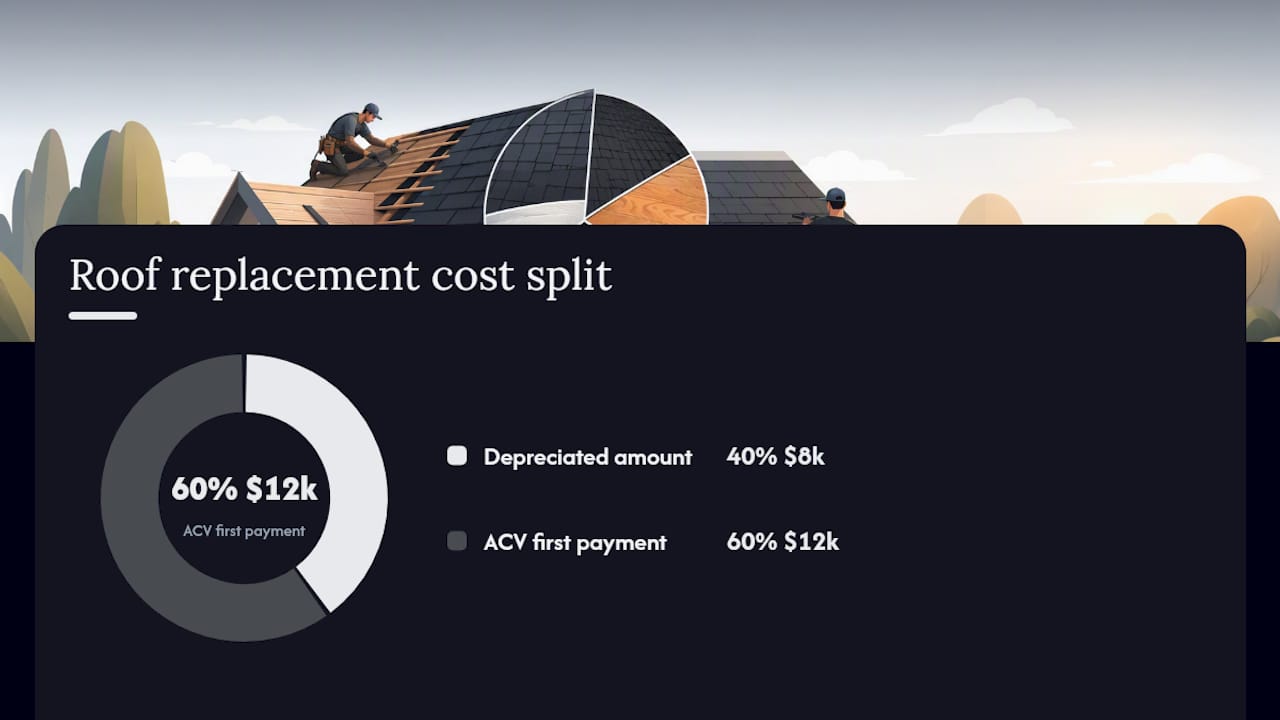
An asphalt composition shingle roof typically carries a 25-year useful life, which works out to roughly 4% depreciation per year. Tile and slate roofs depreciate more slowly given their longer expected lifespans, so the percentage per year is smaller.
Here’s the math on a 10-year-old asphalt roof with a $20,000 replacement cost:
- Depreciation: 10 years times 4% equals 40%.
- Depreciated amount: $20,000 times 40% equals $8,000.
- ACV check (first payment): $20,000 minus $8,000 equals $12,000.
- Recoverable depreciation (second check, owed after proof of repair): $8,000.
One catch worth knowing before you assume that math applies to you: many carriers write roofs older than 15 to 20 years on an ACV basis regardless of what the rest of the dwelling’s policy says. Check your declarations page specifically for a roof age exclusion or ACV endorsement.
Roof Depreciation Deadlines: What the Fine Print Actually Says
Policy language on timing varies more than most homeowners expect, so don’t assume your neighbor’s deadline matches yours.
- Most policies give homeowners 180 days to submit proof and collect the second check, though some extend that to one or two years.
- State rules add another layer. California, for example, requires insurers to pay within 30 days of receiving satisfactory proof. This is an illustration of state-level payment speed rather than a universal rule you can count on elsewhere.
- If a storm backlog threatens your timeline, put your extension request in writing before the deadline, and attach your signed contractor agreement and scheduled start date as evidence.
Your declarations page is where this all lives. Read the “loss settlement” clause specifically, since that’s usually where the exact window is spelled out.
When the Insurer Won’t Release Your Depreciation: Escalation Steps
Sometimes a clean packet still gets stuck. Before assuming the worst, work through this in order.
- Re-check the line-item language on your settlement worksheet and resend anything that appears missing, referencing the exact wording the adjuster used.
- Document every phone call and email, and ask the carrier in writing for a specific reason if they deny or delay the release.
- Consider a public adjuster if the dollar amount is significant and the carrier keeps stalling without explanation, though their fee typically comes out of your settlement.
- File a complaint with your state insurance department if you believe the carrier is acting in bad faith. This is a last resort, not a first move, but it’s a real option when written requests get ignored.
How a Licensed Roofer Structures Invoices for Faster Approval
A properly built invoice is the difference between a two-week release and a two-month fight. Contractors like Thomas Roofing and Repair map every line item to the adjuster’s original estimate, list license and tax ID numbers, and attach permit sign-offs where required. Before you pay a final invoice, verify it references your claim number and matches the adjuster’s scope exactly. That single check prevents most of the delays homeowners run into.
A Straight Answer From the Publisher’s Desk
Homeowners overthink this process far more than they need to. The steps are the steps: confirm the worksheet amount, complete the repair correctly, pay the invoice, submit the packet, follow up. Do that before your deadline and the money comes. What actually derails claims is procrastination, not insurer bad faith, so engage a contractor early and track every document you send. Thomas Roofing and Repair works with homeowners through exactly this process daily, and the pattern holds: early action beats last-minute scrambling every time.
— Results
Thomas Roofing and Repair Handles the Paperwork So You Get Paid Faster
Thomas Roofing and Repair is the alternative to chasing paperwork alone. We build final invoices that map directly to your adjuster’s approved scope, coordinate permit sign-offs with your municipality, and respond fast when storm damage puts you on a deadline clock you can’t afford to miss.
Insurance claim assistance is a core part of what we do in Central Florida, covering Brevard, Volusia, and Orange counties. That means when it’s time to submit your documentation packet, someone who already understands what your adjuster expects has already double checked the scope match, the license details, and the photo labeling. Homeowners working with contractors who understand ordinance and code requirements also avoid a second, separate headache: municipal rules that can force a fuller replacement than the depreciation math alone suggests. For contractor documentation standards beyond roofing, the subcontractor coverage checklist offers a useful comparison point.
If your roof needs repair or replacement and you’re worried about deadlines, start with a free estimate and see our roof installation best practices to understand exactly what a code-compliant invoice looks like before work begins.

Sources
For policy specifics, check your carrier’s own declarations page first. Background on depreciation mechanics comes from Policygenius, Travelers, and MoneyGeek. For documentation steps specific to storm claims, see Insurance Claim Documentation Steps for Storm Damage.
- Recoverable depreciation | Policygenius
- Understanding depreciation | Travelers
- ACV vs. RCV | MoneyGeek
- Ordinance or law coverage | Progressive