
TL;DR:
- Building codes for roofing in 2026 set minimum standards for materials, installation, permits, and inspections that all property owners and contractors must follow. Most jurisdictions adopt the 2024 IRC, but local amendments, especially regarding wind, fire, and energy rules, can vary significantly. Ensuring compliance involves following strict nail and material specifications, securing permits, and understanding regional rules like Florida’s 25% replacement limit.
Building codes for roofing in 2026 set the mandatory minimum standards for materials, installation methods, permits, and inspections that every homeowner, contractor, and property manager must follow. The baseline framework comes from the 2024 International Residential Code (IRC), which most U.S. jurisdictions have adopted, though local amendments refine requirements for wind speeds, fire ratings, and energy efficiency. The International Code Council publishes the IRC, but your local building department enforces it. Knowing which version applies to your project, and where local rules diverge, is the difference between a compliant roof and a costly redo.
What are the key roofing material and installation requirements in the 2024 IRC?
The 2024 IRC sets clear, non-negotiable installation standards for asphalt shingles, the most common residential roofing material in the U.S. IRC Section R905.2 requires a minimum of four nails per shingle under standard conditions, increasing to six nails in wind zones where speeds exceed 110 mph. Staples are not permitted as a substitute for nails. That distinction matters because staples were widely used for decades, and some older contractors still reach for them out of habit.
Nail specifications are equally strict. Galvanized, stainless steel, or aluminum roofing nails with a minimum 12-gauge shank and 3/8-inch head are required. These specs exist to resist wind uplift, which is the force that peels shingles off a roof during a storm. Undersized nails or improper placement are among the most common reasons roofs fail inspection.
The code also governs how shingle courses overlap. Head lap and side lap minimums prevent water infiltration at the joints between shingles. In colder climates, ice and water shield installation is required in vulnerable zones, typically the first few feet from the eave and in valleys. These zones are where ice dams form and where water backs up under shingles during freeze-thaw cycles.
One point that surprises many contractors: manufacturer installation instructions legally form part of code compliance. If a manufacturer requires six nails but the IRC requires four, the inspector enforces six. The stricter rule always wins.
- Minimum four nails per shingle (six in wind zones above 110 mph)
- No staples permitted as nail substitutes
- Galvanized, stainless steel, or aluminum nails with 12-gauge shank and 3/8-inch head
- Head lap and side lap minimums must be met for each shingle course
- Ice and water shield required in cold-climate eave zones and valleys
- Manufacturer instructions override IRC minimums when stricter
Pro Tip: Always keep the manufacturer’s installation instructions on the job site. Inspectors can and do request them, and a missing document can delay your final approval.
How do roofing permit and inspection requirements vary across U.S. jurisdictions?
Permits are not optional for most roofing projects. Roof replacement permits are mandatory in nearly all U.S. cities, with costs ranging from $130 to $646 depending on the project scope and municipality. Spot repairs under roughly 100 square feet are often exempt, but anything beyond that typically triggers a permit requirement. Skipping a permit to save money almost always costs more in the long run.

Permit fee structures vary widely. Miami-Dade fees can reach $400–$650 for a $25,000 project, while Phoenix typically falls in the $200–$400 range. Some jurisdictions use flat fees, others calculate a percentage of the project value, and some combine both methods. The only way to know your exact cost is to call your local building department directly.
The inspection process itself has a step that many homeowners and contractors overlook: the mid-tear-off inspection. Jurisdictions often require this inspection to verify deck condition and fastener patterns before new materials go down. Failing to schedule it can force you to remove newly installed decking or shingles, which adds significant cost and delays.
Here is a practical sequence for navigating the permit and inspection process:
- Contact your local building department before starting any work. Confirm whether your project requires a permit and what the fee will be.
- Pull the permit before work begins. Your contractor should do this, not after the fact.
- Schedule the mid-tear-off inspection as soon as the old roofing is removed and the deck is exposed.
- Keep all documentation on site during installation, including the permit, manufacturer instructions, and material specs.
- Request the final inspection only after all work is complete and the site is clean.
Pro Tip: Verify your contractor’s permit history by calling your local building department. A quick check can confirm whether they have pulled permits within the past 90 days. Contractors who avoid permits are a red flag.
What regional variations and special rules affect roofing codes in 2026?
Roofing codes are not uniform across the country. Most U.S. jurisdictions adopted the 2024 IRC as their baseline, but state and local amendments create meaningful differences in what compliance actually requires. Wind zones, fire ratings, and insulation standards all vary by region, and the gap between a coastal Florida requirement and a landlocked Midwest standard can be significant.
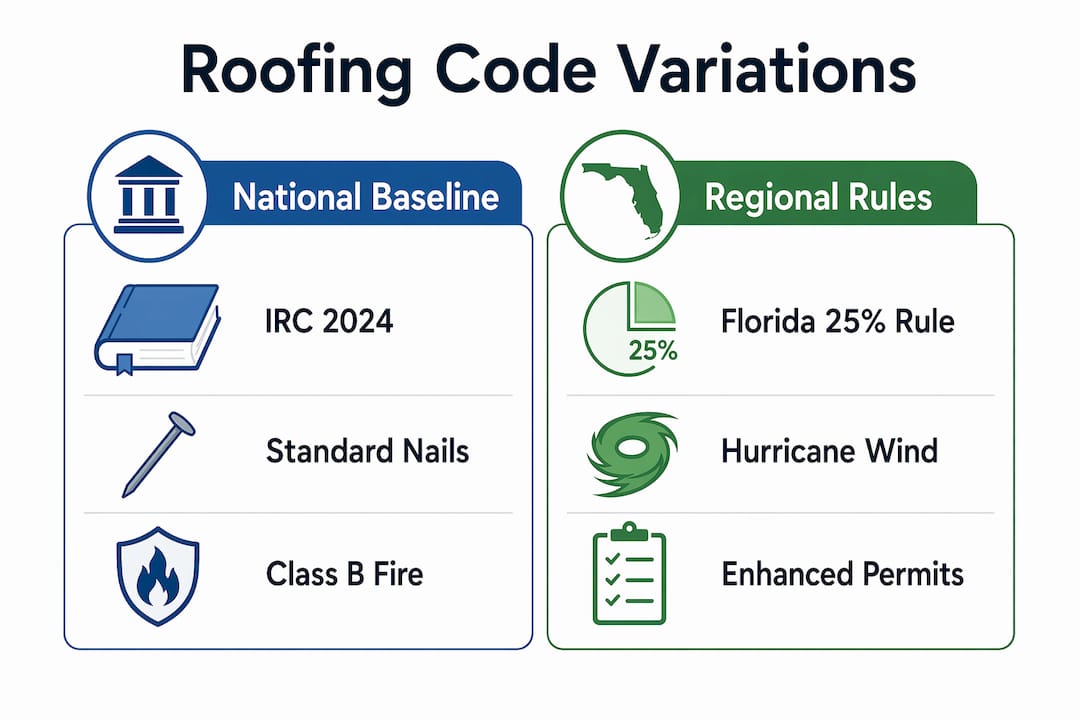
Florida’s 25% rule is one of the most consequential regional amendments in the country. Florida requires full code compliance when more than 25% of a roof is replaced within a 12-month period, unless the existing roof was built under 2007 or later codes. This rule catches many property owners off guard. A homeowner who patches one section after a storm and then replaces another section six months later may unknowingly cross the 25% threshold and trigger a full replacement to current standards. Understanding Florida’s roof replacement rules before starting any repair work is critical.
The table below summarizes key regional differences that affect 2026 roofing compliance:
| Region | Key Code Variation | Practical Impact |
|---|---|---|
| Florida (coastal) | 25% replacement rule; enhanced wind uplift requirements | Full code compliance triggered by cumulative repairs |
| Texas (Gulf Coast) | Elevated fastener and wind resistance standards | Six-nail patterns required in many coastal counties |
| California | Strict fire rating requirements; WUI zone rules | Class A fire ratings often mandatory in wildfire zones |
| Midwest/Plains | Standard IRC baseline; ice and water shield zones | Cold-climate eave protection required in northern states |
| Northeast | Energy code amendments; ice dam protection zones | Insulation R-values often exceed IRC minimums |
Fire rating requirements deserve special attention. IBC Table 1505.1 requires a minimum Class B fire rating for most residential roofs, with Class A required in high-risk fire zones. The rating applies to the entire roof assembly, not just the shingles. That means underlayment, decking, and insulation all factor into the fire performance calculation. Industry experts confirm that roofing codes apply to the entire assembly, not only the visible surface materials.
For Central Florida specifically, wind rating standards are particularly demanding given the region’s hurricane exposure. Brevard, Volusia, and Orange counties each have specific requirements that go beyond the IRC baseline.
How can you efficiently ensure compliance with 2026 roofing codes?
Compliance starts before a single shingle is removed. The most common mistake property owners make is treating code research as something to do after a problem arises. Building departments frequently post amendments on platforms like Municode and eCode360, and official city websites sometimes publish updates first. Checking both sources gives you the most current picture.
Building department staff can answer specific permit and inspection questions within minutes. That single phone call can clarify fee structures, inspection scheduling, and local amendments faster than any online search. Most homeowners and property managers never make that call, and they pay for it later.
- Check Municode, eCode360, and your city’s official website for the latest local amendments before starting any project.
- Call your local building department to confirm permit fees, inspection requirements, and any project-specific rules.
- Verify your contractor’s permit history through the building department before signing any contract.
- Keep manufacturer installation instructions on site throughout the project. Inspectors can request them at any point.
- Schedule the mid-tear-off inspection immediately after old materials are removed. Do not wait until the project is nearly complete.
- Maintain a complete documentation file: permit, inspection reports, material specs, and manufacturer instructions. Store it with your property records.
For Florida property owners, the repair versus replacement decision carries code implications that go beyond cost. Crossing the 25% threshold changes your compliance obligations entirely. Tracking cumulative repair percentages over a 12-month window is not optional. It is a legal requirement.
Pro Tip: Take dated photos of every stage of your roofing project, from deck exposure through final installation. If an inspector questions fastener patterns or material placement after the fact, photographic documentation is your best defense.
Key Takeaways
Building codes for roofing in 2026 require compliance across the entire roof assembly, from fastener specs and fire ratings to permits and regional amendments, with no single element standing alone.
| Point | Details |
|---|---|
| IRC 2024 is the baseline | Most U.S. jurisdictions use the 2024 IRC, but local amendments always apply and often require stricter standards. |
| Nail counts are non-negotiable | Four nails minimum per shingle, six in wind zones above 110 mph; staples are never permitted. |
| Permits protect you | Permit fees range from $130 to $646; unpermitted work risks forced removal and resale complications. |
| Florida’s 25% rule is a trigger | Replacing more than 25% of a roof within 12 months requires full compliance with current codes. |
| Manufacturer instructions are law | When manufacturer specs exceed IRC minimums, inspectors enforce the stricter requirement. |
Why most roofing code mistakes happen before work even starts
The biggest misconception I see is that building codes for roofing are about shingles. Homeowners call to ask about shingle brands and colors, and the code conversation never comes up until an inspector flags something. The reality is that roofing codes govern the entire assembly, including the deck, underlayment, fasteners, and fire-rated components beneath the surface you can see.
The second mistake is assuming the contractor handles everything. Contractors pull permits, yes. But homeowners and property managers who verify that permit independently, with a quick call to the building department, catch problems before they become expensive. I have seen projects where a contractor skipped the mid-tear-off inspection, installed new decking, and then had to tear it all out because the inspector could not verify the deck condition. That is a preventable loss.
Manufacturer instructions are another area where I see consistent gaps. Contractors who have been in the trade for 20 years sometimes rely on memory rather than the printed spec sheet. When a manufacturer updates their installation requirements and the contractor does not catch it, the inspector does. Keeping the current instructions on site is not bureaucratic box-checking. It is how you pass inspection the first time.
My honest advice: build a relationship with your local building department. Call them before the project, not during a crisis. They are a resource, not an adversary, and the ones I have spoken with are genuinely helpful when you approach them early.
— Thomasroofingandrepair
Thomasroofingandrepair keeps your roof code-compliant in 2026
Navigating 2026 roofing compliance standards is straightforward when you work with a contractor who knows the local rules cold. Thomasroofingandrepair serves homeowners, contractors, and property managers across Brevard, Volusia, and Orange counties with installations and repairs that meet or exceed current IRC requirements and local amendments.

Every project starts with a permit review and ends with a final inspection. The team at Thomasroofingandrepair carries manufacturer installation instructions to every job site and schedules mid-tear-off inspections as standard practice, not an afterthought. Whether you need a code-compliant roof installation or a full Central Florida roof replacement that satisfies the 25% rule and wind uplift requirements, the team is ready. Contact Thomasroofingandrepair for a free estimate and get your project started on the right side of the code.
FAQ
What is the 2024 IRC and does it apply to my roof?
The 2024 International Residential Code is the model building code adopted by most U.S. jurisdictions as the baseline for residential roofing standards. Your local building department may have amended it, so always confirm which version and which local rules apply to your specific project.
How many nails are required per shingle under current roofing codes?
The 2024 IRC requires a minimum of four nails per asphalt shingle under standard conditions, increasing to six nails in wind zones where speeds exceed 110 mph. Staples are not permitted as a substitute under any condition.
Do I need a permit for a roof repair in 2026?
Most U.S. cities require permits for any roofing work beyond minor spot repairs under roughly 100 square feet. Permit fees typically range from $130 to $646 depending on the municipality and project scope.
What is Florida’s 25% roofing rule?
Florida’s 25% rule requires full compliance with current building codes when more than 25% of a roof is replaced within a 12-month period, unless the existing roof was constructed under 2007 or later codes. Cumulative repairs count toward the threshold, not just single projects.
What happens if roofing work is done without a permit?
Unpermitted roofing work can result in forced removal of installed materials, fines, and complications when selling the property. Jurisdictions that discover unpermitted work often require a full tear-off and reinspection before issuing a certificate of compliance.