TL;DR:
- Thermal imaging detects hidden roof moisture and defects by capturing temperature differences using infrared cameras. Proper timing, high-resolution equipment, and professional interpretation are essential for accurate results and reliable diagnoses. It provides a non-invasive, fast, and cost-effective way to improve roof maintenance and insurance claims.
Thermal imaging in roofing is defined as the use of infrared cameras to detect temperature differences on roof surfaces, revealing hidden moisture, insulation failures, and structural defects that visual inspections routinely miss. The role of thermal imaging in roofing has grown significantly as property owners demand more accurate diagnostics before committing to costly repairs. Standards from ASTM International and ASHRAE govern how these inspections must be conducted, covering timing, environmental conditions, and camera specifications. Understanding this technology helps you make smarter decisions about roof maintenance, repair budgets, and long-term protection.
How does thermal imaging detect roof problems?
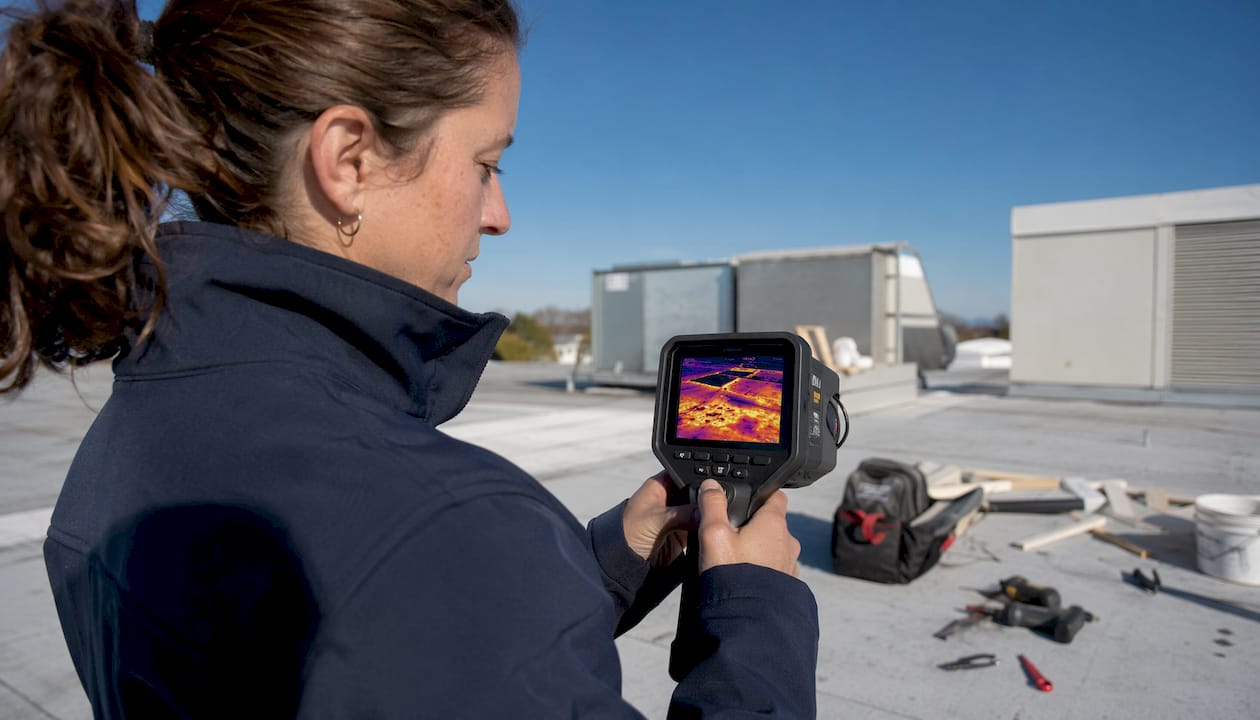
Infrared thermography works by capturing radiation emitted from roof surfaces in the 7.5–13 micron wavelength range. Every material on your roof emits heat at a slightly different rate. When moisture saturates insulation, that wet area retains heat longer than the surrounding dry material, creating a visible temperature anomaly on the thermal camera’s display.
Camera quality directly affects what gets detected. High-resolution thermal cameras with a minimum resolution of 320×240 pixels, and preferably 640×480, are required to accurately locate moisture anomalies on large roofs. Lower-resolution cameras can miss smaller wet spots entirely, producing a false sense of security.
Timing matters as much as equipment. The sun heats your roof throughout the day, and as it cools after sunset, wet insulation releases that stored heat more slowly than dry areas. This temperature contrast is what makes anomalies visible. Scans conducted 30–60 minutes after sunset with a temperature differential of 2–4°C and wind speeds below 15 mph produce the most reliable results per ASTM E1933-20.
Two scan types exist: hot scans and cold scans. Hot scans happen after a sunny day when the roof has absorbed heat. Cold scans happen after a cool night when the roof is warming from interior heat loss. Both approaches reveal anomalies, but the right choice depends on your climate, roof type, and the time of year.
Pro Tip: Schedule your thermal inspection for a clear day followed by a calm evening. Clouds block solar loading, and wind disperses the temperature contrast that makes wet insulation visible.
- Infrared cameras detect emitted radiation in the 7.5–13 micron wavelength range
- Wet insulation retains heat differently than dry areas, creating thermal anomalies
- Thermal sensitivity of ≤0.1°C improves detection of subtle moisture differences
- Camera resolution of 640×480 pixels is preferred for large commercial roofs
- ASTM E1933-20 sets the standard for scan timing and environmental conditions
What are the benefits of thermal imaging for roof inspections?
The accuracy advantage of infrared thermography over traditional visual inspection is substantial. Traditional visual inspections miss 68% of subsurface leaks, while infrared thermography reduces those missed detections by up to 82%. That gap represents real money: a missed leak that goes undetected for one season can saturate an entire insulation layer and require a full tear-off instead of a targeted patch.
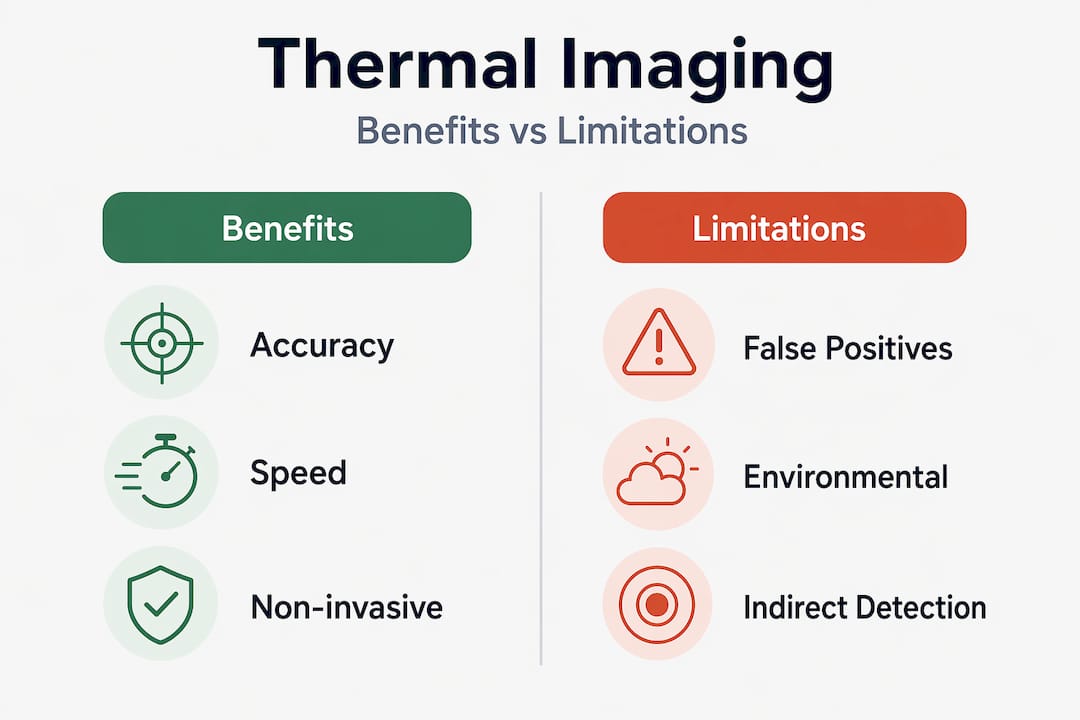
Speed is another major advantage. Professional thermal roof scans cover large roofs in approximately 1.8 to 3 hours, compared to 4 to 8 hours for traditional inspection methods. That efficiency translates directly into lower labor costs and less disruption to your property or tenants.
Thermal imaging is also non-destructive. Infrared thermography enables full roof coverage without cutting into the roofing system, which preserves manufacturer warranties and avoids unnecessary structural disruption. Many roofing warranties are voided by invasive core sampling, so a non-invasive scan protects your coverage while still delivering diagnostic data.
The financial benefits extend to insurance claims as well. Thermal imaging documentation provides detailed thermal evidence of hidden roof damage, which strengthens insurance claims and supports warranty disputes. A thermal report gives adjusters and contractors a clear, objective record of where damage exists and how far it has spread.
- Reduces missed subsurface leaks by up to 82% compared to visual-only methods
- Covers large roofs in under 3 hours, cutting inspection time nearly in half
- Preserves roof warranties by avoiding invasive sampling
- Supports insurance claims with documented thermal evidence
- Helps prioritize repairs so you spend money where it actually matters
What limitations should you know about thermal imaging?
Thermal imaging detects temperature differences, not water directly. This distinction matters more than most homeowners realize. A thermal camera shows you where heat is behaving abnormally. It does not confirm that a leak is actively occurring at that exact spot. Thermal anomalies require moisture meter validation and targeted core sampling to confirm the underlying cause before any repair work begins.
False positives are a real risk. Reflective roofing materials, HVAC equipment, rooftop exhaust vents, and even shadows from adjacent structures can all produce temperature variations that mimic moisture signatures. An untrained technician can easily misread these signals and recommend unnecessary repairs. Professional interpretation combined with physical walk-throughs is the only reliable way to separate genuine moisture from equipment-generated heat.
Environmental conditions can also undermine an entire inspection. Wind speeds over 15 mph, recent precipitation, or high humidity can mask thermal anomalies, making wet insulation appear no different from dry areas. If conditions are wrong, the scan produces unusable data. Contingency planning before scheduling an inspection is not optional.
Thermal imaging also has a size threshold. It excels at mapping large areas of wet insulation but struggles to pinpoint small, localized leaks where water has not yet saturated enough material to create a detectable temperature difference. For early-stage or pinhole leaks, moisture meters and physical probing remain more reliable.
Pro Tip: Always ask your inspector for the moisture meter readings alongside the thermal report. If a contractor offers thermal imaging alone with no confirmatory testing, that is a red flag.
- Thermal cameras detect temperature anomalies, not water itself
- Reflective surfaces and HVAC equipment frequently cause false positives
- Wind above 15 mph and recent rain reduce inspection reliability
- Small active leaks with minimal insulation saturation may not appear on thermal scans
- Moisture meter validation and core sampling are required to confirm findings
How can you apply thermal imaging insights for roof maintenance?
Scheduling your inspection at the right time is the first practical step. Plan thermal scans during optimal environmental conditions as defined by ASTM E1933-20: clear skies the day before, calm winds, and a temperature swing of at least 2–4°C between day and night. In Central Florida, the fall and early spring months often provide the most consistent conditions for reliable scans. A complete roof inspection checklist helps you prepare the property and coordinate timing with your inspector.
Once you have a thermal report, use it as a repair priority map rather than a repair order. Not every anomaly requires immediate action. Work with your roofing contractor to rank findings by severity, location relative to interior spaces, and proximity to existing drainage paths. This approach lets you address the highest-risk areas first and defer lower-priority repairs to fit your budget.
Combine thermal data with your roof’s maintenance history. A thermal anomaly in an area that was previously repaired tells a different story than one in a section that has never been touched. Historical records, combined with thermal imaging, give your contractor the full picture needed to make accurate repair decisions. You can learn more about how professional inspection practices integrate multiple data sources for accurate building diagnostics.
Drone-based thermal inspections are worth considering for large or steep roofs. Drone surveys cover large roofs within 30–60 minutes, eliminating the need for physical roof access and reducing safety risk for inspectors. The data quality is comparable to ground-based scans when conducted under proper conditions, and the speed advantage is significant for commercial properties with multiple roof sections.
- Schedule inspections under ASTM E1933-20 conditions: clear day, calm evening, 2–4°C temperature swing
- Use the thermal report as a priority map, not an immediate repair list
- Cross-reference thermal findings with your roof’s repair and maintenance history
- Require moisture meter validation before approving any repair work
- Consider drone-based thermal scans for large, steep, or multi-section roofs
- Coordinate thermal scans with your annual roof maintenance schedule for consistent baseline data
Key Takeaways
Thermal imaging is the most accurate non-destructive method for detecting hidden roof moisture, but it requires proper timing, professional interpretation, and confirmatory testing to deliver reliable results.
| Point | Details |
|---|---|
| Accuracy advantage | Infrared thermography reduces missed subsurface leaks by up to 82% versus visual-only inspections. |
| Timing is critical | Scans must occur 30–60 minutes post-sunset with wind below 15 mph per ASTM E1933-20 standards. |
| Confirmation required | Thermal anomalies must be validated with moisture meters and core sampling before repairs begin. |
| Non-destructive benefit | Infrared scans cover 100% of a roof without invasive cuts, preserving warranties and reducing disruption. |
| Drone efficiency | Drone-based thermal surveys cover large roofs in 30–60 minutes, improving safety and data quality. |
Why thermal imaging changed how I think about roof care
I used to assume that a good visual inspection by an experienced roofer was enough. Walk the roof, look for cracked flashing, check the field for blistering, probe a few soft spots. That approach catches obvious problems. It misses the ones that cost you the most.
The shift happened when I saw a thermal report on a flat commercial roof that looked perfectly fine from the surface. The thermal scan revealed three large moisture pockets, each covering several hundred square feet of saturated insulation. None of them were visible from above or below. The building owner had been losing energy through those wet areas for at least two seasons without knowing it.
What I have learned is that thermal imaging is not a replacement for experience. It is a force multiplier. A trained roofer who understands what they are looking at on a thermal display can make decisions in hours that would otherwise take days of probing and guesswork. But an untrained technician with the same camera is genuinely dangerous. They will misread HVAC signatures as leaks and recommend tear-offs that were never needed.
My honest recommendation: treat thermal imaging as one layer of a multi-method inspection, not the whole answer. Pair it with a physical walk-through, moisture meter readings, and a contractor who can explain every anomaly on the report. The thermal performance guide for Central Florida is a good starting point if you want to understand how local climate conditions affect scan reliability and what to expect from a professional inspection in this region.
— Results
Thomasroofingandrepair brings thermal precision to your roof
Thomas Roofing and Repair combines professional thermal imaging with hands-on roofing expertise to give homeowners and property managers in Central Florida a complete picture of their roof’s condition. Every thermal scan is paired with moisture meter validation and a detailed written report, so you know exactly what needs repair and what can wait.

Whether you need a reliable roof repair in Titusville or a full inspection before a major project, Thomasroofingandrepair delivers diagnostics you can act on. The team serves Brevard, Volusia, and Orange counties with the same commitment to accuracy and honest reporting that has built its reputation across Central Florida. Schedule your thermal roof evaluation today and get a free estimate.
FAQ
What is the role of thermal imaging in roofing?
Thermal imaging uses infrared cameras to detect temperature differences on roof surfaces, identifying hidden moisture, insulation failures, and potential leak areas that visual inspections miss. It is a non-destructive diagnostic method governed by ASTM E1933-20 standards.
How accurate is a thermal inspection for a roof?
Infrared thermography reduces missed subsurface leaks by up to 82% compared to visual-only inspections, which miss 68% of moisture issues. Accuracy depends on camera resolution, environmental conditions, and professional interpretation of the thermal data.
When is the best time to schedule a thermal roof scan?
The optimal window is 30–60 minutes after sunset following a clear, sunny day, with wind speeds below 15 mph and a temperature differential of at least 2–4°C between the roof surface and ambient air.
Can thermal imaging replace traditional roof inspections?
Thermal imaging does not replace traditional inspections. It works best as one layer of a multi-method approach that also includes physical walk-throughs, moisture meter readings, and core sampling to confirm findings.
Are drone thermal roof inspections worth it?
Drone-based thermal surveys cover large roofs in 30–60 minutes without requiring physical roof access, reducing safety risk and inspection time. They are particularly useful for commercial properties with large or multi-section roof areas.