
TL;DR:
- Seamless roofing reduces water and wind intrusion points, making it highly suitable for hurricane-prone Florida. It includes metal and liquid-applied systems that offer long-term durability, wind resistance up to 180 mph, and energy savings. Proper installation and regular maintenance are essential to maximize performance and storm resilience.
Seamless roofing is defined as a continuous roofing surface that eliminates or drastically reduces joints, laps, and exposed fasteners, cutting the primary points where water and wind force their way in. For Central Florida homeowners in Brevard, Volusia, and Orange counties, where hurricane season runs june through november, this design philosophy is not a luxury. It is a structural decision. Seamless systems reduce failure points like joints, laps, and fasteners that cause leaks and wind damage, while also accommodating thermal expansion that Florida’s heat cycles demand. Thomasroofingandrepair installs and services these systems across Central Florida with a focus on long-term performance.
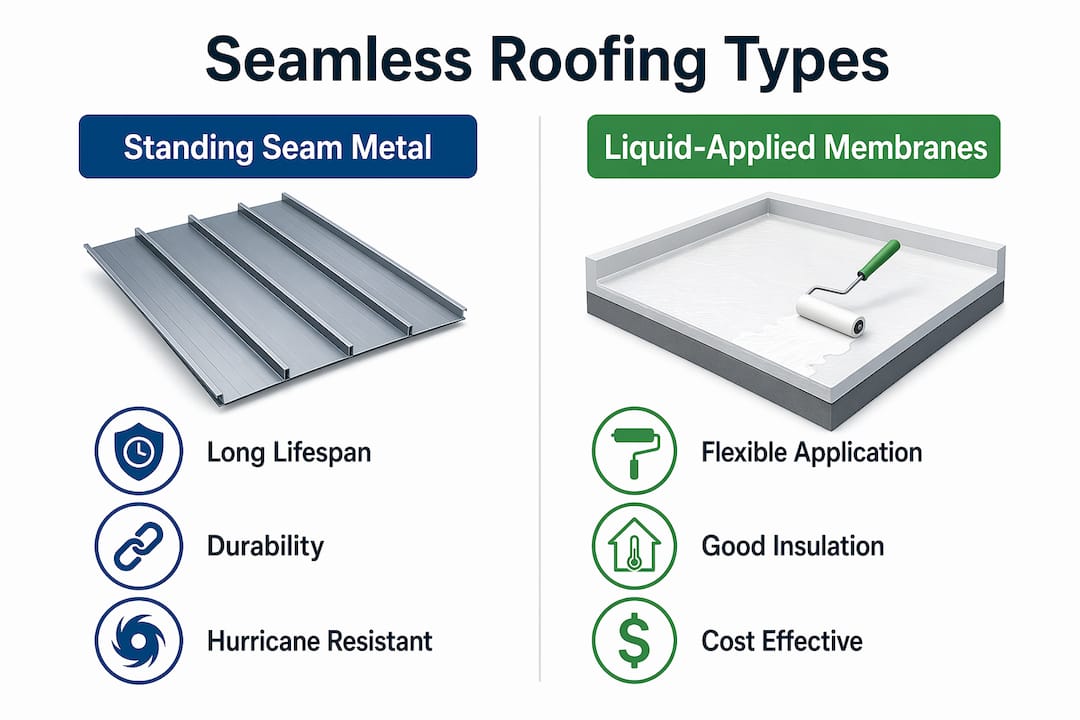
What is seamless roofing and how does it work?
Seamless roofing is not a single product. It is a design category that includes two distinct approaches: mechanically interlocked metal panels and true monolithic liquid-applied membranes. Understanding the difference matters before you spend a dollar.
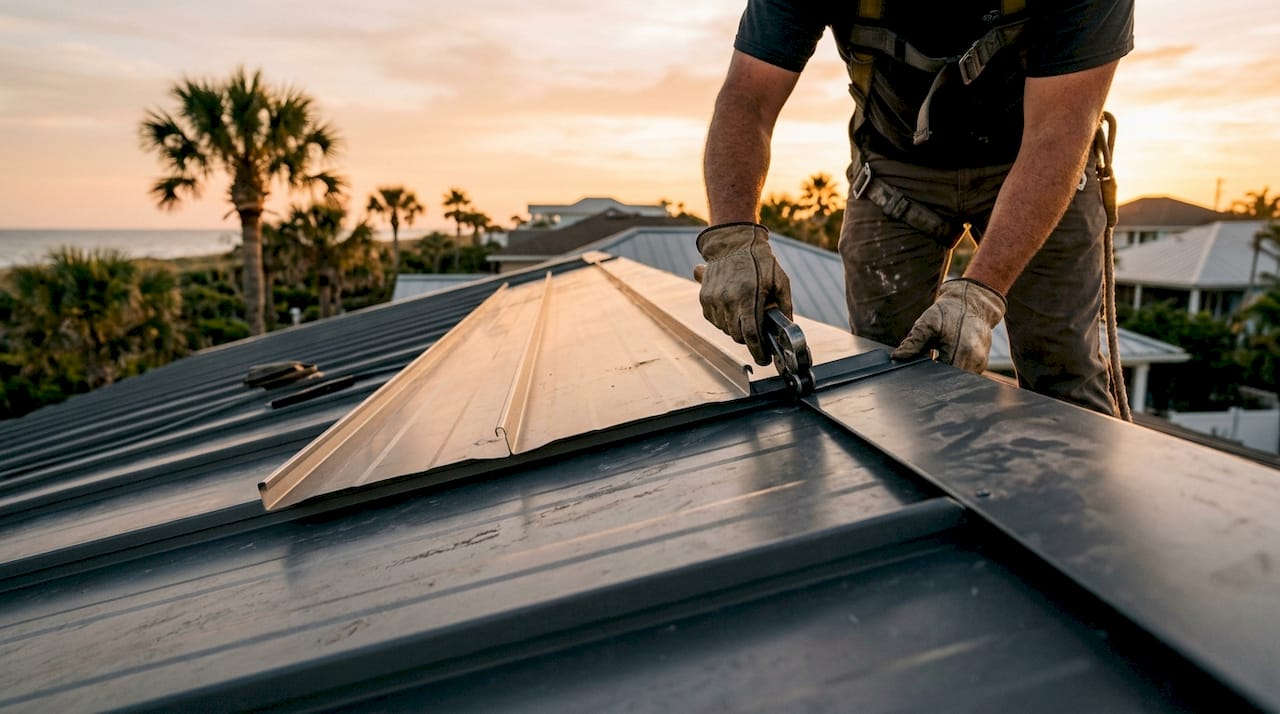
Mechanically interlocked standing seam metal roofs use raised, interlocking panel edges with concealed clips and fasteners. No screw head is exposed to rain or wind. The panels run continuously from ridge to eave, and the raised seams shed water without relying on sealant. These roofs are technically not fully joint-free since they feature seams at ridges and transitions, but concealed fastener systems create a continuous, interlocking surface with zero exposed penetrations, which is the functional goal.
True monolithic systems like Spray Polyurethane Foam (SPF) and silicone membrane coatings are genuinely joint-free. SPF is sprayed as a liquid and expands into a solid foam layer that bonds directly to the roof deck. A silicone or elastomeric topcoat is then applied over it. The result is a single, unbroken skin with no seams at all, not even at transitions. This is the closest thing to a truly seamless roof in the literal sense.
- Standing seam metal: Interlocking raised panels, concealed clips, 40–70 year lifespan, high upfront cost
- Snap-lock standing seam: Faster to install, lower cost, but rated for lower wind speeds than mechanical-lock
- SPF (Spray Polyurethane Foam): Monolithic, joint-free, excellent thermal insulation, requires topcoat renewal
- Silicone membrane coatings: Applied over existing roofs, fully bonded, UV-resistant, lower installation disruption
Pro Tip: Ask your installer specifically whether they are quoting a mechanical-lock or snap-lock standing seam system. The price difference is 10–15%, but the wind resistance difference is dramatic.
Seamless metal panels with thick gauge steel show less oil canning, the aesthetic rippling caused by internal panel stress, than traditional standing seam panels. For homeowners who care about curb appeal as much as performance, that distinction is worth knowing.
How does seamless roofing improve hurricane resilience?
Central Florida sits inside one of the most active hurricane corridors in the United States. A roof’s ability to survive a major storm depends on three things: wind speed rating, water tightness under dynamic rain, and the quality of attachment to the deck.
Mechanical-lock standing seam roofs achieve wind resistance up to 180 mph, which covers Category 5 hurricane conditions. Snap-lock and exposed fastener systems, by contrast, are rated for 100–140 mph and are not recommended for high-wind coastal zones. That gap represents the difference between a roof that survives a major storm and one that fails mid-event.
The structural logic is straightforward. Every exposed fastener is a potential failure point. Under hurricane-force wind, water does not fall vertically. It drives horizontally at high velocity, and any screw hole, lap joint, or unsealed edge becomes an entry point. Concealed clip systems eliminate that vulnerability entirely.
“Proper installation with concealed fasteners and high-quality flashing remains the most critical factor for hurricane survival, beyond the basic seamless design. The term ‘seamless’ represents a design philosophy focused on minimizing water intrusion points, not an absolute guarantee of storm-proof performance.”
Flashing quality at roof transitions, chimneys, and skylights is where many roofs fail even when the field panels perform well. A storm-ready roofing system treats every transition as a potential weak point and seals it accordingly. The roof deck itself also matters. A well-attached deck with ring-shank nails at code-required spacing gives the panels something solid to hold onto when uplift forces peak.
One misconception worth correcting: “seamless” does not mean “hurricane-proof.” Gauge thickness and panel attachment dramatically affect durability. A thinner 29-gauge exposed fastener panel fails far earlier than a thicker 24-gauge mechanical-lock panel, even if both are marketed as metal roofing. Engineering and installation quality determine storm survival, not the label on the product brochure.
Why choose seamless roofing? Cost, lifespan, and energy savings
The financial case for seamless roofing is strongest for homeowners who plan to stay in their property for ten or more years. The upfront cost is higher than asphalt shingles, but the long-term math shifts decisively in favor of metal and liquid-applied systems.
Standing seam metal roofing lasts 40–70 years and can save homeowners $5,000–$12,000 over 25 years by avoiding reroofing cycles, reducing cooling energy by 10–25%, and lowering insurance premiums by 5–35%. Asphalt shingles in Florida’s UV-intense climate typically need full replacement every 15–20 years. That means a homeowner with shingles pays for two or three roofs in the same period a metal roof owner pays for one.
| Factor | Standing seam metal | Asphalt shingles |
|---|---|---|
| Expected lifespan | 40–70 years | 15–20 years (Florida climate) |
| Cooling energy savings | 10–25% | Minimal |
| Insurance premium discount | 5–35% | Minimal |
| 25-year reroofing cycles | 0 | 1–2 |
| Wind resistance (mechanical-lock) | Up to 180 mph | 90–130 mph |
Liquid-applied systems like SPF achieve a 30–50 year lifespan with superior wind-uplift resistance and thermal insulation, provided the protective topcoat is renewed every 10–15 years. That renewal is far less expensive than a full reroof and keeps the system performing at its rated level.
The insurance discount angle is particularly relevant in Florida, where Citizens Property Insurance and private carriers have tightened underwriting standards. A roof rated for 180 mph wind with a documented installation by a certified contractor can qualify for meaningful premium reductions. That annual saving compounds over decades.
Pro Tip: Request your installer’s Florida Product Approval number for the specific panel system they are quoting. This document confirms the wind speed rating and is required for insurance discount eligibility in most Florida counties.
Homeowners focused on weatherproof roofing investment should also factor resale value. A documented metal roof with 30+ years of remaining life is a tangible selling point in a market where buyers increasingly ask about roof age and wind rating before making an offer.
Seamless roofing installation and maintenance in Central Florida
Seamless roofing installation requires specialized equipment and trained labor. Standing seam metal panels are often roll-formed on-site using a portable machine that produces continuous panels cut to the exact length of each roof run. This eliminates end-to-end panel joints in the field, which is one reason these systems outperform pre-cut panel systems in water resistance.
The installation sequence for a mechanical-lock standing seam roof follows a defined order:
- Deck inspection and preparation. The existing deck is inspected for rot, soft spots, and nail pull-through. Any compromised sections are replaced before new roofing goes down.
- Underlayment installation. A self-adhering or mechanically fastened underlayment is applied over the full deck as a secondary water barrier.
- Panel roll-forming and layout. Panels are formed on-site and laid out from one edge of the roof, with clips attached to the deck at each panel seam.
- Mechanical seaming. A powered seaming tool crimps the raised panel edges together, locking them without any exposed fastener.
- Flashing and trim installation. Ridge caps, eave trim, and all transition flashings are installed and sealed to complete the water barrier.
- Final inspection. Every seam, flashing, and penetration is checked before the crew leaves the site.
For SPF and silicone systems, the process differs. The existing roof surface is cleaned and primed, foam is sprayed in lifts to achieve the specified thickness, and the topcoat is applied immediately after the foam cures. The entire system bonds to the substrate, which is why it resists wind uplift so effectively.
Maintenance for standing seam metal is minimal. An annual visual inspection, gutter cleaning, and prompt attention to any flashing gaps covers most of what these roofs need. SPF systems require a topcoat renewal every 10–15 years to protect the foam from UV degradation. Skipping that renewal allows the foam to chalk and crack, which shortens the system’s life significantly.
Thomasroofingandrepair recommends scheduling a roof maintenance inspection after every named storm, even if no visible damage is apparent. Wind uplift can loosen clips or shift flashing without leaving obvious signs, and catching those issues early prevents water intrusion from developing into structural damage.
Pro Tip: For SPF roofs, run your hand across the surface after a few years. If the topcoat feels chalky or shows visible cracking, schedule a recoat before the next rainy season. Waiting until leaks appear means the foam itself has been compromised.
Key Takeaways
Seamless roofing is the most durable and leak-resistant roofing category available to Central Florida homeowners, with mechanical-lock standing seam metal rated up to 180 mph and liquid-applied systems offering 30–50 year lifespans when maintained correctly.
| Point | Details |
|---|---|
| Two main system types | Standing seam metal and liquid-applied membranes (SPF, silicone) serve different budgets and roof profiles. |
| Wind resistance matters most | Mechanical-lock systems resist up to 180 mph; snap-lock and exposed fastener systems top out at 100–140 mph. |
| Long-term savings are real | Metal roofing can save $5,000–$12,000 over 25 years through avoided reroofs, energy savings, and insurance discounts. |
| Installation quality is decisive | Gauge, attachment method, and flashing quality determine storm survival more than the “seamless” label alone. |
| Maintenance extends lifespan | SPF systems need topcoat renewal every 10–15 years; metal roofs need annual inspections and flashing checks. |
What I’ve learned after years of watching Florida roofs fail and survive
The word “seamless” gets used loosely in roofing sales conversations, and that looseness costs homeowners money. I have seen snap-lock metal roofs marketed as “seamless hurricane protection” fail at wind speeds well below what a mechanical-lock system handles without issue. The panel looked identical from the street. The performance was not.
The homeowners who get the most from seamless roofing are the ones who ask hard questions before signing a contract. What is the gauge of the panel? Is this a mechanical-lock or snap-lock system? What is the Florida Product Approval number? Those three questions filter out a significant portion of underperforming installations before they happen.
The energy savings argument is also frequently undersold. A 10–25% reduction in cooling costs is meaningful in a Central Florida home running air conditioning nine months of the year. Over a decade, that adds up to thousands of dollars that offset the higher upfront cost of metal over shingles.
My honest observation is that seamless roofing is not the right choice for every homeowner. If you are selling your property within five years, the payback period on a full metal roof installation may not work in your favor. But if you are staying, or if you are buying a home and want a roof that will not need replacement during your ownership, the math is clear. The roofing choices that boost real estate returns consistently point toward durable, wind-rated systems over the cheapest available option.
— Thomasroofingandrepair
Thomasroofingandrepair’s seamless roofing services in Central Florida
Central Florida homeowners have a specific set of roofing challenges that generic contractors often underestimate. Thomas Roofing and Repair specializes in residential roofing across Brevard, Volusia, and Orange counties, with direct experience installing standing seam metal and liquid-applied systems in hurricane-rated applications.

Whether you are replacing an aging shingle roof before storm season or evaluating a new build, Thomasroofingandrepair provides free estimates and detailed system recommendations based on your roof profile, budget, and wind zone. The team handles roof installation in Palm Bay, installation in Horizon West, and communities throughout the region. Every installation includes documentation of the Florida Product Approval number for insurance purposes. Contact Thomasroofingandrepair to schedule your free estimate and get a system matched to your home’s actual needs.
FAQ
What is the difference between seamless and standing seam roofing?
Standing seam metal roofing uses interlocking raised panels with concealed fasteners and is often called “seamless” in the industry. True seamless roofing refers to monolithic liquid-applied systems like SPF or silicone membranes that cure into a single joint-free surface with no seams at all.
Is seamless roofing durable enough for Florida hurricanes?
Mechanical-lock standing seam metal roofs are rated up to 180 mph, which covers Category 5 conditions. Durability depends on gauge thickness, attachment method, and flashing quality, not just the seamless design itself.
How long does seamless roofing last in Central Florida?
Standing seam metal lasts 40–70 years. SPF and silicone systems last 30–50 years when the protective topcoat is renewed every 10–15 years. Both significantly outlast asphalt shingles in Florida’s UV and heat conditions.
Does seamless roofing lower homeowner’s insurance in Florida?
A documented wind-rated seamless metal roof can qualify for insurance premium discounts of 5–35% in Florida. Carriers require the Florida Product Approval number and proof of certified installation to apply the discount.
How much more does seamless roofing cost than asphalt shingles?
Mechanical-lock standing seam systems cost more upfront than asphalt shingles, but the 25-year total cost is lower when you account for avoided reroofing, energy savings of 10–25%, and insurance discounts. Mechanical-lock systems also cost 10–15% more than snap-lock systems but deliver significantly higher storm protection.
Recommended
- What is roofing insurance? 2026 guide for Central Florida
- Why invest in certified roofing in Central Florida 2026
- Roof Overlay Guide: Save More on Your Central Florida Roof
- What is reflective roofing: energy-saving guide for Florida
- Roofing Company Orlando, FL
- Roofing Company Titusville, FL
- Roofing Company DeLand, FL