
TL;DR:
- Regular, documented roof inspections help detect small problems early, preventing costly water damage and structural failures. Prioritizing flashing, shingles, gutters, and attic conditions can extend roof lifespan, save money, and protect warranties. Using photos and professional evaluations ensures accurate claims and effective maintenance for property owners and managers.
Skipping a roof inspection this year could cost you far more than you expect. Water damage, mold, and structural failure are not random bad luck. They follow directly from neglect. A solid roof inspection checklist 2026 gives you the framework to spot small problems before they turn into five-figure repair bills. Whether you own a single-family home in Brevard County or manage a portfolio of rental properties in Central Florida, the same principle applies: consistent, documented inspections protect your investment and keep your warranty intact.
Table of Contents
- Key takeaways
- 1. Use the roof inspection checklist 2026 to set your schedule
- 2. Shingles: the first thing every checklist covers
- 3. Flashing and seals: your highest-priority inspection zone
- 4. Gutters and drainage: the part homeowners ignore too long
- 5. Ridge caps and roof valleys: critical stress points
- 6. Attic ventilation and insulation: the hidden driver of roof failure
- 7. Common roof issues in 2026: a prioritized comparison
- 8. Documenting your inspection: why photos matter more than memory
- My perspective on what most homeowners get wrong
- How Thomasroofingandrepair can help with your 2026 inspections
- FAQ
Key takeaways
| Point | Details |
|---|---|
| Inspect at least twice yearly | Schedule spring and fall inspections plus a check within 48 hours of any major storm. |
| Flashing is your top risk zone | Most water intrusion starts at flashing, not shingles — prioritize it every inspection. |
| Early detection saves big money | Regular inspections can cut repair costs by 60 to 80 percent. |
| Document everything with photos | Photo records strengthen insurance claims and create a maintenance history that adds property value. |
| Attic checks are non-negotiable | Ventilation and insulation problems directly accelerate shingle wear and cause ice dams. |
1. Use the roof inspection checklist 2026 to set your schedule
The single most common mistake homeowners make is treating an inspection as a one-time event rather than a routine. Semi-annual inspections in spring and fall are the standard recommended by the National Roofing Contractors Association and most shingle manufacturers. Miss those windows consistently, and you may also void your warranty without realizing it.
Spring inspections focus on winter damage: freeze-thaw stress, cracked sealants, and debris accumulation. Fall inspections prepare the roof for rain, wind, and whatever cold season arrives. In Florida, where hurricane season runs June through November, you also need a post-storm protocol baked into your calendar.
Pro Tip: About 85% of roof problems are visible from the ground with a good pair of binoculars. Walk the perimeter of your home first before ever thinking about climbing a ladder. You will spot most issues, stay safer, and save time.
Property managers with multiple buildings should build a rotating inspection calendar rather than trying to tackle everything at once. A spreadsheet tied to seasonal dates works well. For storm events, inspections within 48 hours identify hail bruising, wind-lifted shingles, and damage details that fade or change if left a week.
2. Shingles: the first thing every checklist covers
Shingles are the most visible part of your roof and the first line of defense against water. When you look at them, you are looking for four main problems: granule loss, curling edges, missing tabs, and nail pops.
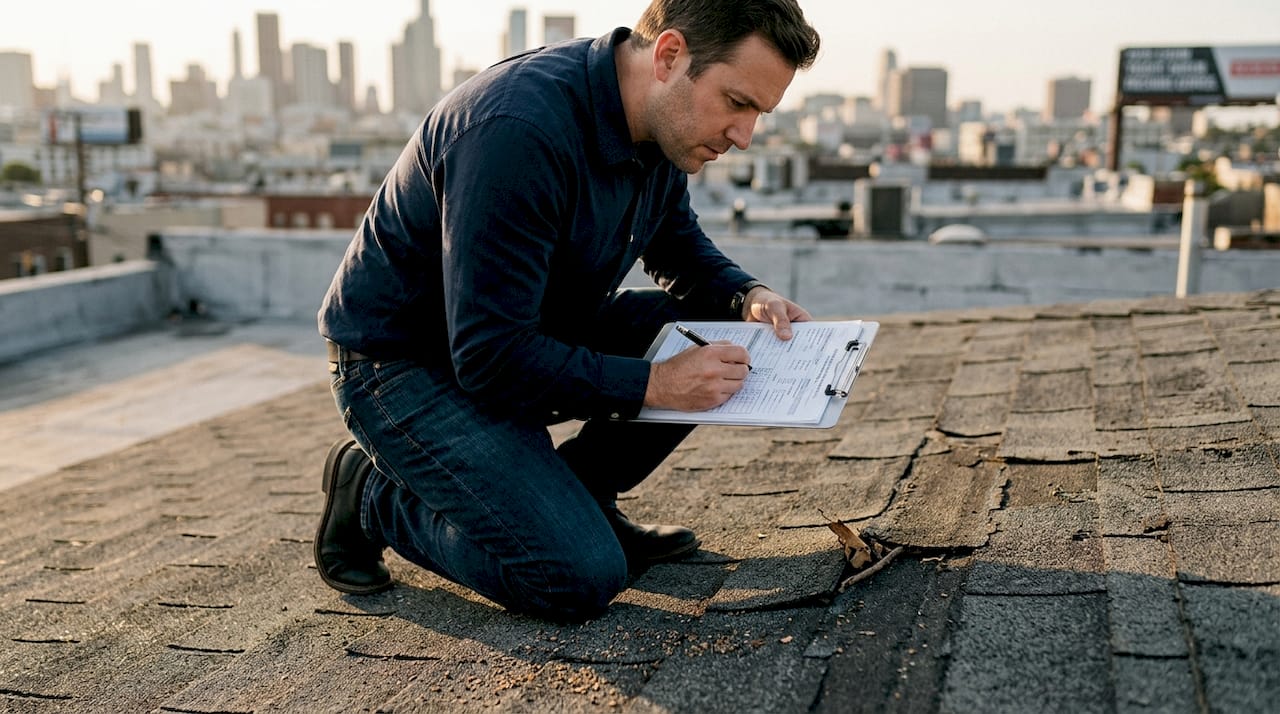
Granule loss shows up as bare patches on the shingle surface or a buildup of grit in your gutters. It signals UV degradation and shortens the remaining roof life significantly. Curling shingles, either at the edges (cupping) or in the middle (clawing), point to moisture problems or age-related shrinkage. Missing tabs leave the decking directly exposed to rain. Nail pops create small raised points that break the seal line and let water creep under.
Walk around the house with binoculars first. Then, if safe access is available, check the roof surface up close. Look for any shingle that appears raised, buckled, or obviously darker than its neighbors. Darker patches often indicate trapped moisture underneath.
Pro Tip: Try the “one-finger test” for seal integrity: press gently under the lower edge of a shingle tab with one finger. If it lifts easily without resistance, the seal has failed. That shingle is a wind damage waiting to happen.
3. Flashing and seals: your highest-priority inspection zone
This is where most homeowners underestimate the risk. Flashing failures cause the majority of interior water damage that gets wrongly blamed on shingles. The flashing around your chimney, skylights, pipe boots, and roof-to-wall transitions takes constant thermal stress. Metal expands and contracts with temperature, and sealants crack over time.
Check every flashing point for:
- Lifted or separated metal edges
- Rust, corrosion, or discoloration
- Cracked or missing caulk at transition points
- Separation at chimney base corners
- Deteriorated rubber boots around vent pipes
Pipe boots deserve special attention. Cracked pipe boots are one of the most frequently overlooked problems in DIY inspections, yet they are a leading cause of premature roof failure. Rubber degrades from UV exposure and temperature cycling. Squeeze the boot gently. If it cracks or shows obvious brittleness, replace it. A new pipe boot costs under $20. The water damage it prevents can easily top $10,000.
4. Gutters and drainage: the part homeowners ignore too long
Your gutters and downspouts are a direct extension of your roofing system. Clogged gutters force water to pool at the roof edge, which accelerates fascia rot, promotes mold, and in colder climates drives ice dam formation. As part of your roof maintenance checklist 2026, clean them thoroughly in both spring and fall.
While cleaning, check these specific items:
- Downspout flow: run water through and confirm it exits freely at ground level
- Gutter slope: water should not pool anywhere in the channel
- Attachment points: look for sections pulling away from the fascia board
- Debris screens: clean or replace if packed with leaves and seeds
In Central Florida, tree litter accumulates fast year-round. Trimming back overhanging branches is one of the most underrated preventive steps any homeowner can take. Leaves decay into organic material that holds moisture against the roof surface. Branches that touch the roof during wind events abrade shingles over time.
5. Ridge caps and roof valleys: critical stress points
The ridge cap seals the peak of your roof where two slopes meet. It is constantly exposed to full sun, wind, and in storm season, driving rain. Look for raised sections, cracking, or missing caps. Any gap at the ridge becomes a direct water entry point.
Roof valleys, where two roof planes intersect, channel the highest volume of water on your entire roof. They accumulate debris faster than flat sections and are common entry points for water intrusion. Check your roof valleys for cracked valley flashing, shingle wear at the center line, or any visible gaps in the material.
During storm season in Florida, debris tends to dam up in valleys first. Clear them during every inspection, not just the annual cleanout.
6. Attic ventilation and insulation: the hidden driver of roof failure
Most homeowners never think to check the attic during a roof inspection. That is a significant oversight. What happens in your attic directly affects how long your shingles last and whether ice dams form.
Poor attic ventilation causes heat to build up. Attic temperatures exceeding 130°F accelerate shingle degradation from the underside. Inadequate insulation combined with air leaks causes warm interior air to melt snow on the roof surface, which then refreezes at the cold eave and forms an ice dam. Ice dams originate from heat loss through the attic, not from roof surface conditions, so inspecting the roof alone misses the root cause.
In your attic, look for:
- Daylight visible through the roof decking (an immediate red flag)
- Staining or discoloration on the decking boards
- Insulation that is wet, compressed, or displaced
- Blocked soffit or ridge vents
- Signs of condensation or mold growth
7. Common roof issues in 2026: a prioritized comparison
Your roof condition assessment checklist should help you sort what needs immediate action from what can be monitored. Use this table to triage what you find.
| Problem | Urgency level | Typical consequence if ignored | Recommended action |
|---|---|---|---|
| Active leak or water stain inside | Critical | Structural damage, mold | Call a professional within 24 hours |
| Missing or lifted flashing | High | Water intrusion at entry points | Repair within 1 to 2 weeks |
| Missing shingle tabs | High | Accelerated deck damage | Schedule repair before next rain event |
| Cracked or split pipe boots | High | Slow leak, hidden mold growth | Replace within 30 days |
| Significant granule loss | Moderate | Shortened roof lifespan | Document and monitor, plan replacement |
| Clogged gutters | Moderate | Fascia rot, potential ice dams | Clean immediately |
| Minor flashing caulk cracks | Low | Future water entry if neglected | Reseal at next maintenance window |
The cost data supports urgency. 81% of commercial roof failures occur on roofs with no documented inspection in the prior 24 months. Average claims range from $22,000 to $68,000. Residential losses follow the same pattern.
8. Documenting your inspection: why photos matter more than memory
Written notes fade. Photos do not. Every time you complete a roof inspection, photograph every problem area and every connection point, including gutters, flashing, pipe boots, and ridge sections. Time-stamp them. Store them in a dedicated folder organized by date.
This habit builds two things over time. First, it gives you a clear record of how fast conditions are changing. A granule loss photo from spring compared to fall tells you whether that section is deteriorating quickly or holding steady. Second, it creates a documented maintenance narrative that insurance carriers increasingly require for claim approval. After a hail storm, the difference between a fast claim approval and a disputed denial often comes down to whether you have pre-storm documentation.
My perspective on what most homeowners get wrong
I have seen what happens when homeowners treat the roof as a “wait and see” system. By the time a visible interior leak shows up, the damage behind the walls and in the decking is usually months old. The fix is always more expensive, more disruptive, and harder to document for insurance.
What I have learned is that the specific areas most inspections miss are flashing transitions and attic conditions. Shingles get all the attention because they are visible. But timely flashing repairs regularly prevent $10,000-plus in subsequent damage. An attic walkthrough adds 15 minutes to an inspection and catches ventilation failures that accelerate shingle wear from the inside.
My honest advice: do the binocular ground check yourself twice a year. Take photos. But get a professional on the roof at least once every two years, or immediately after any significant storm. A professional sees what you cannot, documents what matters for claims, and gives you a repair timeline you can actually budget for. DIY inspections and professional assessments are not competing options. They work together.
— Thomasroofingandrepair
How Thomasroofingandrepair can help with your 2026 inspections
If your inspection turns up anything concerning, whether lifted flashing, storm damage, or a leak you cannot trace, Thomas Roofing and Repair has the expertise to assess and fix it right. Serving homeowners and property managers across Brevard, Volusia, and Orange counties, the team handles everything from routine roof maintenance and inspections to full storm damage assessments.

After a major weather event, fast action protects your home and your claim. Thomasroofingandrepair’s emergency repair service is designed to respond quickly, document the damage thoroughly, and get your roof sealed and stabilized before further damage sets in. If you need professional repair in Titusville or surrounding areas, you can also request an estimate through their Titusville roof repair page. Do not wait for a drip to become a flood. Schedule your inspection now.
FAQ
How often should I inspect my roof in 2026?
Inspect your roof at least twice per year, in spring and fall, and within 48 hours after any major storm event to maintain warranty coverage and catch damage early.
What are the most common roof issues in 2026?
The most frequent problems include failed flashing seals, missing or lifted shingles, cracked pipe boots, granule loss, and clogged gutters that lead to water backup and rot.
Can I do a roof inspection myself?
Yes, about 85% of roof problems are visible from the ground using binoculars, making a DIY inspection practical and safe for routine checks. For detailed assessments, hire a professional at least every two years.
Why does attic ventilation matter for roof condition?
Poor attic ventilation causes heat to build up and can push attic temperatures above 130°F, which degrades shingles from the underside and can trigger ice dams in colder months.
How does documentation help with roof insurance claims?
A disciplined photo log of your roof’s condition before and after storms creates clear evidence for insurance carriers, reducing claim disputes and speeding up approval timelines.