
 407-408-0577
TL;DR:
- Low-slope roofs in Florida are built with a slight pitch, not completely flat.
- Proper drainage, membrane quality, and maintenance are critical for flat roof longevity.
- Flat roofs are suitable for creating outdoor space, solar panels, and equipment placement.
Most people picture a completely level surface when they hear “flat roof,” but that’s not quite right. A low-slope roof is actually built with a gentle pitch to move water toward drains, typically less than a 2:12 slope. For homeowners and property managers in Central Florida, understanding this distinction matters more than you might think. Florida’s intense rain, heat, and hurricane-season winds put every roofing system to the test. This guide breaks down what flat roofing actually is, how it’s built, which materials work best, what challenges to watch for, and how it fits the specific demands of properties across Brevard, Volusia, and Orange counties.
Table of Contents
- What is flat roofing? Definition and core principles
- Major components of a flat roof system
- Flat roofing material options: Pros and cons
- Drainage and common flat roof challenges
- When and why to choose flat roofing in Central Florida
- Flat roofing: What experts wish every homeowner in Florida knew
- Get expert help for your flat roofing project
- Frequently asked questions
Key Takeaways
| Point | Details |
|---|---|
| Flat roofs are low-slope | They are not completely level but engineered to channel water efficiently. |
| Multi-layer design matters | A flat roof’s durability relies on proper assembly of deck, insulation, membrane, and drainage. |
| Material choice is key | Options like BUR, modified bitumen, TPO, and EPDM each have unique strengths for Florida weather. |
| Drainage prevents damage | Efficient water removal and regular maintenance stop leaks and structural issues. |
| Professional help saves money | Expert installation and regular inspections extend life and protect your property. |
What is flat roofing? Definition and core principles
Flat roofing is a term that has stuck around despite being a little misleading. A more accurate label is low-slope roofing, because these roofs are never perfectly level. In roofing practice, low-slope roofs are defined as having a pitch below 2:12, meaning the roof rises less than 2 inches for every 12 inches of horizontal distance. That subtle angle is intentional and critical.
Unlike steep-slope roofs where rain runs off quickly by gravity alone, low-slope systems need carefully designed drainage to move water off the surface before it pools and causes problems. This is why flat roofing requires a completely different set of materials, installation methods, and ongoing maintenance practices compared to traditional pitched roofs.
You’ll find flat roofs on a wide range of buildings. They are popular on commercial roofing types like warehouses, retail stores, and office buildings, and they’re increasingly appearing on modern residential homes, additions, and covered patios throughout Central Florida.
Here’s what sets flat roofing apart at a glance:
- Low slope (under 2:12 pitch) rather than a true flat surface
- Relies on drains, scuppers, and tapered insulation to move water
- Requires waterproof membrane systems, not just overlapping shingles
- Works for both commercial and residential structures
- Needs professional design to handle wind uplift, UV exposure, and heavy rainfall
“A ‘flat’ roof is actually a low-slope roof (not truly level).” — American Roofing Guide
For Florida properties, the drainage design is not a minor detail. It’s the foundation of the whole system’s performance. Getting this right from the start saves thousands of dollars in repairs down the road.
Major components of a flat roof system
Beneath that smooth surface, a flat roof is actually a carefully layered assembly. Think of it like a sandwich, where every layer has a specific job. Skipping or cutting corners on any one layer undermines the whole system.
According to flat roofing systems research, low-slope assemblies are engineered systems that combine the structural deck, insulation, waterproofing membrane, and drainage components. Here’s how those layers stack up, from the bottom of the structure to the exposed surface:
- Structural deck — The base, usually wood, concrete, or steel, that supports everything above it.
- Vapor barrier — Prevents moisture from rising up through the building into the insulation.
- Insulation layer — Controls heat transfer and can be tapered to create slope for drainage.
- Cover board — A rigid layer that protects insulation and gives the membrane a smooth surface to bond to.
- Waterproof membrane — The primary weather barrier that keeps rain out.
- Flashings — Metal or membrane strips that seal edges, penetrations, and transitions.
- Drainage components — Interior drains, scuppers (wall openings), or gutters that carry water off the roof.
| Component | Primary purpose |
|---|---|
| Structural deck | Structural support for the entire system |
| Vapor barrier | Moisture control from below |
| Insulation | Thermal performance and slope creation |
| Cover board | Membrane protection and adhesion surface |
| Waterproof membrane | Primary water resistance |
| Flashings | Sealing edges and penetrations |
| Drainage components | Water removal from the roof surface |
Pro Tip: Ask your roofing contractor how drainage will be designed before installation begins. Tapered insulation that creates slope toward drains is far more effective than relying on the building’s natural pitch alone, especially in Florida where rain events are intense and frequent.
A proper roof maintenance guide will always include checking each of these layers because a failure in one affects the rest. Understanding the system as a whole helps you ask better questions and catch problems early.
Flat roofing material options: Pros and cons
Choosing a flat roof membrane is not a one-size-fits-all decision. Common membrane categories include built-up roofing (BUR), modified bitumen, and single-ply membranes like TPO and EPDM. Each handles Florida’s climate a little differently.
Layered versus sheet membranes behave differently under UV exposure, wind stress, and puncture conditions, which is exactly why material selection matters here in Central Florida.
| Material | Lifespan | UV resistance | Maintenance | Relative cost |
|---|---|---|---|---|
| Built-up (BUR) | 15-30 years | Moderate | Low to moderate | Moderate |
| Modified bitumen | 15-25 years | Good | Low | Moderate |
| TPO (single-ply) | 15-25 years | Excellent | Low | Low to moderate |
| EPDM (single-ply) | 20-30 years | Good | Low | Low to moderate |
Here’s how each material performs in Florida’s conditions:
- BUR (built-up roofing): Multiple layers of asphalt and felt create a tough, redundant system. Heavier and more labor-intensive to install, but very proven over decades of Florida use.
- Modified bitumen: A factory-engineered version of asphalt with added polymers for flexibility. Handles temperature swings well and is a strong choice for residential flat additions.
- TPO: A white or light-colored single-ply membrane that reflects UV rays, reducing cooling costs. Excellent for Florida’s heat and increasingly popular on commercial roof types because of its weldable seams.
- EPDM: A rubber-based membrane with a long track record. Performs well against UV and ozone but can absorb heat if darker in color.
Pro Tip: Don’t choose a membrane based on price alone. Always match the material and installation method to your building’s actual exposure, slope, and use. A TPO membrane on a sun-drenched commercial roof saves far more in cooling costs than the upfront price difference suggests.
Drainage and common flat roof challenges
Knowing your materials is half the battle. The other half is making sure water leaves your roof quickly and completely after every Florida rainstorm. Flat roofs use a combination of interior drains, scuppers, and tapered insulation to manage this, but when any part of the system fails, problems escalate fast.
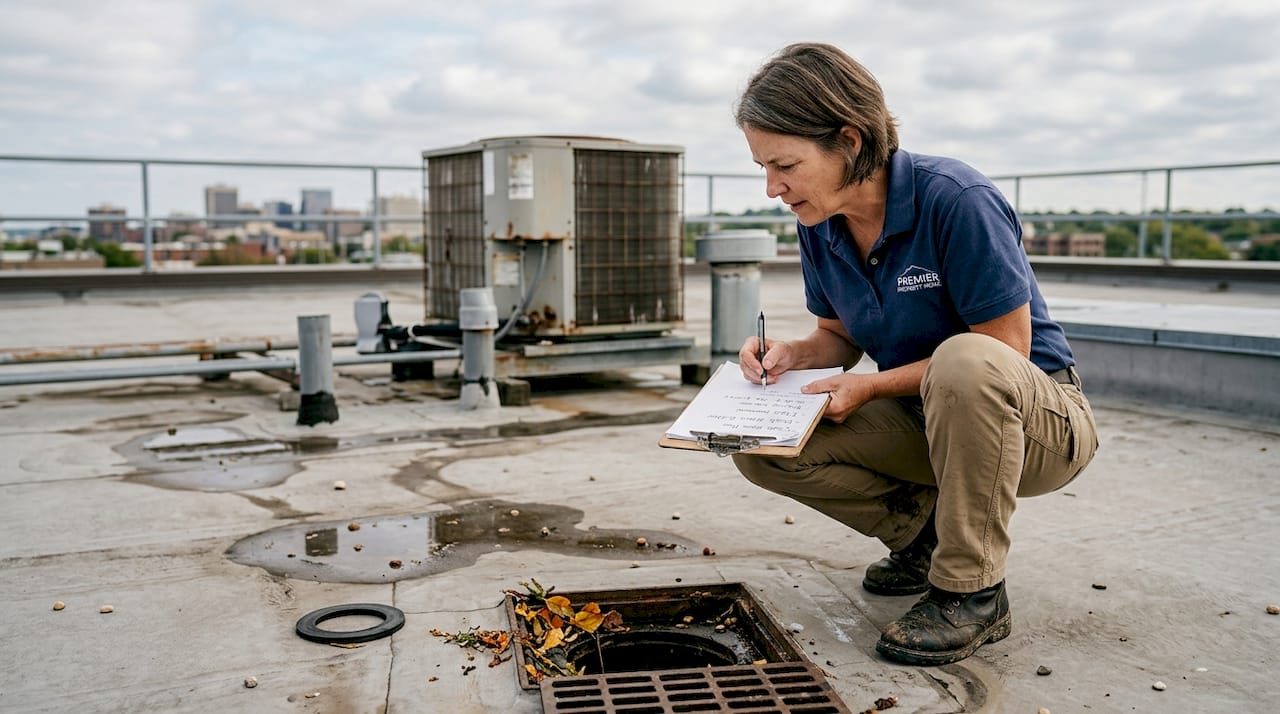
Roof ponding, which means standing water remaining on the roof surface for more than 48 hours after rainfall, is one of the most damaging conditions a flat roof can face. It accelerates membrane breakdown, adds structural weight, and creates a perfect environment for mold and leaks.
“Flat roofs are engineered to shed water toward drains and scuppers, and ponding water lingering after rainfall accelerates roof degradation.”
Here’s what to watch for and how to stay ahead of drainage issues:
- Clogged interior drains: Leaves, dirt, and debris block the drain opening. Inspect and clear drains at least twice a year.
- Scupper blockages: Wall-mounted scuppers are equally prone to blockage and should be included in every cleaning visit.
- Visible ponding: If you notice water sitting on the roof 48 or more hours after rain, it’s time for a professional assessment.
- Soft spots or interior ceiling stains: These are signs that water has already penetrated the membrane and is working through the layers.
- Membrane bubbling or blistering: Moisture trapped beneath the membrane causes it to separate and fail faster.
Our flat roof repair guide covers what to do if you spot any of these warning signs. Following a consistent roof maintenance process is the most reliable way to catch drainage problems before they turn into expensive structural issues. If you’re wondering whether your roof has reached the end of its life, review common roof replacement signs to know when repairs are no longer enough.
When and why to choose flat roofing in Central Florida
After understanding the challenges, the benefits of flat roofing in Central Florida become clear when you match the right system to the right property. These roofs open up possibilities that pitched roofs simply can’t offer.
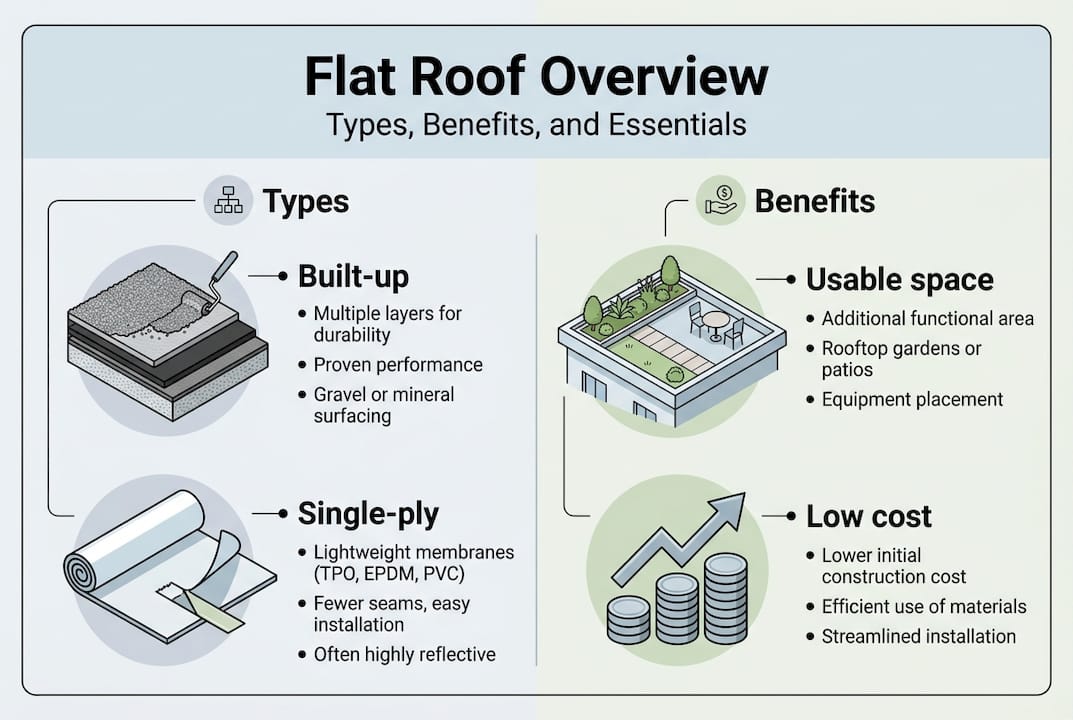
Flat roofs create usable outdoor space. Rooftop decks, HVAC equipment pads, and solar panel arrays all fit naturally on a low-slope surface. For a small business owner in Orange County or a homeowner in Brevard adding a modern extension, flat roofing can turn dead square footage into something functional.
A well-designed flat roof system, with membrane choice and attachment tailored to wind uplift, UV, and ponding management, fits Florida’s building codes and its extreme climate conditions. That’s the key phrase: tailored to the conditions, not just installed generically.
Here’s a balanced look at advantages and drawbacks for Central Florida properties:
Advantages:
- Lower material and labor costs compared to steep-slope roofs of similar square footage
- Easier and safer for contractors to access during maintenance or repairs
- Compatible with rooftop solar installations, which can dramatically cut energy bills
- Supports modern, clean architectural styles increasingly popular in new construction
- Allows HVAC units and other equipment to be placed off the ground
Drawbacks:
- Requires professional drainage design from the start
- Florida’s permitting process for flat roofs can add planning time
- Higher maintenance attention needed compared to steep-slope roofs
- Ponding risk is higher in areas with poor natural drainage or improper installation
Pro Tip: Before committing to a flat roof for your Central Florida property, get a professional site assessment. Wind uplift, sun angle, and local rainfall patterns vary enough across Brevard, Volusia, and Orange counties that a design that works perfectly in one location may need adjustments just a few miles away. Our roof maintenance tips can help you stay on top of your system once it’s in place.
Flat roofing: What experts wish every homeowner in Florida knew
Here’s something that surprises most property owners: the majority of flat roof failures we see are not caused by bad materials. They come from rushed design, skipped maintenance, or mismatched installation methods for the local climate. The membrane itself is rarely the villain.
In Florida, drainage is more important than brand name. A premium membrane installed with poor drainage design will fail faster than a modest membrane with excellent water management. We see this pattern repeatedly, and it’s 100% preventable with qualified installation from the start.
The popular myth that all flat roofs leak is simply wrong. When built correctly and maintained consistently, flat roofs deliver decades of protection. The owners who avoid problems are the ones who schedule regular inspections rather than waiting for a ceiling stain to tell them something is wrong. Proactive beats reactive every single time in Florida’s climate.
Get expert help for your flat roofing project
Flat roofing in Central Florida is not a DIY project. The combination of intense UV exposure, hurricane-force winds, and near-daily summer rainstorms means your system needs to be designed and installed by professionals who know this region.

At Thomas Roofing and Repair, we work with homeowners and property managers across Brevard, Volusia, and Orange counties on everything from new flat roof installations to repairs and full inspections. If storm damage is a concern, our storm damage repair guide is a great place to start. For those who want durable roofing solutions built to last in Florida’s demanding climate, or if you’re ready to talk to flat roof repair experts, reach out today for a free estimate.
Frequently asked questions
Are flat roofs really flat?
No, flat roofs are built with a slight slope to direct water toward drains or scuppers. A truly level roof would trap water and fail quickly.
What is the most common flat roofing material?
The most common materials are built-up roofing, modified bitumen, and single-ply membranes like TPO and EPDM, each suited to different budgets and exposure conditions.
What causes leaks in flat roofs?
Improper drainage is the leading culprit. Ponding water that sits more than 48 hours breaks down the membrane faster than almost any other condition.
How do I maintain my flat roof in Florida?
Clean your drains and scuppers at least twice a year, schedule professional inspections annually, and address any membrane damage or soft spots immediately before Florida’s rainy season arrives.
Is flat roofing more affordable than pitched roofing?
Flat roofs generally cost less to build per square foot, but long-term savings depend heavily on proper drainage design and consistent maintenance to avoid premature repairs or replacement.