
TL;DR:
- Many Central Florida homeowners underestimate storm repair costs because of insurance valuation methods and hurricane deductibles. Roof age, damage scope, and documentation significantly influence insurance payouts and out-of-pocket expenses. Proper planning, understanding policy details, and timely documentation help homeowners navigate storm-related roof repairs effectively.
Most Central Florida homeowners assume their insurance policy covers roof repairs after a storm, and then the first check arrives and it’s thousands less than expected. Understanding the cost factors for insurance roof repairs before you file a claim is what separates a manageable repair from a financial shock. From hurricane deductibles to depreciation holdbacks, the variables that determine what you actually pay out of pocket are specific, calculable, and worth knowing now.
Table of Contents
- Key takeaways
- 1. How insurance valuation methods affect your roof repair costs
- 2. Impact of Florida hurricane deductibles on insurance roof repair costs
- 3. Role of roof age, condition, and materials in insurance cost factors
- 4. Extent of damage and repair scope influence on insurance repair cost estimates
- 5. How timing, payment staging, and working capital affect your repair costs
- 6. Summary comparison of key cost factors and budgeting advice
- What I’ve learned about managing roof repair costs after storms
- How Thomasroofingandrepair helps you navigate insurance roof repairs
- FAQ
Key takeaways
| Point | Details |
|---|---|
| RCV vs. ACV changes everything | Replacement cost value policies pay more upfront; actual cash value policies reduce your payout based on roof age. |
| Hurricane deductibles are percentage-based | On a $400,000 home, a 5% hurricane deductible means $20,000 out of pocket before insurance pays anything. |
| Roof age limits your coverage | Roofs older than 15 to 20 years often get downgraded to ACV-only coverage, shrinking your settlement. |
| Scope disputes cost you money | Disagreements between adjusters and contractors over what’s included regularly leave homeowners covering the gap. |
| Document everything before damage | Maintenance records, photos, and inspection reports directly affect claim approvals and payout amounts. |
1. How insurance valuation methods affect your roof repair costs
The single biggest factor shaping your roof repair insurance costs is whether your policy pays replacement cost value (RCV) or actual cash value (ACV). Most homeowners don’t fully understand this difference until they’re staring at an underpayment.
RCV vs. ACV coverage works like this: an RCV policy pays what it actually costs to repair or replace your roof today, minus your deductible. An ACV policy reduces that payout by depreciation calculated on your roof’s age and condition. If your 12-year-old asphalt roof costs $15,000 to replace and has depreciated 40%, your ACV payment would be around $9,000 before the deductible comes out.
There’s another wrinkle with RCV policies that catches homeowners off guard. Insurers often pay in two stages under RCV: first an initial payment reflecting the ACV, then a second “recoverable depreciation” payment released only after repairs are completed and documented. That means you need working capital to get repairs started before you receive the full settlement amount.
Pro Tip: Ask your insurer directly whether your policy is RCV or ACV, and request clarification on how and when depreciation is released. Get it in writing before you file.
Here’s what that two-stage process looks like in practice:
- Initial payment reflects ACV (depreciated value minus deductible)
- Repairs must be completed and documented before depreciation is released
- The gap between those two payments can range from a few hundred to several thousand dollars
- Financing or savings may be needed to bridge that gap
Understanding your roofing insurance coverage type is the first thing to check before storm season hits.
2. Impact of Florida hurricane deductibles on insurance roof repair costs
Standard homeowner policies have flat deductibles, typically $500 to $2,500. Florida hurricane deductibles work completely differently, and they’re one of the most underestimated roof repair expense factors in the state.
Florida hurricane deductibles are percentage-based, calculated as a percentage of your home’s insured dwelling value rather than a fixed dollar amount. Common percentages are 2%, 5%, and 10%. On a home insured for $400,000, the numbers look like this:
- 2% deductible: $8,000 out of pocket
- 5% deductible: $20,000 out of pocket
- 10% deductible: $40,000 out of pocket
Those figures apply before your insurer pays a single dollar toward repairs. Most people who bought their policy years ago have no idea what their hurricane deductible percentage actually translates to in dollars today, especially after home values increased significantly.
Florida homeowners regularly underestimate hurricane deductibles because the percentage framing feels abstract until you do the math. Your flat deductible applies to non-hurricane claims like a fallen tree branch. The hurricane deductible kicks in specifically for windstorm and named storm events, which is exactly when most Central Florida roof damage occurs.
Review your insurance deductible details now and calculate the actual dollar amount so it’s not a surprise when you need it most.
3. Role of roof age, condition, and materials in insurance cost factors
Your roof’s age isn’t just a maintenance concern. It directly controls how your insurer calculates your settlement and whether they’ll even cover you at full replacement value.
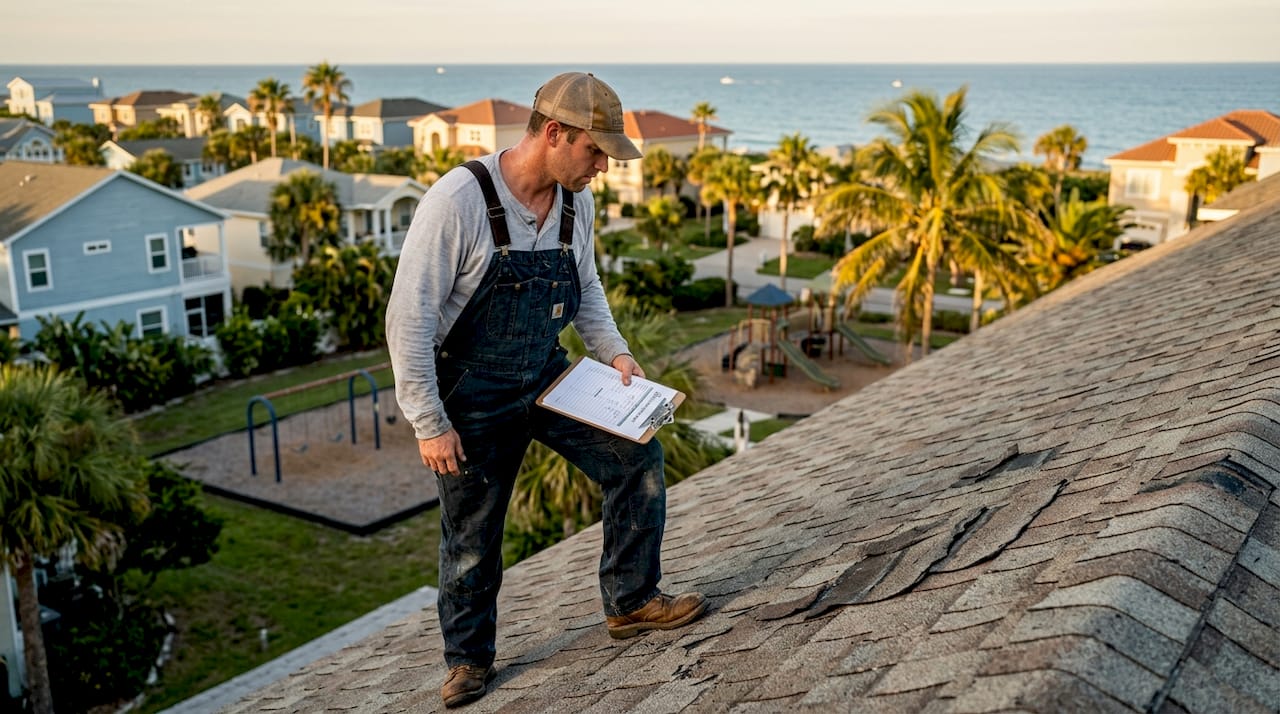
Roofs older than 15 to 20 years frequently get downgraded to ACV-only coverage, meaning no recoverable depreciation at all. Some insurers non-renew policies on homes with aging roofs entirely. For Central Florida property managers overseeing multiple properties, this creates a compounding financial risk when storm season arrives.
The roofing material also matters more than most people realize:
- Asphalt shingles: Most common, lowest upfront cost, but age faster in Florida’s heat and UV exposure
- Metal roofing: Higher installation cost but depreciates slower, often earns better insurance rates
- Concrete or clay tile: Durable but expensive to repair; matching tile after damage is a common scope dispute
- Wood shake: Some insurers won’t cover it at all in fire-risk or high-humidity areas
Pro Tip: Get a professional roof inspection every two to three years and keep the report on file. If your insurer audits your claim, documented maintenance history is evidence that the damage was storm-related, not neglect.
Poor maintenance is the easiest reason for an insurer to reduce or deny a claim. A roof with missing shingles or visible wear before a storm gives adjusters grounds to argue pre-existing damage. Regular roof repair documentation protects your claim as much as the repairs themselves.
4. Extent of damage and repair scope influence on insurance repair cost estimates
Not all storm damage looks the same from the outside, and that gap between what’s visible and what’s actually damaged is where many insurance claim roof repairs run into trouble.
Typical roof repair costs range from $400 to $2,000 for minor work, while full replacements run $3,500 to $12,000 per 1,000 square feet depending on materials. The coverage you receive depends heavily on how completely the damage is documented and whether the adjuster and contractor agree on what’s included in the scope.
Here’s where homeowners lose money without realizing it:
| Scope item | What adjusters sometimes miss | What it costs you |
|---|---|---|
| Underlayment replacement | Often excluded or minimized | $500 to $2,000+ |
| Code upgrade requirements | Not standard in older scopes | $1,000 to $5,000 |
| Drip edge and flashing | Treated as cosmetic | $300 to $1,500 |
| Interior water damage | Requires separate claim documentation | Varies widely |
Scope disputes frequently involve code compliance items like underlayment thickness, ventilation requirements, and accessory components. Florida building codes have been updated multiple times since many roofs were installed. If your replacement must meet current code, those upgrades may not be in the original adjuster estimate.
Thorough contractor documentation, including photos, measurements, and line-item estimates that match adjuster formats, directly increases the likelihood of full approval. A contractor who knows how to present damage evidence reduces your risk of an underpaid settlement.
5. How timing, payment staging, and working capital affect your repair costs
Even when your claim is approved for full replacement cost, the money doesn’t arrive all at once. The sequence of insurance payments creates a real cash flow challenge that most homeowners aren’t prepared for.
Here’s how the payment process typically unfolds:
- You file the claim and an adjuster inspects the damage
- Insurer issues an initial check for the ACV amount, minus your deductible
- You hire a contractor and repairs begin
- Once repairs are complete and documented, you submit proof to the insurer
- The recoverable depreciation is released as a second payment
The gap between step two and step five can be weeks or months. The timing gap in insurance payments means many homeowners need to finance repairs upfront before they receive their full settlement.
Contractors typically require a deposit to schedule the job. Material costs come next. If your initial ACV check doesn’t cover those costs, you’re carrying a balance until depreciation is released. For property managers handling multiple units, this problem multiplies fast.
Pro Tip: Contact your insurer the same day you discover storm damage. Earlier documentation, including photos and a contractor inspection report, speeds up adjuster scheduling and gets the payment clock moving sooner.
Exploring your financing options for repairs before you need them gives you a plan when the cash flow gap hits. Many reputable roofing companies in Central Florida also offer financing that aligns with insurance payment schedules.
6. Summary comparison of key cost factors and budgeting advice
Before you contact your insurer or a contractor after storm damage, knowing where the financial variables sit gives you a significant advantage. Here’s a side-by-side look at the main factors influencing roof repair cost.
| Cost factor | What drives the cost | Budgeting tip |
|---|---|---|
| Policy type (RCV vs. ACV) | Roof age, policy terms | Confirm your type before storm season |
| Hurricane deductible | Percentage of insured value | Calculate your actual dollar amount now |
| Roof age and condition | Depreciation schedule | Maintain and document repairs annually |
| Damage extent and scope | Materials, code compliance | Get a detailed contractor estimate fast |
| Payment timing | ACV vs. full settlement timing | Have a financing plan ready before filing |
A few practical steps every Central Florida homeowner and property manager should take now:
- Pull out your policy and find the hurricane deductible percentage
- Calculate what that percentage means in actual dollars based on your insured dwelling value
- Check when your roof was last inspected and whether you have documentation
- Identify whether your coverage is RCV or ACV and what your recoverable depreciation terms are
- Research roof repair budgeting strategies specific to Central Florida before you need them
The homeowners who navigate insurance claims with the least financial stress are the ones who understood their policies before a single storm rolled through.
What I’ve learned about managing roof repair costs after storms
I’ve seen hundreds of Central Florida homeowners go into an insurance claim genuinely believing they’d come out close to whole, only to be blindsided by a hurricane deductible they’d never calculated in dollars, or a depreciation withhold that left them floating an unexpected balance. The frustration is real, and it’s almost always preventable.
The biggest misconception I keep seeing is that having an RCV policy means you’re fully protected. You are, eventually. But that staged payment system means you need to think of your insurance claim not as a reimbursement check but as a loan repayment process. The money comes, but not all at once, and the contractor still needs to get paid on schedule.
My honest advice: treat your roof like a financial asset, not just a structural one. Document every repair, every inspection, every weather event that caused visible damage. When you file a claim, that paper trail is the difference between a fast, full settlement and a months-long dispute over what the adjuster will and won’t cover.
Hire a contractor who understands insurance adjuster documentation standards. A contractor who can produce photo evidence and line-item estimates in the same format adjusters use will consistently get better outcomes for you than one who just shows up with a ladder. That one hiring decision often determines how much of your repair bill insurance actually covers.
— Thomasroofingandrepair
How Thomasroofingandrepair helps you navigate insurance roof repairs
When a storm hits Brevard, Volusia, or Orange County, the clock on your insurance claim starts immediately. Thomasroofingandrepair has spent years working alongside Central Florida homeowners and property managers through exactly this process, from the first post-storm inspection to final documentation for depreciation release.

The team at Thomas Roofing and Repair understands what insurance adjusters look for and builds estimates that hold up through the claims process. Whether you need emergency storm repair to stop active damage or a full roof replacement in Central Florida after a major event, Thomasroofingandrepair provides the documentation, craftsmanship, and local expertise to help you get the most from your insurance claim. Request a free estimate today and know exactly what you’re working with before you file.
FAQ
What are the main cost factors for insurance roof repairs?
The main cost factors are your policy’s valuation method (RCV or ACV), your hurricane deductible amount, your roof’s age and condition, the extent of storm damage, and the timing of insurance payments. Each of these can significantly change what you pay out of pocket.
How much does a hurricane deductible cost in Florida?
Florida hurricane deductibles are percentage-based, typically 2%, 5%, or 10% of your insured dwelling value. On a $400,000 home, that ranges from $8,000 to $40,000 before your insurer pays anything toward repairs.
Does roof age affect my insurance payout?
Yes. Roofs older than 15 to 20 years are often downgraded to ACV-only coverage, which reduces your payout by depreciation and eliminates recoverable depreciation entirely in some policies.
Why is my insurance check less than my contractor’s estimate?
The most common reasons are ACV versus RCV differences, code compliance items the adjuster excluded, and scope disputes over components like underlayment or flashing. Detailed contractor documentation often resolves underpayments through a supplemental claim.
How can I speed up my insurance roof repair payment?
File your claim immediately after the damage occurs, provide same-day photo documentation, and hire a contractor who produces insurance-grade estimates. Earlier adjuster scheduling and complete documentation consistently result in faster payments.
Recommended
- Roof Replacement vs Repair: Choosing for Florida Homes
- 10 roof repair budgeting tips for Central Florida homeowners
- Roof Replacement vs Repair: Making the Right Choice
- Roofing Estimates in Orlando Florida – Thomas Roofing & Repair Inc.
- Roofing Company Orlando, FL
- Roofing Company Titusville, FL
- Roofing Company DeLand, FL