
TL;DR:
- Hail impact damage can weaken roofs significantly before any leaks become visible, often reducing lifespan by over a decade.
- Inspecting gutters, vents, and using professional assessments within two weeks of a storm are crucial for accurate damage evaluation and insurance claims.
- Florida’s 25% rule may require full roof upgrades if repairs exceed a quarter of the surface within a year, influencing repair strategies and costs.
Hail hits fast, and roof hail damage does not always announce itself with a dripping ceiling. That gap between physical impact and visible leak is exactly where costly mistakes happen. Across Brevard, Volusia, and Orange counties, homeowners regularly discover they missed a legitimate insurance claim window because their roof “seemed fine” after a storm. Understanding what actually happens to your roofing materials when hail strikes, how to spot the signs early, and what Florida’s building codes mean for your repair options can save you thousands of dollars and years of roof life.
Table of Contents
- Key takeaways
- What roof hail damage is and how it harms your roof
- How to inspect your roof for hail damage
- Florida’s insurance rules and the 25% code requirement
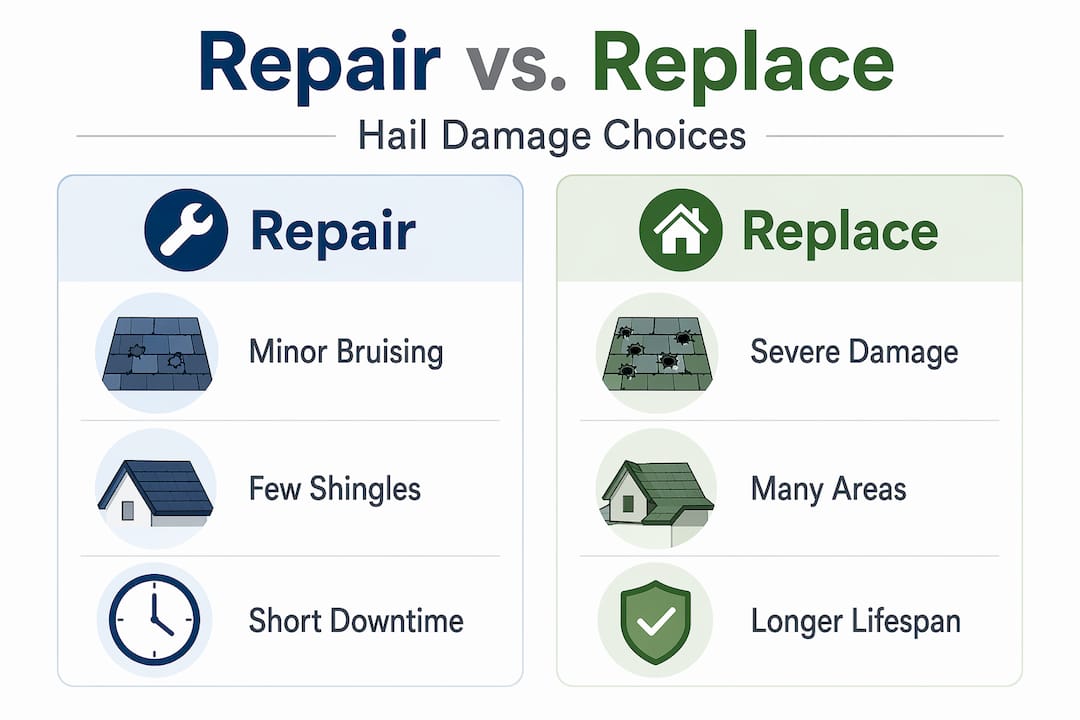
- Deciding between repair and replacement after hail
- My honest take after years of storm season roofing
- How Thomasroofingandrepair helps after hail hits
- FAQ
Key takeaways
| Point | Details |
|---|---|
| Damage can be invisible initially | Hail impact can shorten roof lifespan by 10+ years before a single leak appears. |
| Material type changes the signs | Asphalt shingles bruise and shed granules; metal dents; tile fractures hairline cracks. |
| Florida’s 25% rule matters | Repairing more than 25% of your roof within 12 months triggers full code compliance. |
| Gutters reveal what roofs hide | Granule piles and dented gutters confirm hail impact even when the roof surface looks intact. |
| Policy type affects your payout | RCV policies cover replacement cost; ACV policies subtract depreciation, leaving you a bigger gap to cover. |
What roof hail damage is and how it harms your roof
Roof hail damage is the physical and functional deterioration that results when hailstones strike roofing materials with enough force to compromise their protective ability. The industry term for this is hail impact damage, and it covers everything from surface bruising to structural weakening that unfolds over months. Two key mechanisms are at work: the direct mechanical impact at the moment of strike, and the accelerated weathering that follows from the weakened spots left behind. Both mechanisms degrade roofing even before water finds its way inside.
How that damage looks depends entirely on what your roof is made of.
Damage by roofing material
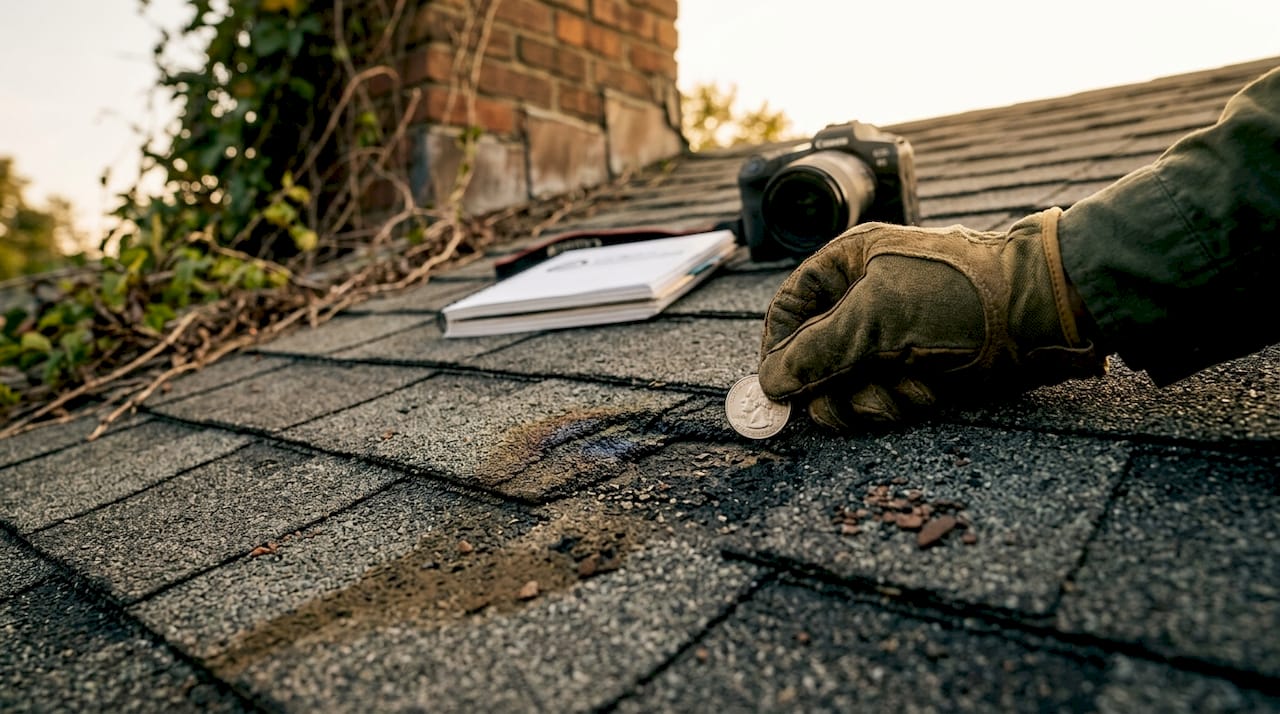
- Asphalt shingles: Look for dark, soft bruises where granules have been knocked away. Run your hand across the shingle and it will feel like pressing on a bruised apple. Granule loss exposes the underlying mat to UV radiation and moisture, speeding up decay.
- Metal roofs: Metal shows hail damage as distinct dimples and dents, particularly visible on softer panels. The structural integrity may not be immediately compromised, but paint and coatings crack at dent points, opening pathways for rust.
- Tile roofs: These are deceptive. A tile may look intact from the ground and still carry hairline fractures that absorb water and widen with each subsequent rain cycle.
- Flat membrane systems (TPO, EPDM): Flat roof systems can suffer subtle punctures or micro-tears that go unnoticed for a full season before the next heavy rain floods an interior space.
Hail size matters as well. NOAA classifies severe hail at one inch or larger, and larger stones produce proportionally more severe roofing damage. A quarter-sized stone hitting an aging shingle can do the same functional damage as a golf-ball-sized stone hitting a new one.
Pro Tip: After any storm with confirmed hail reports in your zip code, check exposed metal on your property first. If your air conditioning unit housing, mailbox, or patio furniture shows fresh dents, your roof almost certainly took impacts too.
How to inspect your roof for hail damage
A careful inspection does not require you to crawl across your roof. A methodical approach from the ground and around the perimeter catches most of the evidence you need.
- Check your gutters and downspouts first. Granule accumulation in gutters after a storm is one of the clearest indicators of shingle damage. A handful of granules is normal seasonal shedding. A cup or more after one storm is a red flag.
- Look at your soffit vents and fascia. Metal vents dent easily. Fresh dents on vents that were smooth before the storm confirm the hail size and intensity that hit your specific property.
- Scan from the ground with binoculars. Look for dark circular patches on asphalt shingles, missing sections, or disturbed flashing around chimneys and skylights.
- Photograph everything with timestamps. Your insurance adjuster and any roofing contractor will need documentation that ties damage to the storm event, not to prior wear.
- Get a professional inspection within two weeks of the storm. Most Florida homeowners insurance policies carry claim filing windows, and professional contractor measurements often uncover damage that adjusters undercount or miss entirely.
One distinction worth knowing: hail bruises and blistering look similar to untrained eyes, but they behave differently. Hail impact bruises are soft to the touch and vary in size based on hailstone diameter. Blistering from trapped moisture produces shiny, round bubbles that feel firm and are not tied to storm events. Misidentifying one as the other can derail an insurance claim.
Pro Tip: Note the hail storm date and cross-reference it with your local National Weather Service records before calling your insurer. Having official documentation of hail occurrence in your area strengthens your claim from the first conversation.
Florida’s insurance rules and the 25% code requirement
This is where Central Florida homeowners get blindsided most often.
Florida’s 25% rule requires that any roofing project which touches more than 25% of the roof covering within a 12-month period must bring the entire roof into current building code compliance. That sounds like a technicality, but it has real financial weight. A modest hail repair affecting 30% of your shingle area can legally require you to upgrade decking, underlayment, and flashing across the entire roof.
There is more to it. The 25% threshold applies to all roofing system components, not just the visible shingles. If decking replacement and underlayment upgrades together push you past the threshold, full compliance is triggered. This is why accurate damage measurement by a qualified contractor is not optional; it directly shapes what your insurer owes and what you pay out of pocket.
| Factor | Repair (under 25%) | Replacement (25%+ or full damage) |
|---|---|---|
| Code compliance required | Partial only | Full roof must meet current code |
| Insurance payout basis | ACV or RCV for damaged area | Full roof value based on policy type |
| Homeowner out-of-pocket cost | Lower initial cost | Higher upfront, but new roof lifespan |
| Long-term risk | Mismatched materials, future leaks | Clean slate, better storm protection |
Insurance companies typically evaluate hail damage by counting impact marks per 10-by-10 foot test square. Visible impact counts per test area determine whether the insurer approves repair or full replacement. Florida’s policy landscape also divides along two lines worth understanding:
- Replacement Cost Value (RCV) policies pay to replace your roof at today’s material and labor prices, minus your deductible.
- Actual Cash Value (ACV) policies subtract depreciation from the payout, which can leave you covering a significant portion of replacement costs on a 15-year-old roof.
Knowing which policy type you hold before a storm happens is one of the most useful things you can do as a property owner in Florida.
Deciding between repair and replacement after hail
The decision is rarely as simple as “fix what’s broken.” Several factors interact to determine the right path forward.
- Roof age and material condition: Aging roofs suffer more functional damage even from moderate hail. A roof already past 15 years on a 20-year shingle may not be worth patching after significant hail coverage.
- Extent and distribution of damage: Scattered damage across multiple roof planes is harder to repair neatly than concentrated damage on one section. Mismatched materials are both cosmetically problematic and can create weak points where old and new material meet.
- Insurance policy type: As covered above, ACV policies on older roofs often make replacement the more financially sound choice when you factor in future repair costs on a degraded surface.
- Delayed leak risk: Leaking can take 12 to 24 months to develop after hail impact. Choosing a patch repair on a heavily damaged roof often just delays a more expensive problem.
- FORTIFIED Roof standard consideration: IBHS recommends upgrading to FORTIFIED Roof standards when reroofing in hurricane-prone areas, which Central Florida qualifies as. This can also reduce insurance premiums.
You can explore the repair vs. replacement decision in more detail based on Florida-specific conditions, including how code compliance and material matching interact.
Pro Tip: Ask any contractor for a written scope of work that specifies exactly what percentage of your roof will be affected by their repair plan. If it hovers near 20 to 25%, it pays to understand whether completing a full replacement on your terms is better than being pushed into it by a follow-up inspection six months later.
My honest take after years of storm season roofing
I’ve worked with enough Central Florida homeowners to know that the ones who get hurt most financially are not the ones hit by the worst storms. They are the ones who waited.
Waiting for a drip feels reasonable. But hail damage operates on a different timeline. The waterproofing integrity of your shingle surface is compromised the moment granules leave the mat. What follows is months of UV exposure and moisture infiltration working against the material every single day. By the time a stain appears on your ceiling, the repair cost has typically doubled compared to what a proactive inspection would have caught.
What I’ve also noticed is that homeowners who understand their policy type going into storm season get far better outcomes. They file faster, document more thoroughly, and do not get surprised by depreciation deductions on claims they expected to be fully covered. The cost factors for insurance roof repairs in Florida have real complexity, and understanding them before you file is a genuine advantage.
My advice: treat any confirmed hail event in your area as a reason to inspect, not a reason to wait and watch. The roof that looks fine from the street after a storm is often the one that fails quietly over the following year.
— Thomasroofingandrepair
How Thomasroofingandrepair helps after hail hits
When a hail storm moves through Brevard, Volusia, or Orange County, the clock starts. Thomas Roofing and Repair provides on-site hail damage inspections with full documentation to support your insurance claim from the first conversation to final approval.

The team handles everything from granule loss assessment on asphalt shingles to membrane puncture checks on flat commercial roofs. Thomasroofingandrepair’s familiarity with Florida’s 25% rule means you get a repair or replacement scope that accounts for code compliance before work begins, not after a permit gets flagged. Whether you need emergency storm repairs the day after a storm or a full roof installation in Titusville, the process is built around keeping you informed and out of pocket costs predictable. Contact Thomasroofingandrepair for a free inspection estimate.
FAQ
What is roof hail damage exactly?
Roof hail damage is the physical deterioration caused by hailstone impacts, including granule loss on asphalt shingles, dents on metal surfaces, and hairline fractures on tile. It compromises waterproofing integrity even before leaks appear.
How soon should I inspect my roof after a hail storm?
Inspect within two weeks of the storm. Most Florida insurance policies have filing windows, and delayed professional inspections reduce your ability to tie damage directly to the storm event.
Can hail damage a roof without causing an immediate leak?
Yes. Hail impact can shorten roof lifespan by more than a decade before a single drip appears inside. Water intrusion often develops 12 to 24 months after the storm that caused it.
What is hail-resistant roofing and does it help in Florida?
Hail-resistant roofing refers to materials tested and rated by impact class under standards like UL 2218. Class 4 rated products offer the highest resistance. In Florida, upgrading to resilient materials during replacement can reduce insurance premiums and improve storm performance.
Does Florida’s 25% rule affect my hail damage claim?
Directly. If hail damage repair covers more than 25% of your roof within a 12-month period, Florida building code requires the entire roof to meet current compliance standards, which can convert a partial repair into a full replacement project.