
Modified bitumen roofing is an asphalt membrane reinforced with polymer modifiers and factory-laminated to fiberglass or polyester reinforcement mats, delivering multi-ply waterproofing toughness purpose-built for low-slope roofs. If your project is a flat or low-slope commercial building, a residential addition with a nearly flat pitch, or any roof that sees regular foot traffic from HVAC technicians or maintenance crews, modified bitumen belongs on your short list.
Three signals that point toward modified bitumen:
- Foot traffic or rooftop equipment. The granulated cap sheet handles repeated foot traffic far better than most single-ply membranes.
- Climate with freeze-thaw cycles or intense UV. SBS chemistry flexes in cold; APP resists heat and UV in southern climates.
- Fire or torch restrictions. Self-adhered and cold-applied systems are available where open-flame torching is prohibited.
Pro Tip: If your roof has HVAC units, solar mounts, or any equipment that requires regular service access, modified bitumen’s puncture resistance pays for itself quickly.
Table of Contents
- What is modified bitumen roofing made of?
- How modified bitumen evolved from built-up roofing
- SBS vs. APP: which polymer type fits your roof?
- How modified bitumen is installed: four methods explained
- Key advantages of a modified bitumen roof
- Limitations and tradeoffs worth knowing
- Where modified bitumen roofing is typically used
- How long does a modified bitumen roof last?
- Reflective coatings and cool-roof options for modified bitumen
- How to choose the right membrane and installer
- Central Florida considerations: what local pros look for
- Key Takeaways
- What most guides miss about modified bitumen
- Thomasroofingandrepair handles modified bitumen roofs across Central Florida
- Useful industry and manufacturer resources
What is modified bitumen roofing made of?
Modified bitumen starts with asphalt, the same base material used in built-up roofing (BUR), but the chemistry is upgraded. Manufacturers blend the asphalt with one of two polymer types: SBS (styrene-butadiene-styrene) or APP (atactic polypropylene). That polymer addition changes everything about how the membrane behaves under heat, cold, and mechanical stress.
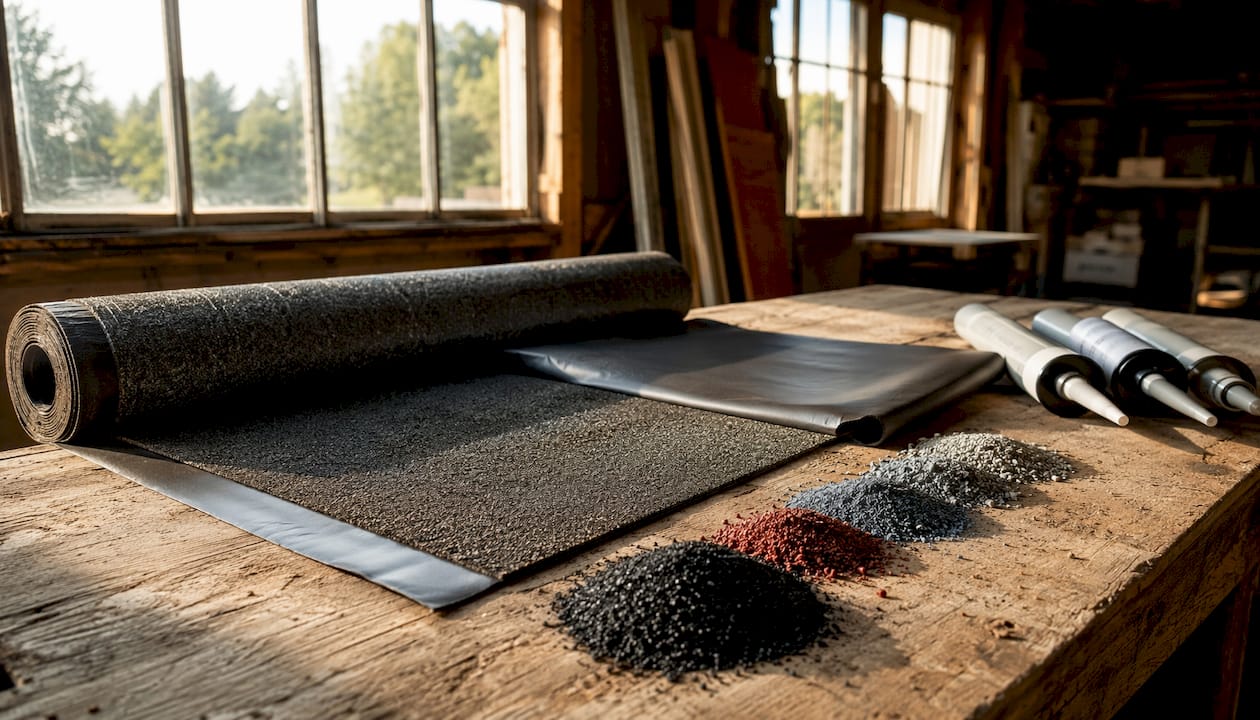
The sheet itself is built in layers. A reinforcement mat, either fiberglass for dimensional stability or polyester for elongation and tear resistance, is embedded into the polymer-modified asphalt. Most two-ply systems use a base sheet under a granulated cap sheet, and that redundancy is what gives mod-bit its edge over single-ply membranes in puncture resistance and repairability.
How it compares to the alternatives:
- Versus single-ply (TPO, EPDM): Single-ply is lighter and often cheaper upfront. Modified bitumen gives you more layers, better puncture resistance, and easier spot repair without specialized equipment.
- Versus built-up roofing (BUR): BUR is field-built, layer by layer, with hot asphalt and felts. Modified bitumen delivers similar multi-ply performance from factory-made rolls, which means more consistent quality and faster installation.
- Reflectivity: Standard granulated modified bitumen runs darker and absorbs more heat than white TPO. Reflective cap sheets and coatings close that gap significantly.
How modified bitumen evolved from built-up roofing
Modified bitumen did not appear out of nowhere. It grew directly out of the limitations of BUR.
- Pre-1960s: BUR dominated low-slope commercial roofing. Roofers built up multiple plies of felt and hot asphalt on-site, a labor-intensive process with quality that varied by crew and weather.
- 1960s–1970s: European manufacturers began blending polymers into asphalt to improve cold-weather flexibility and reduce cracking. APP-modified membranes arrived first; SBS followed.
- 1980s–1990s: Factory-manufactured rolls reached the U.S. market and gained rapid adoption. The ability to ship a consistent, pre-engineered membrane to any job site removed much of the field variability that plagued BUR.
- Today: Modified bitumen accounts for roughly 10% of new low-slope roofing installations in the U.S., holding its position alongside single-ply systems because of its proven track record on trafficked roofs and its repairability.
The factory-roll format is the key practical advantage over BUR. A crew installs a known product with a manufacturer’s data sheet and warranty, not a field-mixed system whose performance depends entirely on the day’s conditions.
SBS vs. APP: which polymer type fits your roof?
Choosing between SBS and APP is really a climate and movement decision. Get this right and the membrane performs for decades. Get it wrong and you are fighting the wrong failure mode.
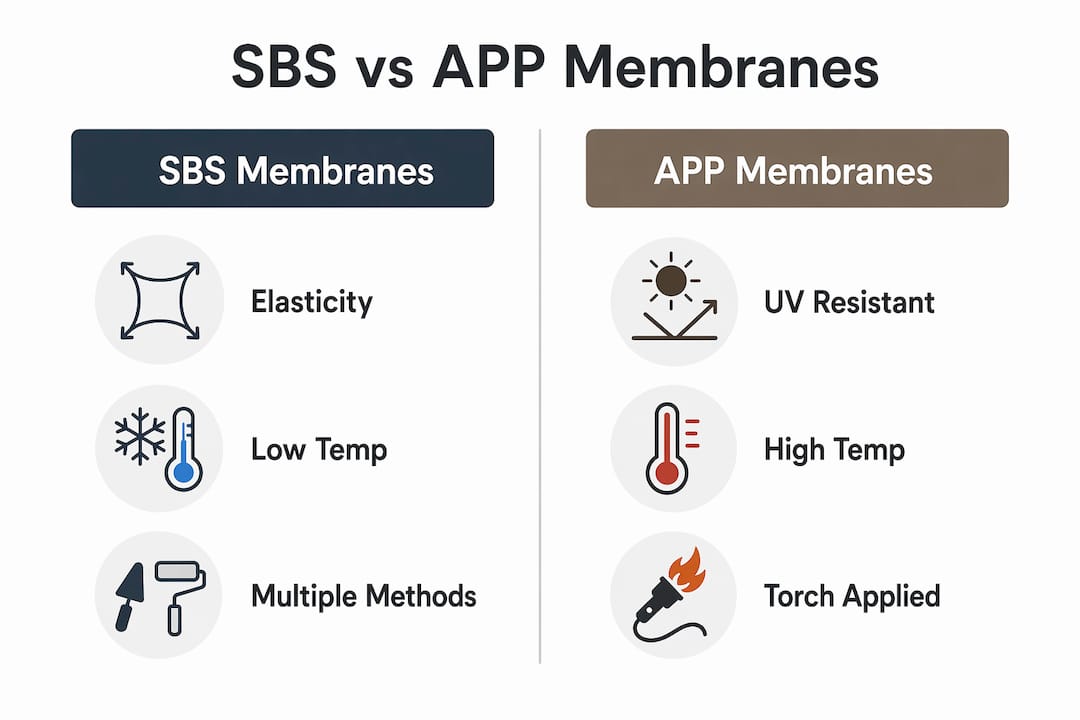
SBS-modified membranes blend asphalt with a rubber-like polymer that keeps the sheet elastic even at low temperatures. APP blends asphalt with a plastic-type polymer that stiffens the sheet and resists UV degradation and heat flow.
| Feature | SBS Membranes | APP Membranes |
|---|---|---|
| Installation method | Torch, hot-mop, cold adhesive, or self-adhered | Torch-applied most common; some cold-applied |
| Best for / climate | Cold climates, freeze-thaw cycles, buildings with structural movement | Hot, UV-intense climates; Southern and Southwestern U.S. |
| Cost shape | Comparable upfront; self-adhered versions add material cost | Similar range; torch-applied labor can be higher |
| Durability / puncture resistance | Excellent flexibility; handles impacts well in cold | Good surface toughness; resists heat-related softening |
| Typical lifespan and warranty | 15–30 years depending on installation and climate | 15–30 years; reflective coatings and granulated cap sheets can extend service life |
| Maintenance / repairability | Easy to patch with compatible SBS material or cold adhesive | Patch with compatible APP material; torch repairs require trained crew |
Key selection signals:
- Northern states with cold winters and significant temperature swings: SBS.
- Florida, Texas, Arizona, and other high-heat, high-UV markets: APP or SBS with a reflective cap sheet.
- Buildings with expansion joints, wood decks, or known structural movement: SBS for its elongation capacity.
- Roofs where open-flame torching is restricted by local code or insurer: self-adhered SBS systems.
How modified bitumen is installed: four methods explained
Four primary installation methods exist for modified bitumen, and the right choice depends on the membrane chemistry, local fire codes, substrate condition, and installer certification.
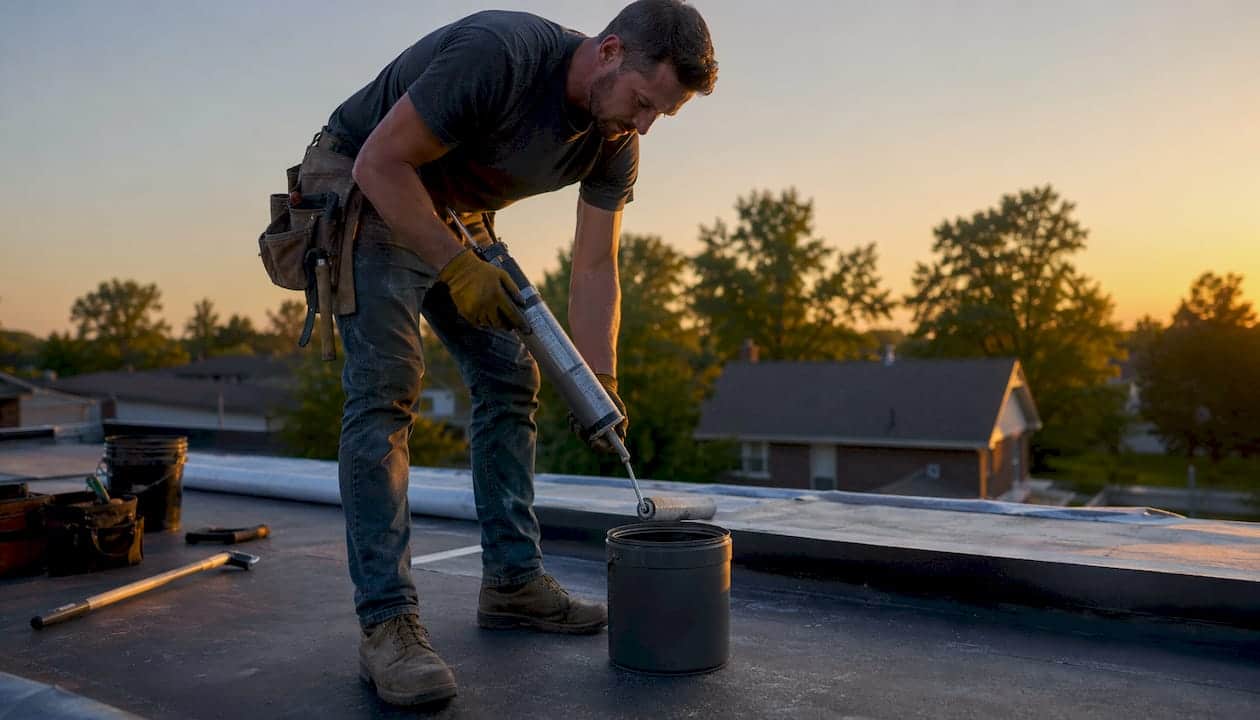
Torch-applied (heat-fused)
A propane torch melts the underside of the membrane as the installer unrolls it, fusing it to the substrate or base sheet. Seams are heat-welded for a strong, continuous bond. The method produces excellent adhesion and is widely used for APP membranes. The tradeoff is fire risk: open flame near combustible substrates requires a trained crew, a fire extinguisher on the roof, and a fire watch after the job. Some jurisdictions restrict or ban torching outright.
Self-adhered (peel-and-stick)
The membrane has a factory-applied adhesive layer protected by a release liner. Peel the liner, roll the sheet, and press it down. No open flame, no kettle, no fumes. This method is safer for occupied buildings and is increasingly popular for residential flat additions and roofs where torching is restricted. Substrate prep matters more here: the deck must be clean, dry, and primed for the adhesive to bond fully.
Cold-applied adhesive
A solvent- or water-based adhesive is spread on the substrate, and the membrane is rolled into it. Works well for SBS membranes and is a practical alternative where torching is prohibited. Fumes from solvent-based adhesives require ventilation, and temperature windows for application are narrower than for torch work.
Hot-mopped
Hot asphalt from a rooftop kettle is mopped onto the substrate, and the membrane is embedded into it. This method is closer to traditional BUR practice and is less common for new mod-bit installations today, though it remains in use for specific multi-ply assemblies.
Pro Tip: Regardless of method, seam and flashing quality is where most modified bitumen roofs fail prematurely. Insist on a contractor who details flashings at every penetration, parapet, and drain — the membrane itself rarely fails first.
Where torching is restricted by local fire codes or insurer requirements, cold-applied or self-adhered systems are the compliant alternatives. Always confirm local requirements before specifying a method.
Key advantages of a modified bitumen roof
Modified bitumen’s staying power in a market full of single-ply alternatives comes down to a few concrete performance characteristics.
- Multi-ply redundancy. A two-ply base-plus-cap-sheet assembly means a breach in one layer does not immediately mean a leak. That redundancy is the core reason trafficked commercial roofs favor mod-bit.
- Puncture resistance. The polyester or fiberglass reinforcement mat resists punctures from dropped tools, foot traffic, and hail better than unreinforced single-ply sheets.
- Foot-traffic tolerance. Granulated cap sheets handle repeated service access without the surface damage that can compromise thinner membranes.
- Repairability. A damaged section can be cut out and patched with compatible material and a torch or cold adhesive. No specialized welding equipment required for most repairs.
- Proven track record. Modified bitumen has been installed on U.S. low-slope roofs for decades, with a well-documented failure mode profile that experienced contractors know how to avoid.
Modified bitumen often costs more upfront than some single-ply options, but its long-term value comes from lower repair frequency on roofs that see regular foot traffic or equipment access. A roof that gets walked on twice a week needs puncture resistance, not just waterproofing.
Modified bitumen accounts for roughly 10% of new low-slope roofing installations in the U.S., a share that has held steady despite competition from TPO and EPDM, which reflects its continued relevance for trafficked and multi-use roofs.
Limitations and tradeoffs worth knowing
No roofing system is right for every situation. Modified bitumen has real tradeoffs.
- Upfront cost. Materials and installation typically run higher than basic single-ply systems. The lifecycle math usually favors mod-bit on trafficked roofs, but the initial invoice is larger.
- Slope limits. Modified bitumen is designed for low-slope applications, generally roofs with a pitch of 2:12 or less. Steep roofs are not suitable; the membrane can slip or fail to drain properly.
- Heat retention. Standard granulated cap sheets absorb heat. In warm climates, this raises cooling loads. Reflective cap sheets and coatings address this, but they add cost and require compatibility checks.
- Torch fire hazard. Torch-applied installation near combustible materials is a genuine fire risk. Improper technique has caused structure fires. This is not a DIY method.
- Weight. Multi-ply modified bitumen assemblies are heavier than single-ply. Older structures may need a load assessment before reroofing.
Where modified bitumen roofing is typically used
Modified bitumen works across a wider range of building types than many property owners realize. The self-adhered systems in particular have expanded its reach well beyond large commercial projects.
Commercial applications:
- Retail strip centers and big-box stores with flat roofs and rooftop HVAC units
- Warehouses and light industrial buildings where roof access for equipment service is routine
- Office buildings with rooftop mechanical rooms or solar arrays
- Any low-slope commercial roof where a maintenance crew walks the surface regularly
Residential applications:
- Flat or low-slope additions (sunrooms, rear extensions, garage conversions)
- Detached garages with flat roofs
- Modern homes with low-slope architectural rooflines
- Rooftop decks where a protective surfacing layer is needed over the waterproofing membrane
The key differentiator from single-ply is foot traffic and equipment access. When a roof gets walked on regularly, the granulated cap sheet and multi-ply structure of modified bitumen outperform thinner single-ply alternatives. For a simple warehouse roof that no one ever walks on, TPO or EPDM may be the more cost-efficient choice. For a retail building where HVAC contractors are up there monthly, modified bitumen earns its price premium.
How long does a modified bitumen roof last?
A well-installed modified bitumen roof typically lasts 15–30 years, with the range driven by membrane type, climate, installation quality, and how much foot traffic the roof sees. APP membranes in high-UV climates tend toward the lower end without reflective protection; SBS systems in moderate climates with good maintenance can reach the upper end.
What to inspect and how often:
- Inspect twice a year: once in spring after winter stress, once in fall before storm season.
- After any major storm, inspect for membrane punctures, displaced granules, and standing water.
- Check seams and flashings at every penetration, parapet wall, and drain.
- Look for membrane blisters, which indicate trapped moisture or adhesion failure.
- Check for ponding water that remains more than 48 hours after rain.
Common repairs:
- Small punctures or tears: cut out the damaged area, prime the substrate, and apply a compatible patch membrane with cold adhesive or torch.
- Seam separations: clean, prime, and re-bond with compatible adhesive or heat.
- Flashing failures: remove and replace with properly detailed new flashing material.
- Blisters: cut, dry, and patch; do not simply press them flat.
A patch is appropriate for isolated damage covering less than roughly 25% of the total roof area. Beyond that threshold, or when the membrane shows widespread granule loss or brittleness, a full replacement is the more cost-effective path. For a step-by-step approach to routine roof maintenance, Thomasroofingandrepair has detailed guidance specific to Florida conditions.
| Roof type | Typical lifespan | Recommended inspection frequency |
|---|---|---|
| SBS modified bitumen (moderate climate) | 20–30 years | Twice yearly + after major storms |
| APP modified bitumen (high-UV climate) | 15–30 years | Twice yearly + after major storms |
| APP with reflective coating (warm climate) | 15–30 years | Twice yearly + after major storms |
| Two-ply system with granulated cap sheet | 15–30 years | Twice yearly + after major storms |
Reflective coatings and cool-roof options for modified bitumen
Heat is the enemy of roofing materials and cooling bills alike. In warm U.S. climates, a standard dark granulated modified bitumen cap sheet can reach surface temperatures well above ambient air temperature on a summer afternoon, pushing cooling loads up significantly.
Reflective coatings and reflective cap sheets address this directly. A white or light-colored elastomeric coating applied over an existing modified bitumen surface reflects solar energy instead of absorbing it, lowering roof surface temperature and reducing the heat transferred into the building below. American WeatherStar documents the energy benefits of reflective coatings on mod-bit roofs and offers product guidance for both reflective cap sheets and field-applied coatings.
Compatibility is the critical question. Not every coating bonds well to every modified bitumen membrane. Solvent-based coatings can attack some APP membranes. Acrylic coatings generally perform well on granulated surfaces but require proper surface prep. Before applying any coating, request the manufacturer’s technical data sheet (TDS) and a written compatibility statement. Applying an incompatible coating can void the membrane warranty.
Practical guidance for Central Florida and similar warm markets:
- Specify a reflective cap sheet at installation rather than retrofitting a coating later.
- If coating an existing roof, use an acrylic elastomeric product rated for modified bitumen and follow the manufacturer’s surface prep requirements.
- Check local utility incentive programs; some Florida utilities offer rebates for cool-roof installations that meet Energy Star reflectance thresholds.
- For a deeper look at reflective roofing options in Florida. Thomasroofingandrepair’s energy-saving guide covers local code and utility incentive details.
How to choose the right membrane and installer
The membrane decision and the contractor decision are equally important. A great membrane installed poorly fails early; a modest membrane installed with precision lasts decades.
Decision checklist:
- Climate: freeze-thaw exposure points to SBS; high heat and UV points to APP or SBS with reflective cap sheet.
- Roof traffic: regular access by maintenance crews or HVAC technicians favors granulated modified bitumen over smooth single-ply.
- Rooftop equipment: penetrations for HVAC, solar, or exhaust require careful flashing; confirm the contractor has documented experience with your equipment type.
- Local fire codes: confirm whether torch-applied installation is permitted before specifying it.
- Warranty expectations: manufacturer warranties typically range from 10 to 20 years depending on system and installer certification; ask for the specific warranty document before signing.
- Lifecycle cost vs. upfront cost: get a 20-year cost model that includes expected repair frequency, not just installation price.
Questions to ask any contractor:
- How do you detail flashings at penetrations and parapet walls?
- Are you certified by the membrane manufacturer for this system?
- What is your fire-watch procedure for torch work, and do local codes permit it on this building?
- Can you provide documented examples of similar projects with inspection photos?
- What does your warranty cover, and what voids it?
For general guidance on choosing a roofing contractor, the selection criteria around certifications, documented experience, and warranty terms apply regardless of geography.
Budget context: Modified bitumen installation in the U.S. typically runs higher per square foot than basic single-ply systems, with materials, labor, and flashing work all contributing to the total. Get itemized quotes that separate material cost, labor, flashing and detail work, and disposal of the existing roof. A quote that bundles everything into a single number makes it impossible to compare bids fairly.
Central Florida considerations: what local pros look for
Florida’s climate creates a specific set of demands that shape every modified bitumen decision in the region.
- UV intensity. Central Florida’s year-round sun degrades unprotected asphalt membranes faster than northern climates. Reflective cap sheets or coatings are not optional here; they are a practical necessity for reaching the upper end of the lifespan range.
- Hurricane wind uplift. Modified bitumen systems must meet Florida Building Code wind uplift requirements. Confirm that the specified system carries a Florida Product Approval (FL#) and that the fastening pattern meets local wind zone requirements for Brevard, Volusia, or Orange County.
- Ponding from heavy rain. Florida’s intense rain events test drainage design. Modified bitumen handles ponding better than some single-ply membranes, but standing water beyond 48 hours accelerates membrane degradation. Proper slope-to-drain design is non-negotiable.
- Torch restrictions. In densely built areas and some commercial zones, open-flame torching may be restricted or require special permits. Self-adhered and cold-applied systems are the practical default for many Central Florida projects.
Thomasroofingandrepair recommends a pre-installation inspection that covers existing substrate condition, drain flow, and any existing moisture in the assembly before new membrane goes down. Installing over wet insulation is one of the fastest ways to shorten a new roof’s life.
Pro Tip: In Central Florida, always ask your contractor to confirm the membrane system’s FL# before installation begins. A system without Florida Product Approval may not pass inspection and could affect your insurance coverage after a storm.
For roof repair guidance specific to the region’s storm and UV conditions, working with a contractor who understands local code requirements saves time and avoids costly re-work.
Key Takeaways
Modified bitumen roofing is the right call for low-slope roofs with foot traffic, rooftop equipment, or climates that demand both flexibility and UV resistance, provided the membrane chemistry and installation method match the local conditions.
| Point | Details |
|---|---|
| Polymer type matters | Choose SBS for cold climates and building movement; choose APP for high-heat, high-UV markets like Central Florida. |
| Lifespan range | Properly installed systems last 15–30 years; reflective coatings extend service life in warm climates. |
| Failure starts at seams | Flashing and seam quality, not the membrane itself, is the most common cause of premature failure. |
| Reflective coatings require TDS review | Always request the manufacturer’s technical data sheet before applying any coating to confirm warranty compatibility. |
| Thomasroofingandrepair | Provides modified bitumen installation, inspection, and repair services across Central Florida, with local code and wind-uplift expertise. |
What most guides miss about modified bitumen
The conversation around modified bitumen tends to get stuck on material specs: SBS vs. APP, torch vs. peel-and-stick, 20-year vs. 30-year lifespan. Those details matter, but they are not where most roofs actually fail.
The real variable is workmanship at the details. A factory-manufactured modified bitumen roll is a consistent, well-engineered product. What happens at the parapet wall, around the HVAC curb, and at every pipe penetration is entirely up to the installer. A crew that rushes the flashing work or skips the primer step on a cold-applied seam will produce a roof that leaks within a few years, regardless of the membrane’s published lifespan.
The second thing guides understate is the importance of the substrate condition. Modified bitumen installed over wet or deteriorated insulation will trap moisture, blister, and fail from the inside out. A proper pre-installation inspection that probes for moisture in the existing assembly is worth more than any upgrade in membrane grade.
For property owners in Central Florida, the torch-vs-no-torch question also deserves more attention than it gets. Many local projects are better served by self-adhered or cold-applied systems, not just because of fire code considerations, but because the installation environment (occupied buildings, adjacent structures, dry-season conditions) makes open-flame work genuinely riskier than the spec sheet implies.
Choose the membrane that fits your climate. Then spend equal energy choosing the contractor who details the flashings correctly.
Thomasroofingandrepair handles modified bitumen roofs across Central Florida
For property owners in Brevard, Volusia, and Orange counties who need a modified bitumen roof installed, repaired, or assessed, Thomasroofingandrepair brings local code knowledge and hands-on experience with the systems that actually perform in Florida’s climate.
The team focuses on self-adhered and cold-applied modified bitumen systems where torching is restricted, along with reflective coating applications that reduce cooling loads on existing roofs. Every project starts with a thorough inspection of the existing substrate and drainage before any new membrane goes down. After a quote is accepted, Thomas Roofing & Repair handles permitting, installation to Florida Building Code wind-uplift requirements, and post-installation documentation for your warranty file.
Storm damage to an existing modified bitumen roof? Thomasroofingandrepair provides emergency repair services and insurance claim assistance across Central Florida. Financing options are available for qualifying projects.
For commercial roofing in Orlando or a new installation in Horizon West, request a free estimate and get a clear scope of work before any commitment.
Useful industry and manufacturer resources
These resources are worth bookmarking if you are specifying, bidding, or researching modified bitumen systems.
- Polyglass U.S.A. — One of the major modified bitumen manufacturers in the U.S. market. Their blog and product pages explain membrane construction, ADESO self-adhering technology, and system configurations. Request their TDS for any product you are considering.
- American WeatherStar — A recognized industry resource for reflective coatings and modified bitumen system guidance. Their complete guide covers energy benefits, coating compatibility, and product selection for warm climates.
- Interlock Roofing Glossary — A concise independent explainer covering modified bitumen material properties, failure modes, and the importance of seam and flashing quality. Useful for understanding what separates a durable installation from a problem roof.
- IIBEC (International Institute of Building Enclosure Consultants) — The most technically rigorous resource in this list. IIBEC’s publication on polymer-modified bitumen covers membrane chemistry, system design, and performance at a level useful for specifiers and building envelope consultants.
- DG Floors Modified Bitumen Installation Guide — Practical installation method guidance covering torch, self-adhered, cold-applied, and hot-mopped approaches, with notes on safety and method selection.
When reviewing any of these resources, note that some entries are manufacturer pages and others are independent industry explainers. Always request the manufacturer’s TDS and a written warranty document before approving a system or applying a coating. Published guides, including this one, are general information; your specific project may have code, substrate, or climate conditions that require a qualified contractor’s assessment.